adventures with the vet · Uncategorized

What the vet found

Short answer: foot is probably fine, but heel is not. Surprise!

Okay, and now for the long answer.

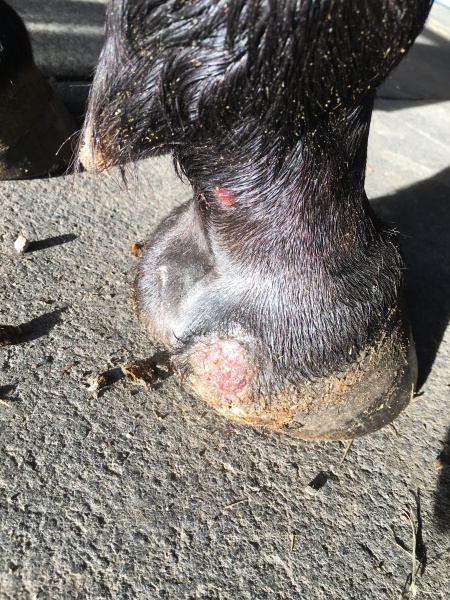
We started off right away with the vet pulling off Tristan’s heel bandage and blanching at what she saw – which I did, too. It did not look good. I knew that it wasn’t doing great, but it was several shades of not good worse than I had anticipated.

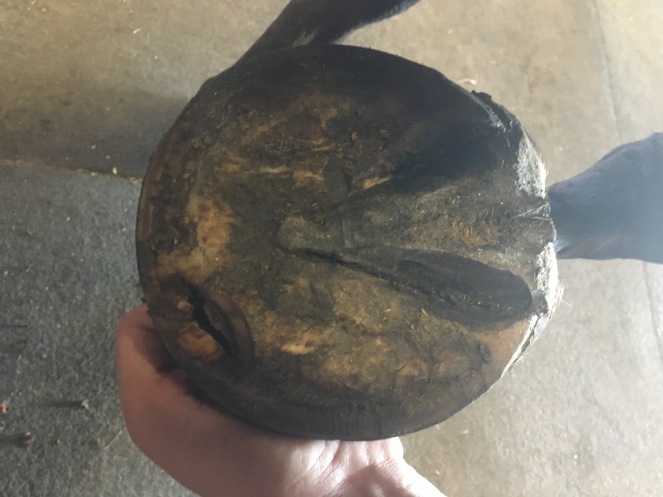
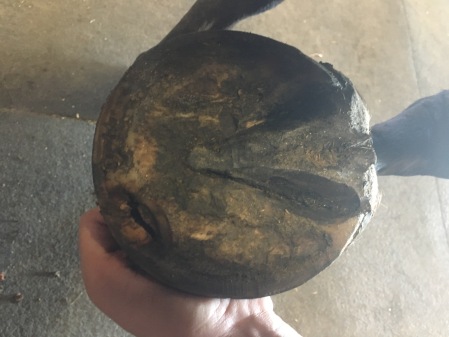
We set the heel aside for a moment, however, to take a good deep look at the problem child foot. I laid out what the farrier had told me – he believed there was scar tissue preventing the sole from growing well in that spot – and asked her what she thought.

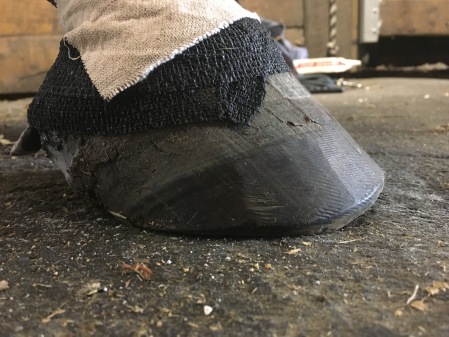
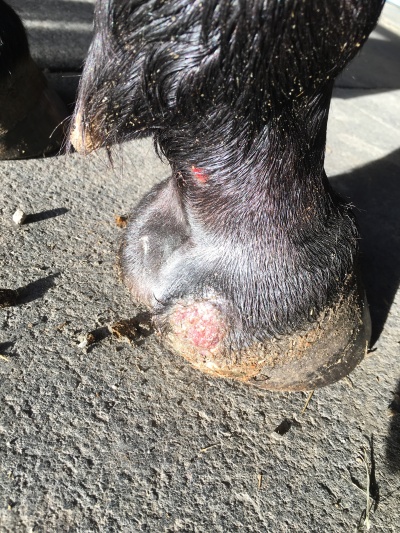
IMG_4013reminder of what the foot looks like right now

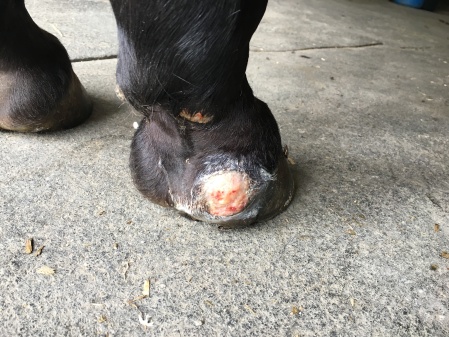
Almost instantly, she said she thought it looked like white line disease – not a problem of the foot itself. But she also said that she’s not a farrier, and we should get foot shots juuuuuust to be sure.

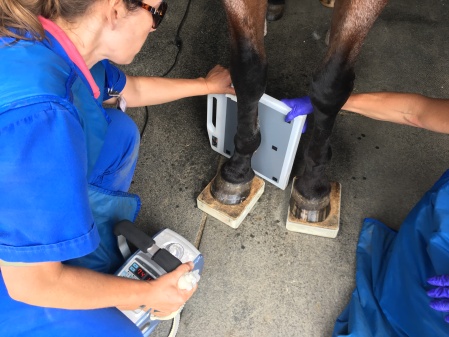
IMG_4128without question the most radiographed foot in the history of horse feet

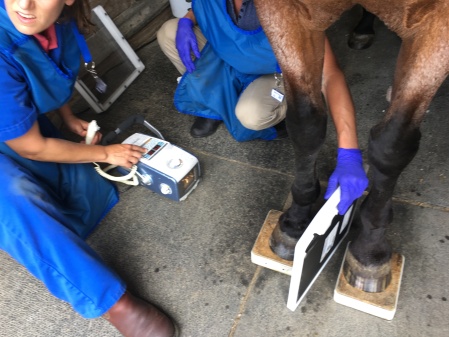
Sooooooo we did! Many of them!

IMG_4127

We also got shots of the left front for comparison, because findings from the x-rays were as follows:

  • holy shit does his foot actually look good?
  • let’s take another shot to be sure
  • god damn, look at that coffin bone, it might actually have remodeled
  • shit, that is a really deep hole
  • you know what, though, nothing else is cropping up
  • hmmmmmmm, his toe looks longer than we’d like to see it.

Vet and I formed a preliminary hypothesis – which is what was in the back of my mind – that his toe is too long, and that’s leading to just a touch of separation at the toe, which is leading to white line. That toe will always be more susceptible to fuckery because there is still a scar at the hoof wall. And it may be that the toe just needs to be brought back further than the farrier would take it based on external evidence because of the abnormality in the hoof wall.

IMG_4070lateral view from a week ago: a little tough to follow the lines properly because of the wrap, but you can actually if you look closely see the slight bulge of the scar and maybe that the toe is a touch long

Overall, though? Actually less worried about the foot.

That said, vet is sending the rads off to both the farrier and Tristan’s surgeon because she is the very best and wants everyone in the loop. I’ll wait and see what the farrier has to say, but the meantime prep is to keep the hole clean, spray Blu-Kote in it, and pack it as possible.

My usual treatment for white line disease would be to nuke it with White Lightning, but that’s not possible right now because, well, that heel grab (which I will have you know I just mistyped as “hell grab”) is really not in good shape.

IMG_4061a week and two days ago

IMG_4121Tuesday

Why yes that IS both a raging infection AND proud flesh on both the heel grab AND the rub from the bell boot. BECAUSE WHY DO ANYTHING HALFWAY, TRISTAN.

Sigh.

Vet was not thrilled at. all. We spent almost as much time talking through a treatment plan for the heel grab as we did for the foot.

Going forward:

  • wrapped 24/7, changed every 2 days
  • heavy-duty antibiotic cream on both wounds until they’re good quality pink flesh again
  • oral antibiotics for 8 days
  • once the wounds start looking marginally healthy, swap between the antibiotic cream and a steroid cream to fight proud flesh
  • fingers crossed?

So yeah that’s great. Not.

I reminded everyone cheerfully that it’s been almost a year since his last epic vet adventure, to which the vet shook her head and said “I see all these animals in crappy pastures that no one has touched in months and they’re in perfect health, and then I come see your horse, who is so immaculately cared for, and he’s always doing something.”

(that said she does have a soft spot a mile wide for him, she grew up in California and had a red roan mustang, so she genuinely thinks he’s great)

Syringing meds 2x a day is still the plan going forward, though, tiny bright spot, he’s at least eating his cup of alfalfa again – not the multivitamin supplement – so there may be a future in which he at least eats his Prascend in his grain once summer is over and the allergy meds can go away.

But in the meantime, he’s now up to 25 pills at each feeding, which is, count ’em, THREE 60cc syringes’ worth of dissolved drugs. I loaded up on applesauce now that we’re doing this longterm, and last night he did at least seem to tolerate that a bit better than the water+jello, so that’s not nothing.

HORSES. *facepalm*

adventures with the vet · Uncategorized

When it rains, it pours

Also an apt description of our weather for the past 10 days or so, after several weeks of brutally hot and dry weather. Yay climate change?

Anyway, when last we left our intrepid mustang, he had a funky spot on his sole in the same place as his old surgery scar.

In rapid succession, last week after I wrote and published that post, a heel grab that he’d done a few days previous started to get worse, and he went on a hunger strike against his grain, which meant he wasn’t getting his meds, which meant his hives came back.

First, the heel grab. It was fairly run of the mill last weekend, and for my lesson on Monday we covered it up with alushield and a bell boot and it was fine. He went out in bell boots the next day…and came in with a rub from them on his pastern.

IMG_4061

Not catastrophic, but not great, right?

Well. Between the humidity & wet rain, and I don’t even know what idiocy, it got worse. It kept opening up, and kept bleeding. The coronet band below got white and soft. Kept bleeding. We kept chasing it but finally had to start wrapping it, and as of today, it’s still not really healing. It’s not getting worse anymore, but it’s pretty definitively not great.

IMG_4066

Around day 3 of the heel grab just not cooperating, he started truly and definitively refusing to eat his grain. Now, in one sense, that’s not a huge problem; he’s on the chubby side of where he should be just from hay and grass, and when I say grain I mean “a cup of alfalfa and half a cup of ration balancer” and really it was mostly intended to hide his allergy pills, because remember how he has to be on allergy meds all summer or he breaks out in hives?

Yeah, well, no grain, no meds, hello again hives! So starting Friday night, I’ve been going to the barn in the morning and evening and dissolving his pills in some water with Jello powder and syringing them down his stupid throat. Which we are both enjoying just as much as you might imagine! He’s always been really bad about taking meds orally – he’s a total pain to deworm. No coaxing, positive reinforcement, patience, or anything else has ever changed it, nor will it ever. The only thing that works is to grab his halter, and if he is being extra asshole-y, snapping the halter hard once to remind him who’s in charge, and getting it over with quickly.

IMG_4091

the face of a horse who is very carefully ignoring me

In good (?) news, I chatted back and forth with my sainted vet last week, and she’s going to be in the area tomorrow, so I took the day off from work and we are going to go to town on him. Initially, she thought she was just looking at the funky spot on his hoof, doing a lameness exam, some x-rays, and maybe a venogram (short aside, I am struggling with the venogram because on the one hand $$$ but on the other hand my brain keeps going THAT SOUNDS SO COOL!!!!!).

Little did she know that she’d also be trying to find us new allergy meds (maybe a powder?) and looking at a heel grab that the barn manager is increasingly worried about getting infected because IT JUST WON’T STOP FUCKING BLEEDING.

IMG_4073

the barn manager does a damn fine wrap

I am a little on edge and fed up with life right now, is what I’m saying. I’m trying to channel into other things, but with yet another week of no riding, my hopes of competing at First Level in September and not completely embarrassing myself are starting to fade.

Uncategorized

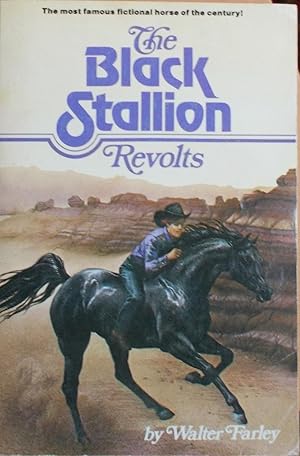
Summer Series: The Black Stallion Revolts

The Black Stallion Revolts: Farley, Walter

Of all the sins a Black Stallion book can commit, the only truly unforgivable one is to be boring. Which is your preview for this book: it managed to make a wilderness survival story boring.

Let’s start where the book itself starts: fat-shaming Napoleon. Who is somehow still alive. (He has to be in his late 20s by now, right?)

The gray gelding, Napoleon, was built from the ground up and butter fat. His roundness was not due to overfeeding or lack of exercise but to a most placid disposition and an ease of adapting himself to any kind of situation or way of life.

I wish I could say the same. But seriously, what a weird way to open this book, of all the books.

We continue on to learn that Napoleon also knows (he’s just that wicked smart) that part of his job at Hopeful Farm is to be a barrier between the Black and Satan. He likes that job. He hangs out and grazes and thinks about the layout of Hopeful Farm and the logic behind night turnout and also a gathering storm for many, many pages. Did I mention he’s really smart?

Meanwhile, the Black is conspiring.

He made no sound except for the slight, hushed beat of his hoofs over the grass. He did not shrill his challenge to the burly stallion two paddocks away from him. It was not yet time. The Black was clever and able to control the savage instinct that sought release within his great body.

The next bit is so fucked up, you guys. Apparently the Black is about to Shawshank Redemption his way out of his paddock. See, he’s got this board he’s been working on for a while, and now he’s got it good and loose. And he knows the storm is perfect cover for the noise he’s about to make. He gets out of his paddock and heads straight for Satan.

No longer was he calm and cunning, but trembling and brutally eager to kill.

Someone could write a whole treatise on toxic masculinity + fetishization of the concept of wildness + hyperviolence in the Black Stallion books.

The Black spends many pages trying to get into Satan’s paddock, and eventually succeeds by…using a loading ramp as like a liftoff point? It’s so insane, you guys. He somehow gallops up this slight hill and uses it to gain enough height to jump the fence. He gets into the paddock and proceeds to beat the everloving shit out of Satan. Remember when Alec was all “oh, the Black will recognize his son!” Yeah. No.

Henry wakes up and hears what’s going on, and then wakes Alec. He tries to chase the Black away from Satan with a pitchfork, and then a whip, which gets the Black’s attention in a murderous way. Alec arrives just in time to prevent Henry from dying gruesomely, and calms the Black down.

Alec and Henry have a whole conversation that boils down to: the Black is still a wild horse, and he’s got all these instincts for violence and freeeeeeeedoooooooommmmm, and he needs to go have like a back to the land vacation where he runs out for a while. Over the course of this conversation they spend many, many, many pages recapping all of the previous books. All of them.

Henry shook his head in disgust. “Alec, if you’re going to bother tellin’ me the whole story of the Black again, you’d better just save your breath an’ I’ll save you some time.

AND THEN HE RECAPS ANYWAY.

At the end of this endless conversation, Henry and Alec decide to fly the Black out west, to spend time with a friend of Henry’s who has apparently thousands upon thousands of acres of fenced-in irrigated pasture in Southern California, because fuck you, water conservation.

The chapter ends with this bit of weirdness, which will become a recurring theme in the book.

He’d tell the great stallion what they were going to do, and somehow the Black would understand. Not from his words, but through some other way, which he himself didn’t understand and could only accept.

Yeah. It comes out in this book that Alec and the Black have their own language. It’s like nonsense sounds and noises and maybe also telepathy. Several outside observers comment on it. This is a thing that really happens in this book.

So, the next thing that happens is one of the more batshit insane things that has happened so far in the Black Stallion books. (SO FAR.)

Basically: they are on the plane heading to California. The plane encounters some turbulence, and the Black gets a little nervous, and a little overly warm and sweaty. Alec leaves him alone for a few minutes to look out the front cockpit window, and while he’s there one of the pilots gives the Black a big bucket of ice-cold water.

What happens next is something that I’ve always though of as the Black Beauty Fallacy. For a long time in horsekeeping there was a theory that cold water + hot horse is a trigger for gas colic. It was the mistake Joe made after Beauty got back from bringing the doctor. Thanks to modern science, we know it’s bullshit. I’m not sure if Walter Farley could have known it’s bullshit; this book was written in 196? and that particular myth may well have still been hanging in there.

Anyway, thanks to the plot, the Black colics. Bad. And as we’ve already established the Black’s response to everything is to try violence first. So he absolutely looses his shit in the cargo hold of this small plane, which is small enough to crash because of this.

Just before the plane crashes, though, Alec falls out the door, which mysteriously popped open. Shittiest safety door ever. He falls through many, many trees and hits the ground.

And I’m just going to address this here, briefly: later on the pilots tell searchers that they saw Alec ride the Black away from the crash. It’s pretty clearly stated as conclusive evidence that they’re both alive. Is this just a massive plot hole? Were the pilots lying? Is this all some big conspiracy? What the hell?

Alec wakes and he is in really bad shape. I’m not going to recap the next 50 or so pages in detail, because here’s what happens: he has amnesia and thinks his name is McGregor because that’s what it says on his clothes, he gets rides from a bunch of strangers, he becomes convinced that he’s a wanted criminal who robbed a diner.

No one cares what Alec is up to, because the Black? Is up to some completely fucking insane stuff. Like, you know, BATTLING TO THE DEATH AGAINST A BULL MOOSE. YEAH. YOU READ THAT RIGHT.

[The Black] whirled to meet the headlong rush of an enemy from the cover of the woods.

The trumpet roar of the bull moose was low and guttural at first. Quickly it rose to a high-pitched scream, only to descend to the roar again, and end with a grunt. He charged, his heavy antlers cleaving the air in their great spread and length.

YOU GUYS THE BLACK FIGHTS A FUCKING MOOSE.

But his foe began slipping away from him, so with raking teeth the stallion bit deeply into the moose’s dark-brown neck, ripping and tearing…

No animal of the wild country could have met an adversary so worthy, so ruthless. The great bull moose knew this now that it was too late. He coughed, the choking cough of death. And with the sound of it, the black stallion came in again for a fresh and final assault…

Then he reared and his powerful forelegs came down together, splitting the bull moose’s skull.

SPLITTING HIS SKULL. A MOOSE. THE BLACK FIGHTS A MOOSE.

NO I WILL NOT CALM DOWN THIS IS SO COMPLETELY INSANE.

I just.

For a moment, the Black stood over the great body beneath him, and his loud clarion call of conquest was heard for the first time in those regions.

You see why no one cares about Alec’s story?

I guess we have to get back to it, though, because we leave the Black to his insanity and have to spend a loooooooong time with Alec. People are looking for him; Henry is particularly upset; Mrs. Ramsay apparently no longer exists. (She gets mentioned briefly at the end of the book, but not while her son is missing.)

Oh I did want to mention one thing about one of the people who picks up Alec, which is that he’s a colossal dick.

“[My wife’s] life was going on pretty much as always in spite of my retirement. A wife’s job doesn’t change much when the old man retires, but his does.”

Fuuuuuuuuck you, dude, I hope your wife is back home going to swingers parties and burning her bra.

Alec bails on this asshole by jumping out of the moving car and running into the desert, which actually is totally on-brand for him, doing stupid shit without thinking it through.

He gets picked up by a guy named Gordon and his burro named Goldie. Gordon nurses him back to health and turns out to be a retired Hollywood magazine guy who fled to the country and now lives hours from civilization. He’s also – conveniently! – a huge racing fan who spends the rest of the book a) convinced he knows Alec from somewhere, like how does he not recognize him?! and b) swanning about and talking about the superiority of the Thoroughbred breed over the Quarter Horse. Everyone else in this book is a QH person, and Gordon basically just shitposts them every chance he gets.

But to hear some of the folks talk in Leesburg, the quarter horse is a breed of long standing. He isn’t at all, he’s a type of horse that’s been developed to work the range. He’s no racehorse.

Gordon is mostly a decent guy, but the trolling gets really old. Every conversation about racing he pops up and “Actually…”s all the QH people.

Meanwhile, the Black has been getting into more fights and assembling a harem.

His great body was torn and scarred from the rakings of savage teeth and claws. Yet he had survived his terrible battles, and now, shining in his eyes, was the wild look of an animal who knew desolate country, and feared neither it nor man nor beast…

Anyway, Gordon brings Alec (or as the book insists on calling him, McGregor) into town, where they have a really horrific interlude with a guy named Cruikshank, who is dragging a horse behind his truck for absolutely no reason that I can figure out. Alec lets the horse go, and Cruikshank goes to jail for…something. Which of course means he hates Alec now.

Alec goes to work for a guy named Allen, who is a rich guy from New York City who owns a ranch where he breeds Quarter Horses. He has a stallion named Hot Feet that he wants to race and use as a foundation sire and can we take a moment and appreciate that Hot Feet is pretty much the greatest QH name EVER?

Alec settles in at the ranch, and one day he’s out and about when he comes across the Black and somehow recognizes him. (Remember, amnesia.) He brings him down to the ranch and rides him around and a) everyone just thinks that he magically tamed him in like a day out on the range?!?!? and b) HOW DOES NO ONE RECOGNIZE THEM TOGETHER.

I feel like this book is way longer than the others but it’s not. It’s just disjointed and boring. I’m summarizing things for you but please know that reading through it is basically endless descriptions of the landscape followed by deep and endless angst on Alec’s part interspersed with very occasional plot.

Next we have one of the more bizarre plot contrivances of the book. Let me see if I can explain it quickly.

A guy named Herbert owns the current hot racehorse, named Night Wind. He’s a friend of Alec’s new employer Allen, and wants to arrange a match race between Night Wind and Allen’s QH Hot Feet because he thinks it would be entertaining. If Hot Feet wins, Herbert will give Allen five QH mares; if Night Wind wins, Herbert gets Hot Feet.

So, okay. Allen decides that since he never promised that he would enter Hot Feet in the match race, and since this new black stallion they caught looks awfully fast, he’ll enter that horse instead! Alec doesn’t want to do this, because he thinks that if he calls attention to himself the police will arrest him for the murder he’s convinced himself he committed.

Brief aside to let you know that Allen has named the Black “Range Boss.” Yeah.

Okay: back to our regularly schedule programming, Alec and the Black head down to the racetrack for the match race, where the following things happen in very quick succession:

  1. a) Cruikshank (from above, who tried the kill the horse and is mad at Alec for stopping him) tells the sheriff that Alec is the fugitive everyone’s looking for
    b) the sheriff arrives to arrest Alec
    c) Allen convinces the sheriff to hold off on arresting Alec until after the race
    d) Alec spends most of the race thinking about…galloping away from the racetrack and into the desert, like that’s a viable plan, for fuck’s sake, Alec
    e) they win the race though, and arrive at the backstretch…
    f) just in time for Gordon to figure it all out and OH YEAH THAT’S ALEC RAMSAY.

An entire grandstand of racing fans watched Alec and the Black race and none of them guessed it. The entire plot of this book is driven by epic stupidity.

To be fair, Gordon is all of us when he finally figures it out.

“Just a horse race, nothing!” Gordon shouted hysterically. “That’s Alec Ramsay riding the Black against the fastest Thoroughbred in the country! It’s the race of the year, and you don’t even realize it!”

Here’s also a taste of Alec’s angst, which is dumb, repetitive, and poorly written:

The boy’s mind still erupted with fiery currents that afforded him no peace and produced nothing but a great, flowing mass of conflicting and incoherent elements.

Anyway, Alec calls home, but he thinks that his family might as well have learned from the newspapers.

He realized this was just the beginning, and that his all home hadn’t been necessary at all in order for his parents and Henry to learn of his whereabouts.

What an asshole thing to think, Alec. “Oh, I figured you’d come get me once you saw the front page headlines.”

Henry arrives (not Alec’s parents lololol) and mostly wants to know about how the race went.

“He didn’t make any attempt to attack Night Wind during the race?”

“No, Henry, not at all. Perhaps he got all the fighting out of his system while he was running wild. I don’t know.”

“Maybe you’re right,” Henry agreed.

HE’S NOT RIGHT.

Anyway, there’s a bit where Allen’s ranch manager decides to keep the Black’s harem because Alec and Henry explain to this supposedly experienced horseman that the mares might be in foal to the Black and worth a ton of money.

Aaaaaand…that’s the end.

Do you remember this book? Did you remember that the Black FIGHTS A MOOSE TO THE DEATH? I sure didn’t.


Uncategorized

Boosting the Signal: Sole Trouble?

Like me, you may have thought the days of obsessing over Tristan’s right front hoof were over.

HAHAHAHAHAHAHAHAHA.

That goddamn foot is like a bad penny. It always turns up again, at the moment you are least able – emotionally, intellectually, financially – to cope with it.

Where are we now?

Well, you may remember that late last fall, my farrier suggested that we shoe Tristan for a few cycles to support the toe on that foot. He thought the hoof needed additional support for an area of weakness at the toe that was directly in line down from the scarring on the coronet band/surgical site. So we shod him. He was happy and sound, etc., but I was hemorrhaging money.

About eight weeks ago, we took him out of shoes and he went back barefoot. I did some preventive treatments with White Lightning and Durasole to try and head off any problems, and he held beautifully sound and happy right through.

Except, at his last trim, the farrier took out a LOT of that toe. A big hole. And the other day he called me over and had a long conversation with me. He thinks that because of the scar tissue leftover from the abscess, Tristan will never grow that toe right again. and the mushy spot on the sole will just always be there. And he needs shoes full-time: not for support, but to hold in place a pad that will mostly prevent anything from getting into that hole. Barefoot, he’s worried that it’s just going to get infected constantly, and possibly even progress to something worse.

IMG_4013

I’ve never heard of a horse unable to grow sole in one specific part of the foot. And he did so well for so many years. I’m worried there’s something deeper going on, and I don’t want to just cover it up with a shoe until I have a better answer.

In the meantime, I’m going back on a White Lightning & Durasole regimen, and I ordered some hoof packing that should last a few days at a time to try and keep things out of it. I’ve emailed the vet and we’ll start yet another round of “what in the hell is going on now?”

Anyone have any ideas on what might be going on? Part of my brain wonders if it’s just really weird white line disease? But then shouldn’t it have cleared up with the things we’ve done so far?

He’s sound and comfortable, at least, but god damn it I wish we could move on.

lasik · Uncategorized

Lasik Surgery and Horses

On June 30, I had Lasik surgery to correct my nearsightedness. I did a ton of research, thought really hard about it, planned it as best as I possibly could, and eventually went through. I’m really glad I did it, and since being able to be around horses without glasses was a major motivation behind the decision, and because I wasn’t able to find a whole lot of information specifically about the intersection of horses + Lasik, I thought I’d write about it for posterity.

It’s important to note that I’m chronicling my own research, decision, and experiences. Human beings are different, and your experience might be different. I’m going to do my best to provide some general information that I learned alongside my own personal situation, but you should make your own choices based on your own factors!

Background

I have had poor eyesight my whole life. I first got glasses in fifth grade, and can still remember perfectly clearly what it felt like to press my face to the car windows and marvel at all the leaves on the trees.

My eyesight worsened over the years, as it often does, and it settled in to a fairly consistent -4.25 in my right eye and -4.50 in my left eye, with mild astigmatism in my left eye. Not huge, no, but enough. I used to joke that my life was like a Monet painting; beyond the range of my arms, things started to get blurry. It wasn’t so bad that I couldn’t navigate my surroundings, but it was enough that I couldn’t be truly functional at more than a cautious walk.
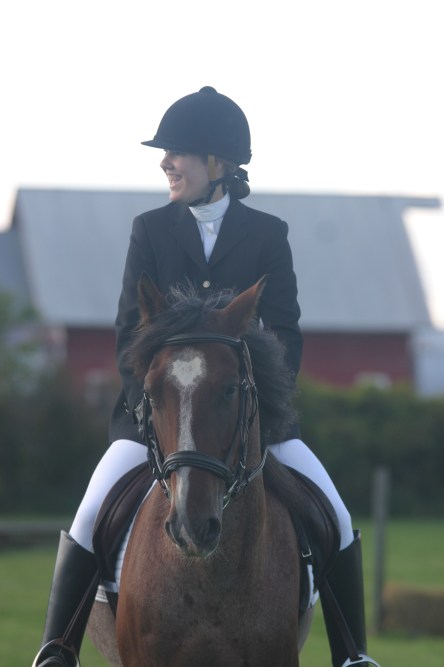
58-0011first dressage show with Tristan, spring 2007, wearing contacts

I wore contacts as a teenager, and abused them very badly right through college. I left them in for days (…weeks…) at a time. I got semi-frequent eye infections. I got a smidge better after college – I don’t think I slept with them in except accidentally after junior year – but they were still starting to get uncomfortable. I also couldn’t see as well as I could with glasses. When I was about 27, an eye doctor told me that my eyes were starting to grow extra blood vessels to the cornea to make up for my contact use – they were feeling starved of oxygen. I started wearing my glasses more and more often, and by the time I was 29, was pretty much full-time in glasses again. When I would try to go back to contacts, my eyes just were not happy. They were dry, strained, and so weary I would fall asleep at my desk in the afternoon – I just could not keep my eyes open.

Photo Jun 05, 9 10 56 AMmore recent show, fall 2016, wearing glasses

Research & the Decision

Like most people with poor vision, I’ve wanted Lasik as long as I knew it existed. I have little to no anxiety about medical procedures, so I wasn’t terribly nervous about the idea of surgery, and I’d had contacts so long that I had zero issues with the idea of poking around in my eye.

I first started openly pondering the idea a couple of years ago, and actually posted here on this blog about it. Many of you answered with your experiences, or your family or friends’ experiences, and I revisited and read through that post a lot while I was entering the final stages of my decision. I probably have the responses memorized! So THANK YOU to everyone who commented. In that post, I said I had to pay off my car first, since I knew Lasik was an expensive proposition. Well, I paid off my car in late fall 2017, and began thinking in more concrete terms about Lasik.

One of my biggest hurdles was that the Lasik industry is that – an industry. It’s an elective, cosmetic procedure that is almost never covered by insurance. That means that surgeons who do Lasik surgery often advertise for it in a way that would not be common for any other surgical procedure. There are online ads, glossy brochures, glowing testimonials, and a lot of things that made me really uneasy. It felt more like snake oil than medicine. I didn’t see any objective way to choose a surgeon or center – should I go all the way to Boston? should I just start Googling? how did I know that any of these places were quality medical centers and not just out to make a buck?

I eased some of my nerves by scheduling an appointment with a new optometrist who came recommended and who specifically listed Lasik consults on his website. I got my regular checkup with him in late winter 2018, and laid out my concerns. I was very frank and explicit about my fears about the Lasik industry, and asked him to be honest with me in return. He was – I liked him enormously! – and after we got through the standard risks (about which more in a moment) he was able to offer a personal recommendation for a local surgeon. She’d been doing it for a long time, he had frequently sent patients up to her and seen patients after they had surgery with her, and though it was not his first choice of treatment for nearsightedness (he preferred contacts or glasses) he felt confident in her.

I scheduled an initial consultation with the surgeon and got some of my major concerns answered.

First, they don’t operate on anyone they don’t consider a good candidate. There are a lot of not-obvious things that can make you not a good candidate. Severity of eyesight correction is only one factor. Your corneal shape and thickness also play a role. A friend of mine got turned down because her pupils were too large. Your age, general health, and willingness to commit to post-surgical care are all factors.  So I had to go through a barrage of tests to make sure I was in the right margins for all of that, and I was. I also had to have a stable prescription, ie my eyes could not be changing anymore. I’d been stable since my mid-20s. (The reasoning is that Lasik fixes what it sees in front of it, and if your eyes get worse again after the surgery…well, then your eyes are worse again and there wasn’t much point to the surgery. It’s not that it wears off, it’s that if your eyes are actively changing, they will continue to do so.)

Second, the cost. They quoted me a total of $3,790 for the surgery for both eyes, and an additional $300 for post-op visits (of which there would be three). I could potentially avoid the $300 by scheduling the post-op visits with my own optometrist and billing my insurance, but I wanted to stick with the surgeon, so I made the choice to pay the extra $300 – for a total of $4,090. When I made the decision to go ahead, I got financing through CareCredit – 0% interest for 24 months. (After that, they screw you on interest, but I already had done the math and knew that I could make the payments plus would be funneling quite a bit of extra money into it from other income sources. The plan is to have it all paid off in about 18 months, possibly sooner.)

I also heard a lot about the risks of the surgery. They are not insignificant. It’s eye surgery. You only get one pair of eyes, and you should not shoot a laser into them lightly. They want to be very sure you understand that before agreeing.

You can google a lot about the risks, though I don’t recommend you do; what was more important to me was the types of side effects they have seen themselves in their practice, and what the incidence rate was. They assured me, first that they have not made anyone blind. Which was good to hear! Their biggest side effects were dry eye, glare and/or haloes from light, light sensitivity, and some vision anomalies – some blurring, floating specks, etc. They said that they do about 1,200 surgeries per year and each year have about 10 people that they continue to work with past six months to resolve those problems.

I scheduled the surgery, and then a week later read this New York Times article and freaked out. I called my surgeon back and specifically asked about some of the problems in the article. They answered all my questions clearly and calmly, and gave me a lot of the information I’ve already included above – especially about the careful diagnostics to rule out any eye factors that might make some of the side effects more likely. They said they had read the article and never had anyone in their practice experience such severe side effects. So that helped.

Surgery

The day before the surgery, I had about 2.5 hours of pre-operative testing and counseling. I had to go through most of the tests over again to make absolutely sure that all the initial readings were correct. They triple-checked the shape/architecture of my eye with their laser machine. They triple-checked my prescription. I met my surgeon for the first time, and was able to ask her any questions I had. I came away feeling good about the whole thing.

That night, I filled prescriptions for antibiotic & steroid drops, and Valium. I started taking the steroid drops, as well as some vitamins (multipurpose, but with higher levels of Vitamin A and E) and fish oil pills. I’d done a little bit of reading and they were supposed to help. I started the drops that night, getting in two doses, and then another dose the following morning. They stung a little bit and made my eyes blurry for a few seconds, but nothing too bad. I also bought the preservative-free eyedrops that they recommended and that I would use for many weeks to come as my eyes healed. (I bought two boxes and then a few days later bought two more.)

The morning of the surgery itself, my husband drove me up. They did all my final tests, and strongly recommended that I take at least a half a tab of Valium. I did, though I actually wasn’t feeling too nervous. I’m honestly not sure why, but I just wasn’t.

For the actual surgery, they put in some numbing drops. They laid me down on a gurney. They lowered something down to my eye – I didn’t see it, but it put pressure on my eye. This was the most discomfort I was in the entire time, and it just felt like maybe someone was pushing in on my eye for a few minutes. They taped my eyelids open. Then they put me under the laser the first time; it made the incision and created bubbles under the surface of the eye to basically lift up the flap. Then the second time. I stared at a blinking light for 25 seconds. This was the most nervous part – I had to hold very still and concentrate on the blinking light. I was incredibly focused. They counted me down from 25 seconds. Then it was done, and we did the same thing for the other eye. I was in the room maybe a total of 10 minutes.

I was able to walk back to the room, where they looked carefully at my eye to make sure the flap had come down correctly. Then I put on some super-ugly goggles and walked out to the car. My vision was blurry, but a different kind of blurry from what it had been previously – more like I was underwater. Some things were almost-sort-of-sharp, and some things were blurry. I only kept my eyes open long enough to get to the car, and then kept them closed for the drive home.
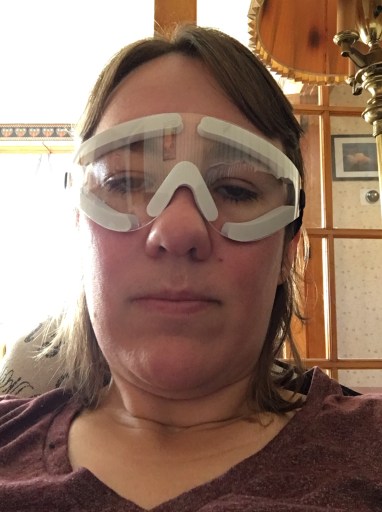
IMG_3805Not the most attractive picture ever taken, but the goggles I had to wear for sleeping. It was still hard to focus on my phone, as you can see, on day 3.

Recovery

Day 1: I spent the entire day on the couch listening to audiobooks. I only opened my eyes to put in my drops, every 2 hours for the steroids and every 4 for the antibiotics, and every hour (or more frequently if I felt like it) for the lubricating drops. I missed a lot, and the drops were all very sticky, so my eyes felt gross. I had some mild stinging – like I’d gotten shampoo in my eyes – for the first few hours. I also took ibuprofen around the clock, as I would for the next four days, to fight any possible inflammation.

Day 2: I woke up able to see. It’s as simple as that. It wasn’t perfect – a little blurry around the edges – but it was very much like wearing my glasses. I was able to drive myself to my follow up appointment (where my eyesight tested as 20/15) and back, and stopped for groceries on the way back. That was a little too much, honestly. I went home and laid down for an hour or two, listening to more audio books. The pattern for the next two days became to rest my eyes about 2/3 of the time and to get up and do simple things the rest of the time. Looking at my phone was hard, from both the light and the intense focus. So I did a few other things that didn’t require a lot of focus, like tidying up a bit around the house.

IMG_3824One of the things I could do was sew, so I made this bag for myself to hold all my post-surgery supplies: goggles, eyedrops, ibuprofen, tissues, vitamins.

Days 3: Very much the same. Lots of resting, with slightly more and more activity. At this point, I didn’t feel like I needed the rest. I was just being incredibly careful. Every time I put my drops in I would keep my eyes closed, and rest them for at least 15 minutes. Sometimes I would rest for longer.

Day 4: This was actually my first bad day – I went back to work. I couldn’t look at a computer for a long time, but we had a big day-long event so I didn’t need to. But by mid-afternoon I was dragging. I was tired, and had a dull, throbbing headache from eyestrain. I felt mildly queasy, possibly from drinking too much caffeine, possibly from the headache/exhaustion. I was prone to headaches from eyestrain and light exposure before the surgery, and this definitely fit in that category. I did call in to the surgeon and they said as long as I didn’t have any specific, acute pain in either eye and as long as my vision was clear, I wasn’t in any danger. I started wearing my sunglasses inside, and as dumb as I looked, it definitely helped. I did this for the next two days.

Days 5-18: The eyestrain definitely started to ease up, and by day 8 was entirely gone. At day 8, I was off my medicated drops and on to just my lubricating drops every hour. On day 10, I had my one-week surgical follow-up, and got a glowing review from the surgeon. She said the flap had healed incredibly well, and I had no inflammation. I talked to her about some of the things I was experiencing, and she said it was all well within the bounds of normal and would continue to improve.

My dry eye is slowly, slowly easing, as is my sensitivity to light. I’m able to tolerate a little bit better every day. I’m still doing lubricating drops hourly, but honestly mostly because they say to do them even if you don’t feel like you need them. The surgeon said that dry eye can lead to regression, so I’m pretty fussy about making sure I get drops in hourly, and more frequently if I’m at a computer. At the end of the day, my eyes feel an awful lot like they did with dry contacts – sort of dry and tired and thick, almost? Except I can’t take my contacts out and rinse my eyes. Instead, I just use a few more drops. And it’s getting better and better every day. On days without screens, I’m at about 85% of normal.

In terms of computer and phone use, I’m mostly back to where I was pre-surgery. One major thing has helped with this, and I can truly almost feel a physical easing, and that’s blue light filtering reading glasses (with no prescription). I’d heard of them before the surgery and ordered a pair from Amazon to try out. And, wow. They make a HUGE difference in how much screen time my eyes will take. (Again – I was prone to screen-related eyestrain before the surgery already.)
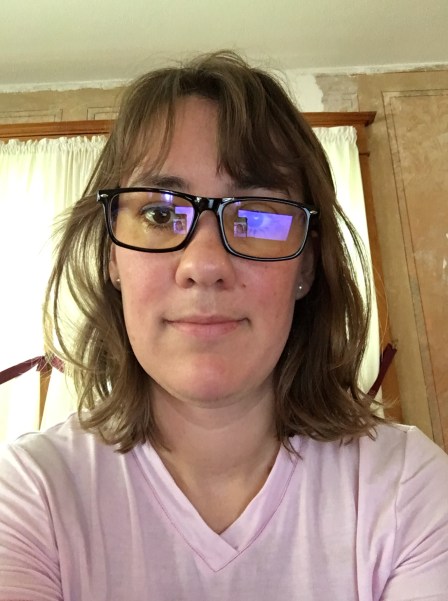
IMG_3809wicked super dorky but also REALLY effective blue light glasses

Overall Pros and Cons

Pros: I CAN SEE. YOU GUYS. Perfectly. Better even, a little bit, than with my glasses. And all the time. In the morning. In the shower. In my peripheral vision. In some ways it’s an awful lot like wearing my contacts again. In other ways, it is profoundly weird.

Cons: Anxiety. A lot of it. Constantly guarding my eyes and worrying. The eyedrops are sticky and gross – my eyes seal shut overnight and I have to drip around the edges to loosen them up in order to open my eyes. I definitely have dry eyes, sensitivity to blowing air (my husband does not love that I can’t tolerate having the AC on all night), sensitivity to light, and haloes and glare related to light. All of that was expected, and all of it is slowly easing, but it’s still very much present. Night driving is tough, honestly, but on day 4 I had to hold a shirt over my head even as a passenger in a car; on day 14 I drove us back from the movie theater in the dark with minimal problems. (Like I could notice that the lights weren’t right, but they didn’t hurt or distract me.)

And – on a more existential note – I spent the last few weeks of wearing my glasses feeling somewhat grateful for them. Grateful that I knew what it was like to navigate the world without seeing perfectly. Grateful that I could take them off and zone out. That I could get respite from interacting with the world constantly. Honestly, that’s something I miss sometimes. I never used to put my glasses on until I left the house. There was a strange comfort in slightly fuzzy familiar surroundings. I know that sounds weird, but there you have it.

On a really superficial note, my haircut no longer works without my glasses. :/ I have to sort of rethink that.

IMG_3800Last pre-surgery photo with glasses, taken the morning before

Yes, yes, but what about horses?

My first day back at the barn was day 4 after surgery, mostly just to pet Tristan on the nose and say hi. It was very hot, and there was a good wind coming up from the valley. I got pretty nervous very quickly about my eyes, and left after only a short time. I visited a few more times in the following week, mostly to check on him, because 5 days after the surgery was when he started in with his hives.

My surgeon had cleared me for riding in the first week after surgery, but it was blisteringly hot – too hot for serious riding, especially on a senior horse who hadn’t acclimated to that kind of heat – and then the hives started. In retrospect, I was glad I didn’t try to ride in the first week after surgery. I needed that time to rest and relax and focus entirely on healing, and one week off is not the end of the world.

I started Tristan back into work 10 days after surgery, with some longeing. I felt okay about the dust that kicked up, though nervous. I used my eyedrops every 15 minutes or so, and was very, very careful about how I handled myself around him.

IMG_3938FUCK YEAH NO GLASSES. Day 15.

I rode in the indoor next, for about 35 minutes, and that was way too much dust. My eyes definitely felt drier than they would have otherwise, but they weren’t irritated. I just stopped and put in eye drops during my walk breaks. It was more that it made me nervous. I washed my face carefully when I got home – I didn’t want any grit to get into my eyes after the fact – and put eyedrops in and closed my eyes for a bit when I got home.

Since then, I’ve done my rides outside on the grass, and I’ve had zero problems at all. I’ve been wearing sunglasses because really bright sunlight is still tough. But no problems in terms of riding. I’ve had three or four rides outside in that time. My surgeon grew up with horses, and explained to me that I had no real medical restrictions. The problem would be if I really hit my head and dislodged the healing flap, and if I then got some dust or something in my eye.

So, I don’t know if I would go back to jumping right away, or really galloping. I trust Tristan a great deal, and knew that I could handle what he had to throw at me – and that I could read him well enough to spot trouble coming. On a less reliable horse or a trickier horse I might have chosen to stay inside, even with the dust.

I’ve been a little picky about doing some things right now. I stopped doing Dursaole on his feet because WOW do they have some dire warnings on the bottle about getting it in your eyes. I also asked someone else to do his fly spray, and put in his big bit for riding outside even though he hasn’t used it yet this summer. Basically, I chose to err on the side of overcautious every chance I got, and I don’t regret that.

I do know that riding without glasses is fantastic, and I feel zero problems riding on the grass, especially with sunglasses. Especially now, entering week 3, when I can go longer and longer without feeling like I need to do eyedrops. (I always carry a vial in my breeches, just in case.)

IMG_3900sunglasses + eyedrops = essential right now

Anything else?

I think that covers everything that people have asked me about. Any other questions I can answer?

 

horse finances · lasik · surgery · Uncategorized

The Best Money I’ve Ever Spent

I had Lasik surgery about 10 days ago. I’m going to do a whole wrap-up post about it next week, after I’ve gotten a few rides in and can report reliably on that part (because when you google “Lasik + horseback riding” there basically crickets? which was not helpful for my brain?).

Lasik is not generally covered by insurance, which means that I paid for the surgery out of pocket. Or, more accurately, I arranged for financing through Care Credit, and will be paying for it for another ~18 months or so. I planned carefully, did my research, evaluated my budget, and felt comfortable taking on that amount of debt for that amount of time.

A lot of people have asked about the money part. Honestly, it’s pretty much in line with any other surgery. I didn’t find it agonizingly expensive, not for the return on investment. But the reactions veer between “that’s so expensive, I can’t believe anyone would spend that!” and “isn’t it the best money you’ve ever spent?”

I’ve thought a lot about that in the last few days, for some reason. Yeah, I’m happy with the money I spent! Seeing clearly for the first time in my life is pretty great!

But is it the best money I’ve ever spent? For some reason, that question – which was surely intended to be rhetorical! – has stuck in my brain.

No, it’s not the best money I’ve ever spent.

I have an easy answer for the best money I’ve ever spent: Tristan’s coffin bone surgery.

img_3394

almost exactly six (!) years post-surgery

If you tally up the actual procedure + hospital stay, it cost almost exactly the same as my Lasik surgery. If you include everything related to that injury it was 50% more, over the course of about nine months.

It was life-saving surgery. Not at the time – he wasn’t going to keel over – but surely it was a matter of time before the infection in the bone went septic and then systemic. Certainly he would never have been sound again if it had chewed away more of the coffin bone.

So, yeah. Easy call. Keeping him alive, sound, and happy was an easy call, financially. It certainly helped that I had an emergency fund that covered the surgery + vet bills, and steady employment that assured me of replenishing the emergency fund, but even if I’d had neither of those things, it still would have been an easy call.

But the average person who asks me that question does not want to hear about my horse, much less his surgery, so I usually just smile and say “it’s pretty great!”

hives · Uncategorized

Happy Hives Season! (Not.)

I’ve written about this before, but the first summer after his Cushings diagnosis, Tristan came out all over in hives. Bad hives. Fast. It was a lot of fun! He got lots of baths, some IM shots of allergy meds, and then OTC allergy meds, and then finally prescription allergy meds.

For the two summers after that, we started him on the prescription allergy meds as soon as it started to get hot (so, late June/early July) and a fly sheet whenever he’s out. He only had very occasional small outbreaks. We never did find out what he’s allergic to. The vet felt strongly that it was topical – but it wasn’t affected at all by baths, and he could still happily and easily get hives underneath his fly sheet. Barn manager and I both feel strongly that it’s something he eats. Something blossoms at this time of summer, and my darling horse feels compelled to eat it.

2015-09-17 10.08.38.jpg

his old fly sheet – that never fit well – and has since been replaced.

The catch – of course there’s a catch – is that the allergy meds are expensive. About $1.50 a day to feed. This year, with the switch to Prascend, I am struggling a little bit to find a way to anticipate and fund the large ongoing vet bills, so I had a conversation with the barn manager. We decided to delay on starting him on the allergy meds this year until we saw that he got hives.

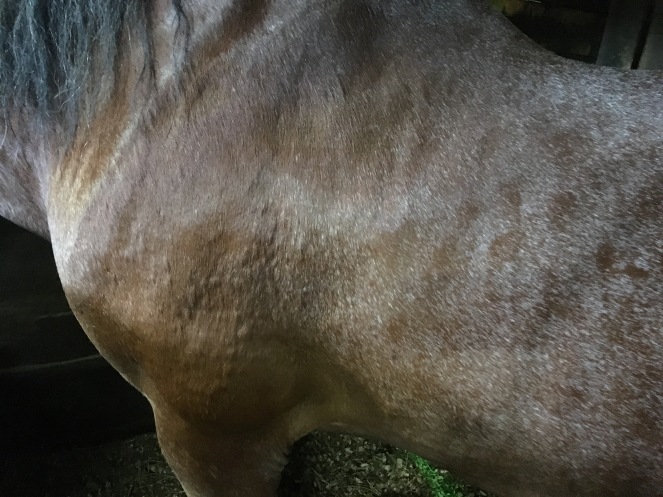
Well, like clockwork, last Thursday he came in with his neck and shoulders a pulpy, hive-y mess. It figures, of course, that I was just starting to feel confident enough after my surgery to ride again. Barn manager (bless her forever, I owe her booze) gave him a long cold shower and started him on the meds. The hives have not spread and are slowly, slowly easing up.

IMG_3867.JPG

In the first few days of hives, I prefer not to ride. For me, it doesn’t matter whether they’re in the saddle area or not. I worry about speeding up the allergic reaction – getting his blood going which causes it to go faster through his system – and triggering something more severe. That first summer, I was deathly afraid they would move on quickly and cause some kind of respiratory reaction. They came on so fast – within an hour or two he was just covered. Now, I worry a little bit less about that, but I still want the drugs to have time to get into his system.

So, we’re in a bit of a waiting game, which also neatly coincides with waiting for the one-week checkup after my surgery. I’m hoping once I clear the one-week mark his hives will be almost all gone, and I’ll get back in the saddle.

Anyone else have a horse who gets summer hives? How do you treat them? Do you ride through them or give time off?

black stallion series · Uncategorized

Summer Series: The Black Stallion’s Sulky Colt

Editorial note: In theory, today would be a Finance Friday, and the next Black Stallion book is The Black Stallion Revolts. I’m re-publishing a 2014 review I did of The Black Stallion’s Sulky Colt because I had Lasik surgery last Friday, and screens are still a little tough. I should be able to get back on track for next week!

The Black Stallion’s Sulky Colt
Walter Farley

Oh, boy. I bought this for $2 at a used book store because of the cover: I couldn’t resist. Hands-down my favorite cover era for the Black Stallion books. I had vaguely positive memories of The Blood Bay Colt and Jimmy and Tom and ever-so-vague memories of this book, so this would be good, right?

Wrong. Oh, it wasn’t bad, in the way of that Island Stallion book with the aliens (YES REALLY), but nor was it a Black Stallion and Satan, or The Black Stallion’s Filly, either.

Let me summarize this book for you.

Tom is an asshole.
Alec is an asshole.
Henry is an asshole.
Jimmy is an asshole.
Bonfire puts up with them all.

So let me back up. This book picks up after the storyline of The Blood Bay Colt. Bonfire, the second son of the Black (out of a harness mare named Volo Queen, because why not breed your nutjob mystery stallion to a Standardbred) has moved from the county fair circuit to the big time, and is prepping for the Hambletonian. One night, Alec Ramsay decides to go see Bonfire race; it just so happens that during the race he watches, Bonfire gets into a bad wreck. Thereafter, Bonfire is nervous and jumpy and seemingly ruined for harness racing.

If you’e ever read a single Black Stallion book, you don’t need me to tell you what happens next. If you haven’t, know that Alec takes over the reins and mysteriously a) is instantly an expert sulky driver and b) gets his driving license by magic after Tom is injured. Despite unexplained and bizarre prejudices against harness racing, Henry Dailey arrives on scene to save the day. Alec and Henry help Bonfire overcome his (um, totally justified) fear, thanks to a clever mechanical hood & blinker arrangement, and then win the Hambletonian. Shocking, right? (Yeah, no.)

Things that annoyed me about this book:
– all the characters who were not horses
– Henry’s bizarro prejudices
– the way Alec and Henry came into the harness racing world and never asked anyone to explain their training techniques, simply forged ahead with their own and were of course miraculously succesful
– the deification of Alec and Henry
– how poor Tom was basically turned into a demon for plot purposes
– how horrible everyone was to the horses, while outwardly talking about being gentle and easing them along and blah blah

Things that I really liked about this book:
– Walter Farley writes a racing scene second to none; all of Bonfire’s races were genuinely exciting and tense
– quirky horse antics! I never get tired of quirky horse antics in these books
– it was a short, straightforward story told relatively well

Anyone else read this one? Thoughts?

2018 goals · Uncategorized

June 2018 Goals Update

Original Goals Post

January Goals Post
February Goals Post
March Goals Post
April Goals Post (didn’t happen)
May Goals Post

Horse Goals

1. Take 6 lessons through the year. – 5/6 done! Here’s the first June lesson, and here’s the second.
2. Ride 3 new-to-me horses. – I’m between a rock and a hard place for this. Tris is doing SO well in lessons that I don’t want to take valuable lesson time to ride another horse.
3. Research 3 different retirement situations. – Still at 1/3.
4. Write retirement budget for Tristan.
5. Reach goals for horse-specific income stream. (Primarily through Etsy shop.) – I moved some important steps forward this month: I stabilized my average monthly earnings (though low), and I learned a lot through very selective restocking about what people most want to buy. I also kept expenses tightly reined in. Overall, I’m happy with my positioning for July.
Stretch: 6. Read and review 12 books about riding on the blog. – 3/12 done now that the Black Stallion series has started!

Financial Goals

1. Fully fund Tristan’s savings account (to $1,500) – Knocked this down with new prescription refills of Prascend and his allergy drugs, but in the next two weeks I have money coming in through other reimbursements that will top it back off.
2. 50% fund my overall emergency fund savings account (to $7,500) – on to $6,250!
3. Track every purchase made in 2018. – June was better! I actually did really well with this! Here’s to July.
4. Create 30 day wait list for any purchase over $25 (excluding groceries & emergencies). – Yup!
5. Pay off 50% of energy improvement debt. – we’ve paid off 29% of the total
6. Stretch: 75% fund my overall emergency fund savings account (to $11,250)

House Goals

1. Finish dining room (finish wallpaper, skimcoat lower half, plaster upper half, paint). – I’ve started skimcoating! I’m having people over for a neighborhood political gathering in late July, and my stretch goal is to have this totally done by then.
2. Finish garage in basement (finish strappingput up drywall, plaster drywall, paint floor, clean out).
3. Finish upstairs guest bedroom (strip wallpaper, plaster, deal with ceiling, repaint).
4. Develop plan & budget for preserving mud room mural.
5. Build second raised bedstart seedlings indoors, can/process results of garden. – I did not build a second raised, but I shifted plans to put in terraces. Half of the things in there are growing well, and half are not. It’s been a good experiment, anyway! I also picked strawberries and did freezer jam and froze the rest.
6. Stretch: Finish breakfast nook room (strip wallpaper, plaster, figure out heating, repaint

black stallion series · Uncategorized

Summer Series: The Black Stallion’s Filly

1053244._UY200_

After Satan retires, Alec and Henry find themselves without a horse to race. Henry buys Black Minx, the Black’s first daughter, and together they help her overcome her fears and race in the Kentucky Derby.

On the surface, this is a really simple, straightforward book. Black Minx (and apparently she has no barn name. She’s always either “the filly” or “Black Minx”) was poorly brought up and poorly trained, and Alec and Henry rehabilitate her and aim her toward the Kentucky Derby.

Here’s a scientific equation about the makeup of this book:

40% Alec taking long, slow gallops around the track + 20% exposition through weird training stuff + 30% watching races on television or reading recaps of them in newspaper articles + 10% actual action. That’s 100% of a book, I guess. There must be literally a dozen long paragraphs or entire chapters in which Alec says “another long slow gallop, I guess, Henry must know what he’s doing!”

Fear not, though. Black Stallion books are all alike; every Black Stallion book is batshit crazy in its own way.

In this book, the batshittery is not in the small details (like, say, the Island Stallion books) but rather in the overall picture. Henry buys Minx (that’s right, I’m giving the poor mare a barn name) at an auction in late November with no manners, little to no training, little to no condition, and they race her in the Kentucky Derby. The small details of this book are all awfully good! It’s maybe a bit boring, but it’s still really charming, generally, and then you realize again that the timeline is completely fucking insane and you kind of get jarred right out of that charm.

Strap yourselves in and let’s go back to the beginning of the book.

Satan, the Black’s son, is retiring from racing after a fractured sesamoid. Which is a real thing that really happens, and the way it’s reported in Jim Neville (our old friend!)’s newspaper article sounds thoroughly plausible. It’s almost weird to start off so sensibly and understandably, and that kind of sets the tone for the rest of the book.

For you Satan fans, fear not, Alec still fat-shames and daddy-complexes the poor horse at every opportunity.

Satan’s neck is shorter and more muscular. And his body is so heavy that it gives you the feeling of grossness.

ffs, Alec. But, kind of, spoiler alert: he spends this whole book, too, comparing Minx to the Black, both favorably and unfavorably. In fact, he’s really down on the poor filly pretty much the whole time.

Satan arrives home at Hopeful Farm, and Henry a) goes waaaaaaaaaaay over the top in transport, driving 24 hours straight personally and harassing the guys who are supposed to be helping him constantly and b) mopes around and to Alec’s total non-surprise, announces he’s going to find a horse to race for the coming season.

(Total side note, but it baffled and irked me at this point: Mrs. Dailey got fridged! She is totally, 100% absent from this narrative, Henry lives some kind of weird bachelor life in an above-barn apartment, and though they talk about his retirement they never talk about her role in it! She was an actual walking-talking-speaking character in previous books and she’s just GONE!)

Henry jaunts off to …I think it’s supposed to be Keeneland, but all they keep saying is “Kentucky.” Anyway, he hangs out at the auction for a while, watching a gray colt go for the unheard-of sum of $62,000, and we meet Tom Flint for the first time.

Flint was wealthy, but unlike most owners he trained his own horses. He didn’t hire someone else to do all the work and then sit on the sidelines until it was time to collect the trophies.

Flint sounds like a micromanaging nightmare. Also: can we talk a little bit about how each Black Stallion book exists in its own microcosm of the racing world? In every single book, all of the owners, jockeys, trainers, and horses are 100% different. It’s like the whole rest of the world is episodic and only Alec et al get continuity. When you really stop and think about it, it’s totally wild. And it means we have to get re-introduced to a whole new cast of characters every single time. There’s never “so-and-so, you know, who owned Sun Raider” who has a fancy new horse.

Henry buys Black Minx, who everyone else thinks is kind of a shit (on account of how in her only race ever she bolted sideways, went through the rail, and dumped her jockey), and brings her home.

At home, Alec gives us our first glimpse into how weird farm operations at Hopeful Farm are.

He would turn the horses out later in the morning if it didn’t rain. Mud wouldn’t hurt them any. But a cold rain falling on their backs at the same time would invite any number of illnesses.

I have so many questions about Alec’s thinking here I almost don’t even know how to start, but I’m going to let it stand for itself, except to say: Alec really doesn’t know all that much about taking care of horses.

Henry announces his plan to race Minx in the Kentucky Derby, and Alec has the money line of the entire book and introduces the central tension of the whole narrative.

When Alec spoke again he had regained full control of his voice. “It’s almost December,” he said calmly, “and in five months, you’re going to have rid this filly of her bad manners and have her trained and ready to go a mile and a quarter?”

ALEC SPEAKS FOR ALL OF US.

He gets on the horse anyway, and he kind of likes her! Except because he’s Alec, he can’t stop comparing her to the Black. Oh, and poor Satan, too.

She had gone smoothly into her gallop, so much like the Black and so unlike Satan, whose first movements were heavy and ponderous…

Well, why shouldn’t she be able to go the distance? Alec asked himself. Wasn’t her sire the greatest distance runner of them all?

sigh.

Poor Minx doesn’t seem to have any fire or will to compete, though. She never digs in and tries to run away with him, which Alec interprets as total failure. I say she wants to be an eventer. But this is a Black Stallion book, so a) Alec has long angsty monologues (for like the next 75 pages) about how poorly she reflects on the Black and b) damn it, she’s going to race anyway.

Minx’s ground manners still aren’t entirely improved, and after she’s been working on the track for a while Henry turns to address her biting in particular in what might be one of the greatest sequences in this entire series. He keeps an eye on her while he’s grooming her to get her pattern down, and then he boils a potato. While it’s still hot he has a loooooooooooong conversation with Alec about how to un-spoil her. Somehow, miraculously, the potato is still hot when he puts it up his sleeve and goes back down to Minx’s stall.

Black Minx reached for Henry and there was no stopping this time. She bit his bulging arm!

Her head came back fast, her eyes showing how startled she was. Henry never stopped his grooming to look at her. But Alec was watching. She had bitten squarely into the boiled potato. Her lips were drawn back and her mouth was working frantically. She kept it open and her incessant blowing filled the stall. Alec couldn’t help smiling at her surprise and bewilderment.

All the while Henry continued working.

HOW GREAT IS THAT? I love it so much. That scene right there is what has stuck with me since the first time I read this book. It’s smart, charming, full of personality, it’s a good bit of characterization for all three of them, and gah. It’s just the best.

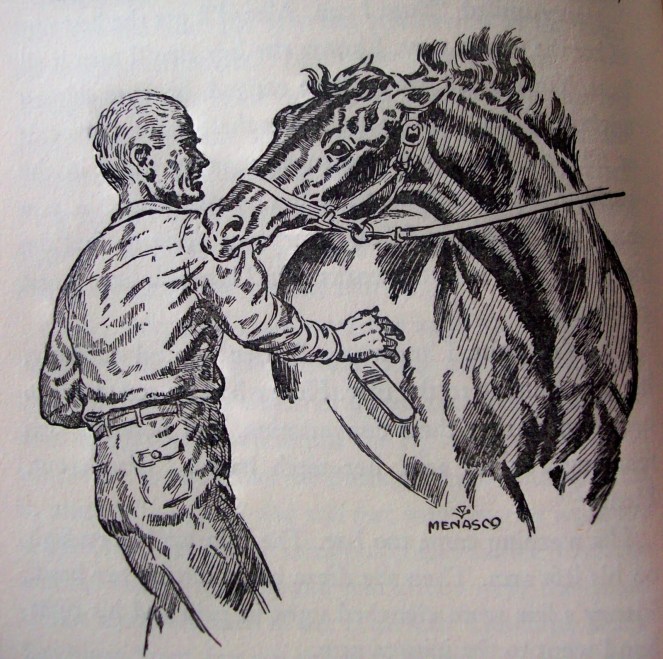
It also gives us this amazing Milton Menasco illustration of the scene.

100_2641

So, so, so great.

Okay. Gushing over. Minx’s mouthiness is cured by the hot potato, but her speed is still distinctly lacking. Pretend we’ve all just read like 50 pages of Alec being snarky and whiny and just not convinced that any of this is a good idea. I’ll wait.

Okay! Now that we’ve done that: Henry has a plan. And it’s a plan I am genuinely interested in your opinions on. See, Henry thinks that because Minx is just so darn ornery, she wants to do the opposite of whatever you want her to do. So he tells Alec to fake that she’s running away with him. He does that.

No longer did he cluck in her ear, urging her to gallop faster. Instead his words were a constant stream of whoa’s which served only to drive her on to greater speed. The wind cut his face. He wanted to smile but couldn’t. He worked his hands against her mouth, but this, too, only made her go faster.

I mean. It works for them. But apparently this horse will never do anything ever but race? Maybe it’s a 1960s attitude toward racehorses, but can you imagine trying to restart this mare off-track when she’s been trained to go faster when she thinks you’ve lost control?!?!? Is there some clever nuance I’m missing here or is this a monumentally bad idea?

(Let’s all be honest though, in Black Stallion terms it’s still like a 2 out of 10 on the Bad Idea Scale. It’s no Henry roping Satan to the ground, is all I’m saying.)

It works, though. Minx starts breezing, presumably faster, but they only do it like three times and Alec never asks for her times. So. Let’s just all trust in Henry and assume she’s going fast enough to make sense as a Derby contender.

The next 50 or so pages are given over to long, obsessive, agonizing speculation over exactly who else is going to race in the Derby. There are a bunch of other horses. We’re treated to Walter Farley’s descriptions of Alec and Henry watching races on television. Yeah, it’s exactly as boring as it sounds.

In between, though, we learn some more about the operations of Hopeful Farm. Let me sketch it out for you. Hopeful Farm is a breeding and training farm in upstate New York. It stands one, now two, stallions and has an unspecified number of mares. (Let’s say 20+ based on context clues.) Total employees? Alec and three part-time guys. And Henry when he’s around but he doesn’t seem to do anything with any other horse except Black Minx. Alec is business manager, exercise rider, barn manager, stallion & breeding shed manager, he’s the first call for foal watch, he’s making daily decisions about turnout and doing stalls, and oh also he’s their main jockey.

The next few nights, like the days, were busy ones for Alec. Three mares foaled on successive nights. Two of the mares were owned by outside patrons, and the sires of the foals resided in Kentucky.

ALEC IS TWENTY FOUR YEARS OLD. HE KNOWS NEXT TO NOTHING ABOUT HORSES. WHO THE FUCK SHIPS THEIR BRED MARE FROM KENTUCKY TO FOAL OUT AT THIS HALF-ASSED OPERATION. JESUS CHRIST.

Presumably managing stud duties for Satan ALONE is a full-time job, right? He won the Triple Crown and the Breeder’s Cup Classic and literally everything else ever. Plus the Black. Does Alec even sleep?????

Onward and upward to yet another race on tv, during which we learn that horses used to be waaaaaaay smaller.

Looking at him now you might think he is a small horse, but he isn’t. He stands a little over fifteen hands.

Oh and also we learn about this totally insane contraption.

This [run-out] bit, ladies and gentleman, is so designed that when the colt is running straight he has only a smooth plate against the right side of his mouth, but if he pushes out there are sharp prongs that are brought into play which stick him. It sounds cumbersome but it isn’t.

WHAT THE ACTUAL EVERLOVING FUCK

THIS IS A REAL THING, PEOPLE

41364

YOU CAN BUY IT FOR $162

Someone, anyone, please enlighten me. Are these really still used? Are there any possible imaginable circumstances under which this is not just horrific cruelty? Am I just totally being a delicate flower here? Anyone???

Moving on to other crazy training decisions:

“I’ll break her from it next week. One or two breaks should be enough. Too much gate work does more harm than good.”

They’re proceeding on the basic assumption that Minx’s basic training was sound. You know, the previous basic training that led her to be a total shit on the ground and also to run through the rail in her first race.

When they do get around to sending her out of the gate, surprise, she is not good with it at all. She hates the door closing behind her.

Small piece of backstory that I have not yet mentioned: Minx has a docked tail. When she was a yearling, a kid slammed a door shut on her tail and broke it, and part of the dock had to be removed.

Alec and Henry come up with an unorthodox solution.

“You mean if we gave her a false tail she’d – ”

“- have something to fling around,” Alec finished for him. “She might even forget all about not having had one for so long. And even if it didn’t help quiet her down in the gate, she’d have a switch to keep the flies away from her this summer.”

“But it might work in the gate, too, Alec,” Henry said quickly. “She might forget fast that she ever had an accident.”

https://gph.is/1zQV4vq

Surprise, surprise, the tail thing works, and gets us to this immortal description of Minx.

She’s a high-headed gal with a complex.

That is like my new personal motto, right there.

Off they go to the Derby, and we get a reminder that Alec basically spends this entire series of books suffering from PTSD.

Pressure and tension were mounting within him. And he knew there wouldn’t be any let-up during the days to come. Instead it would get worse. He tried to think of the calmness and tranquility of Hopeful Farm. But it didn’t help. It seemed that Hopeful Farm had never existed. He was being swept into the all-engulfing whirlpool of the Kentucky Derby, and there was nothing he could do about it.

Henry decides to enter Minx into one race on the Thursday before the Derby, something we would consider insane today, but all the other horses lined up for the Derby have been racing practically weekly.

The race…does not go well. She gets bumped pretty good, goes down, and Alec goes flying. Then she takes off galloping away and they have trouble catching her, which aside from being super-embarrassing seems like a really bad thing to happen three days before the Derby? What do I know, though, Henry thinks it means she’s in fine fettle and she can go the mile and a quarter.

Then we come to the race itself, which, you know what, for all that the television races earlier in the book are boring, the race itself is actually exciting. All that endless exposition at least got us familiar with the jockeys and horses that Alec now comes face to face with in the Derby, and allows him to make this scintillating analysis.

Boys became men riding a Derby, or they remained forever boys.

…okay? that makes…not a whole lot of sense, but…sure, Alec…

It’s an exciting race with a foregone conclusion, though: Black Minx wins the Kentucky Derby! She gets over her need to fight in order to tap into her speed, but she also gets kicked at the starting gate and by all accounts has an foreleg gushing blood through the whole race. It’s cool, though, they take the win photo before treating the leg. Real nice win photo, guys.

She’s fine, though, thankfully, and after all that work, finally gets some well-deserved treats. Aaaand…curtain.

Whew.

What did you think? Do you have any memories of this one? Is the hot potato scene one of your favorites too?