adventures with the vet · first aid · tail tumor

The Miracle of the Elastikon

My love for Elastikon is well-documented. I firmly believe that at least one roll of this miracle substance should be in every equestrian first aid kit. I could not begin to estimate how many rolls I have gone through in the last few years.

On Sunday, I returned to see Tristan for the first time in nearly two weeks after the wedding + mini-honeymoon. Before I left, I did my due diligence and had conversations with the vet and the barn manager about our tail protocol.

The plan was that his tail would stay wrapped as long as the wrap held. He could then keep it unwrapped as long as he was not rubbing it. If he was rubbing it, the wrap would need to go back on. Since the first wrap lasted about two weeks, I expected that the wrap would come off while I was gone and we would see whether or not he rubbed his tail. I didn’t hear anything while I was away – the barn manager was very firm that she would only call or text me in case of actual emergency, since she wanted me to be stress free.

I arrived Sunday…

Whaaaaaaat.
Let me contextualize this for you.
Tails are notoriously difficult to wrap, right? We’ve all been there. They are slippery and if you do them too tight it’s super dangerous. So you have to strike an impossible balance on being snug but not tight, sticky but not anything that will actually damage the tail irreparably.
This wrap has lasted almost four weeks. I thought two weeks was an extraordinary gift. Four weeks!!!
Lest you think that the tail is damaged underneath, I checked carefully for chafing and rubbing, and found none. I’m not saying it will slide right off with zero problems, but I don’t anticipate a complete mess when it’s time.
Here’s what it looked like after I took the old wrap off. Not too bad, huh?

In conclusion:

BUY ELASTIKON RIGHT NOW.

wedding

Back to our regularly scheduled (?) horse blog

I had all these intentions of writing delayed, content-rich posts while I was gone, and then the wedding took over, and then post-wedding brain + lack of actual computer and/or content did in the rest of my break.

So!

I’m back, both home in Vermont and on the internets. I have 1200+ blog posts to read skim and I have not been inactive in the background either in the horse or the house front.

In the meantime, here, have some placeholder wedding photos.

tail tumor

Tail Lump: Final Diagnosis

My horse, the medical marvel. Here’s what the final pathology report says:

ADDENDUM
The following histochemical stains were performed on haired skin, ventral tail nodule (slide 1; 4 sections): 

Toluidine blue (mast cells): In 2 sections, there are small aggregates of mast cells containing metachromatic granules. 

Throughout all sections admixed with the eosinophils there are moderate numbers of individual mast cells. 

Comment: 

Histochemical staining with toluidine blue reveals the presence of clustered mast cells, consistent with a diagnosis of cutaneous mast cell tumor. Serial deeper sections did not show evidence of Habronema parasites or any other additional findings. Equine cutaneous mast cell tumors are usually benign and often, as in this case, very eosinophil rich. Complete surgical excision is curative. Anecdotally, in some cases even partial excision has resulted in spontaneous regression of the mast cell tumor. 

Amended morphologic diagnosis:
Haired skin, ventral tail nodule: Cutaneous mast cell tumor

FFS.

If you remember, this was the least likely of the three original possible diagnoses.

What a special snowflake.

Waiting on the vet’s word, about whether excision is the next step and if so, how soon. Given that it is definitely receding thanks to the bioabsorbable cisplastin beads we sutured in this may not be an immediate step.

Either way, seriously? I have been exposed to my fair share of medical weirdness in person, and I am an avid reader of the COTH forums for weird medical stuff, and I have never even heard of this. I even did a search for “mast cell” on COTH and it came up with cancer stories in people and dogs. No horses.

oy.

blog roundup

Weekly Blog Roundup

Some interesting posts from the greater horse blog world!

Polo Clinic With Helmet Cam Gifs from Fraidy Cat Eventing
Totally living the dream! This looks like so much fun.

Mean Ol’ Dressage (Puns and Plots) from Fraidy Cat Eventing
I know, two in one week, but this is just about the coolest way to analyze your dressage progress that I’ve ever seen.

Favorite Followings from Bay With Chrome
I am more and more into Instagram lately. This is a great list to check out.

Inspection Photos from The $900 Facebook Pony
AWWWWWW.

Body Shaming the Show Ring from If the Saddle Fits
I hate that I’m not surprised either, but – I’m not.

physical fitness (horse)

Getting an Assist

I know that there are many people who have trainers ride their horses regularly. I think that’s awesome. Tristan always makes progress by leaps and bounds when someone who actually knows how to ride horses sits on him. It’s almost like experts do stuff better than out of shape amateurs who jump on bareback three times a week.

Ahem. Anyway.

I’ll be gone for nearly two weeks for Wedding + Aftermath, and right now, Tris is in a somewhat peculiar and precarious place. He’s overall in good health, but his physical shape is utter shit. He’s turned out on a hill, and I’m walking him a few times a week, but…that’s it. Yeah. I know. Last week, I asked him to trot the (mostly flat) cross-length of the hay field and he was blowing hard when we got to the other side. Goooooood grief.

So I had a long conversation with the barn manager last night about what Tris will need while I’m gone (thankfully, not too much) and I voiced my problem(s).

Problem the first: I’d like to keep him in work while I’m away.

Problem the second, which is the larger, underlying problem: he’s out of shape, and I’ve become too nervous to whip him back into shape. If he seems sore, or too tired, or breathing too hard, or anything, I get nervous. It looms much larger in my head than it should. I should just push through and stick to a program, but I back off and noodle around instead.

But he needs to be in better shape. Right now his muscle tone is poor, and he’s week through his hind end, which means he’s tripping even more than usual, and his body feels disconnected all through even in the walk. He’s got a hay gut and no topline, and just overall an even more sedentary attitude. He needs more muscle, more energy, and a better body feel. He needs to go into the winter with a base of fitness.

Solution: while I’m gone, the assistant trainer will sit on him, maybe two or three times. She’ll work out a program. Between the assistant trainer, the working student, and the barn manager, they’ll get him started. When I get back, I will sit down with the assistant trainer and she will tell me to get the hell over myself and what I need to do.

Uncategorized

Lump Progression

WARNING: some of these photos will be a little graphic, in the horse injury/treatment sense. Not bad – but if you are easily squicked, this is not the blog post for you.

Commence leaving some space as a buffer…
Discovery of the lump.

Biopsy, chemo beads inserted, suturing.

2 days later

 Last night, almost 2 weeks out.

Changes: definitely smaller. Developing a scab-like appearance, with separation of skin at the edges. Very sensitive – he would not tolerate even a touch of my fingers or the placement of a gauze pad in order to re wrap. It took some doing to get it covered up again. Sutures are holding just fine, no indication of index ion/drainage/irritation at the stitches.
I sent the vet the pictures. She was happy with them. We keep watching and waiting. If the wrap comes off again, he can leave it off as long as he does not try to rub. At this point, the skin had healed together but is stil new.
adventures with the vet · tail tumor

Pathology Report

I have to admit, this reads to me like the science-y version of a very elaborate and confused shoulder shrug, but there you have it. It does say that we are still waiting on further testing to hopefully prove or disprove at least one of these possibilities.

I share it here in the dual interests of education and curiosity. If you can interpret any piece of it in a way that sheds light, let me know! If you are just deeply curious about what a highly technical pathology report looks like, wonder no more.

If you just want to read my vet’s layman’s explanation for this, it’s what I wrote up on Friday.

The histologic findings show a severe eosinophilic dermatitis. The top differentials for this lesion are habronemiosis, eosinophilic granuloma, or cutaneous mast cell tumor. Some horses have an atypical eosinophilic response to bacterial infection and some fungal infections such as, oomycetes. No bacteria or fungi are noted. No habronema parasites are seen in the examined sections but additional deeper sections to further examine for residual parasites are pending and additional results will follow in an addendum. Cutaneous mast cell tumor in the horse can be a highly eosinophilic condition with very few mast cells present. The clusters of mast cells required for the diagnosis of cutaneous mast cell tumor are not appreciated in these biopsy sections but histochemical staining to better highlight mast cells are also pending and results will follow in an addendum. Excluding these differentials, the remaining differential is equine eosinophilic granuloma, which is a common skin lesion of uncertain etiology. A hypersensitivity response to insect bites is one speculated cause. Lesions of equine eosinophilic granuloma occur most commonly on the neck, withers, back, and girth region and are often alopecic without ulceration. Early eosinophilic granulomas generally respond to treatment with corticosteroids while chronic lesions may require surgical excision. Strict insect control may diminish recurrences in cases due to insect bites.

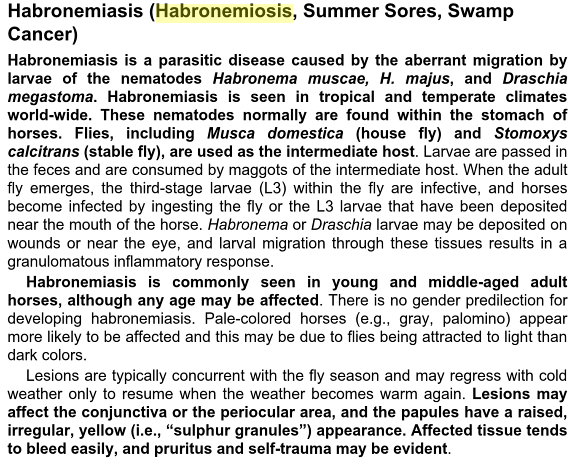
I googled “habronemiosis” because what the heck, did a lot of digging, and came up with this slightly more readable explanation:

So…we wait. Some more.

house post

House Post: Radiators, Part 1

Radiators! We have a lot of ’em.

Our house is heated by steam, a slightly tricky but ultimately rewarding heating system. It is more efficient than many other older heating systems, and it offers a comforting, humid warmth rather than the dry, on & off of forced air. It also makes those wonderful popping sounds when it’s starting up.

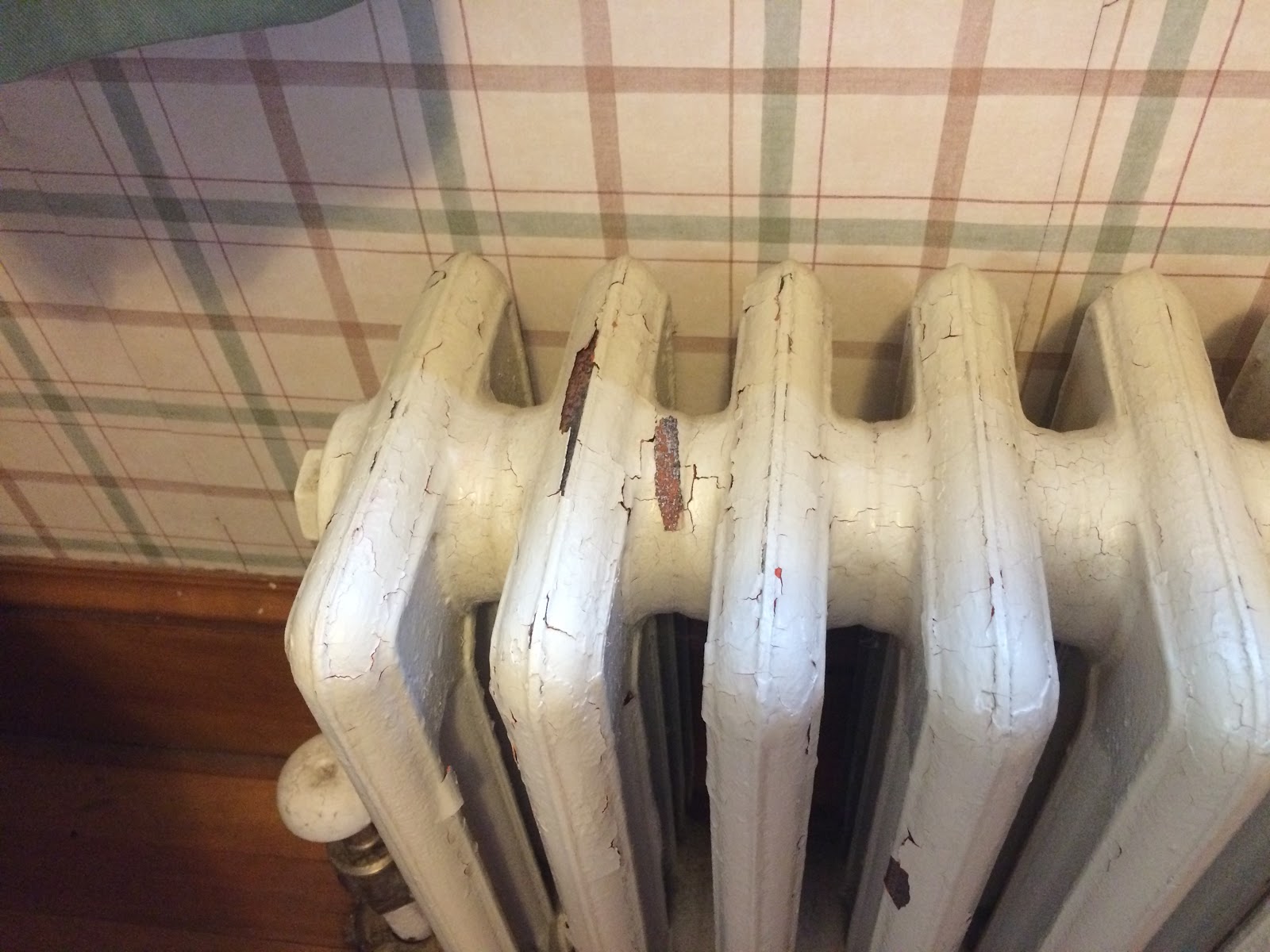
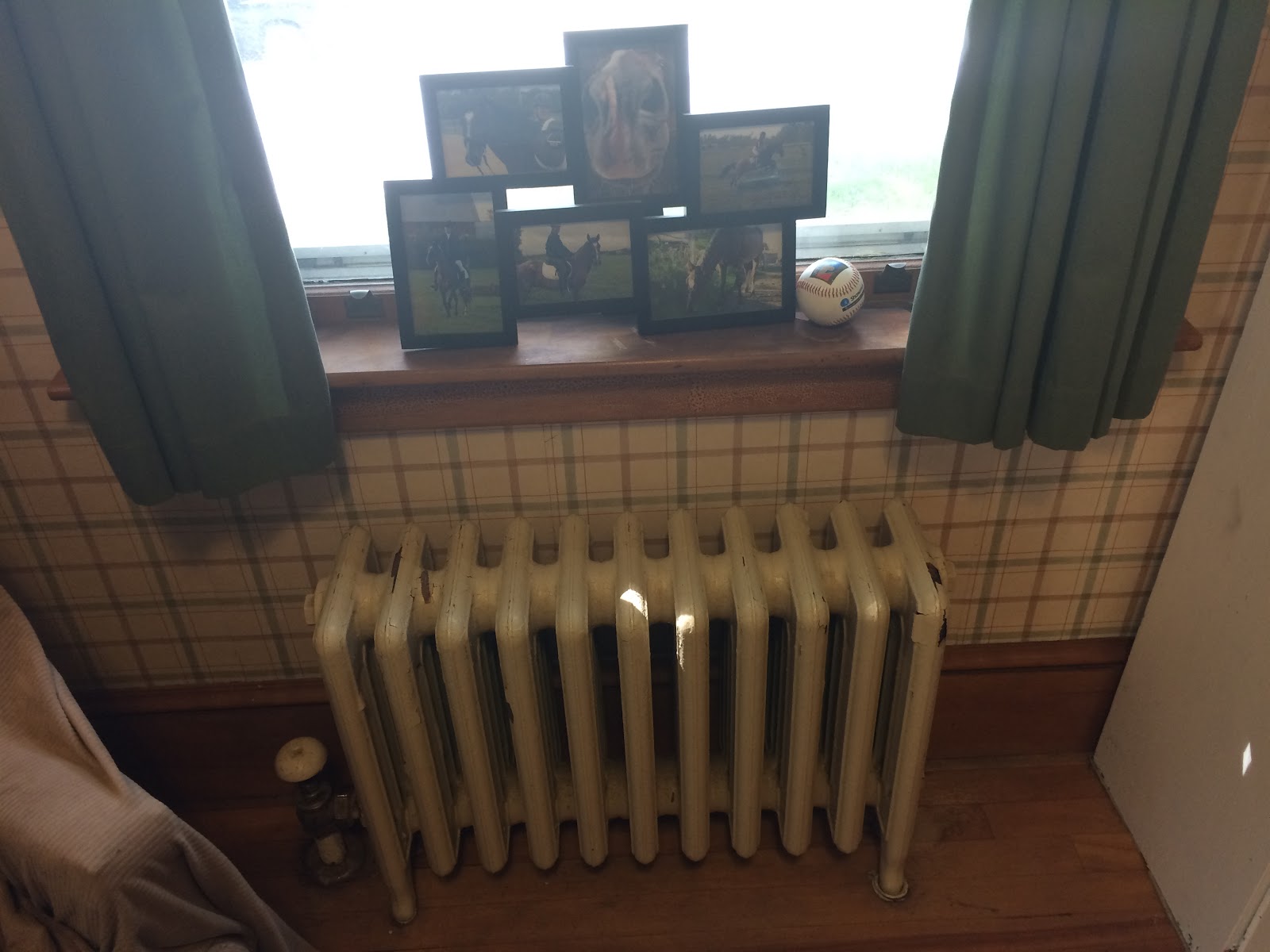
However: all of the radiators in the house (there are eight in total) were painted to match their rooms. That paint is either a) ugly or b) peeling badly. In some cases, both!

I agonized for quite a while over what to do and how to do it. I talked to a ton of people, called places for quotes, researched online, and fretted. I thought about just getting radiator covers made – maybe something custom, to match the woodwork in the rooms. I thought about doing it myself, in place.

Eventually, our electrician recommended a place that was just half an hour around the corner from us. She said they sandblasted her radiators right down to the cast iron for a very reasonable price.

So that was the plan. Our radiators are older, but they have no fancy Victorian filigree on them that might be damaged by sandblasting. While my ideal would have been to have them powdercoated, I couldn’t find anyone who would do that locally, and I wasn’t convinced it would be as cost-effective for its supposed superiority.

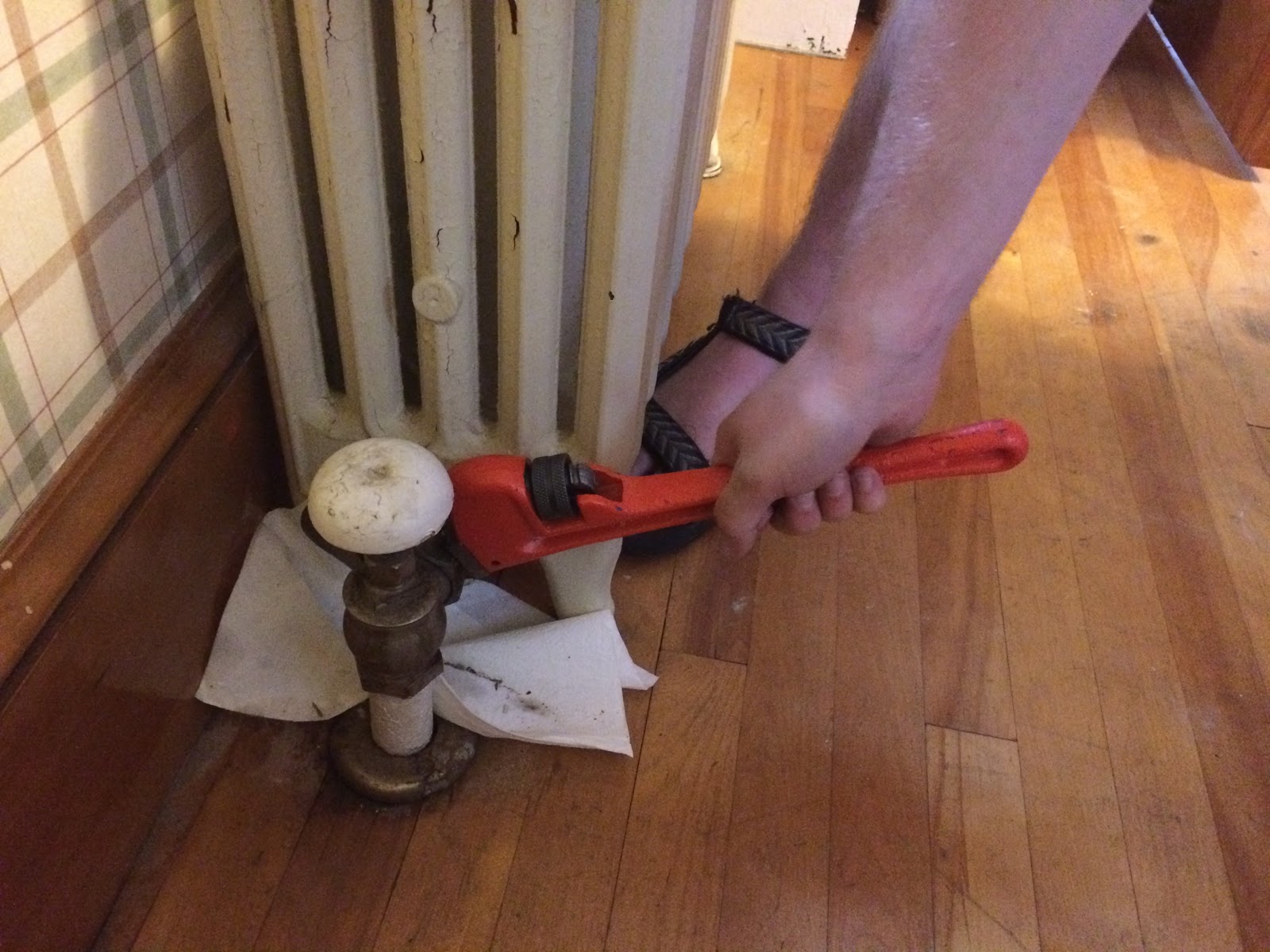
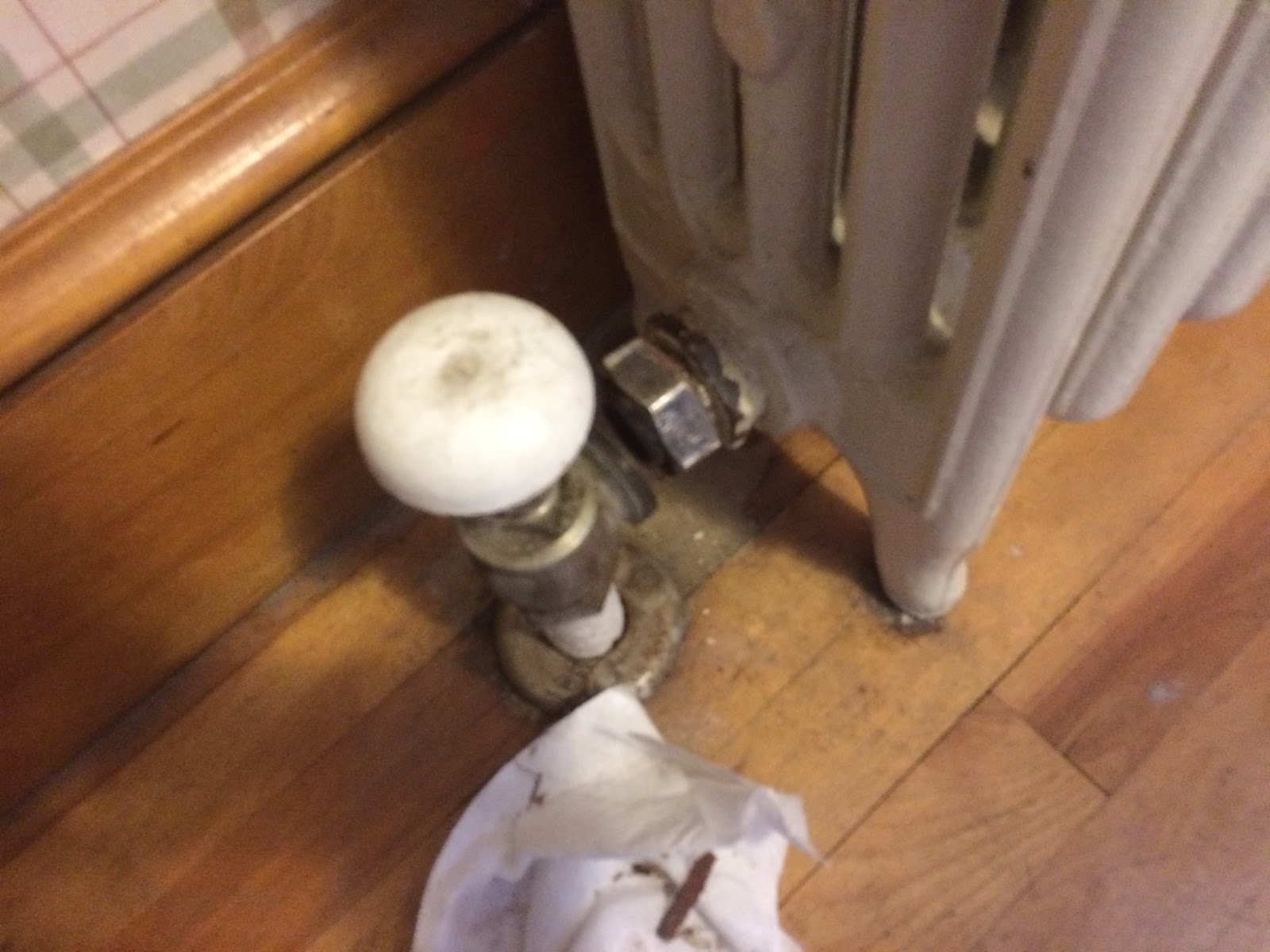
Step 1: Get the radiators out of the house.

THIS REALLY SUCKED. REALLY REALLY SUCKED.
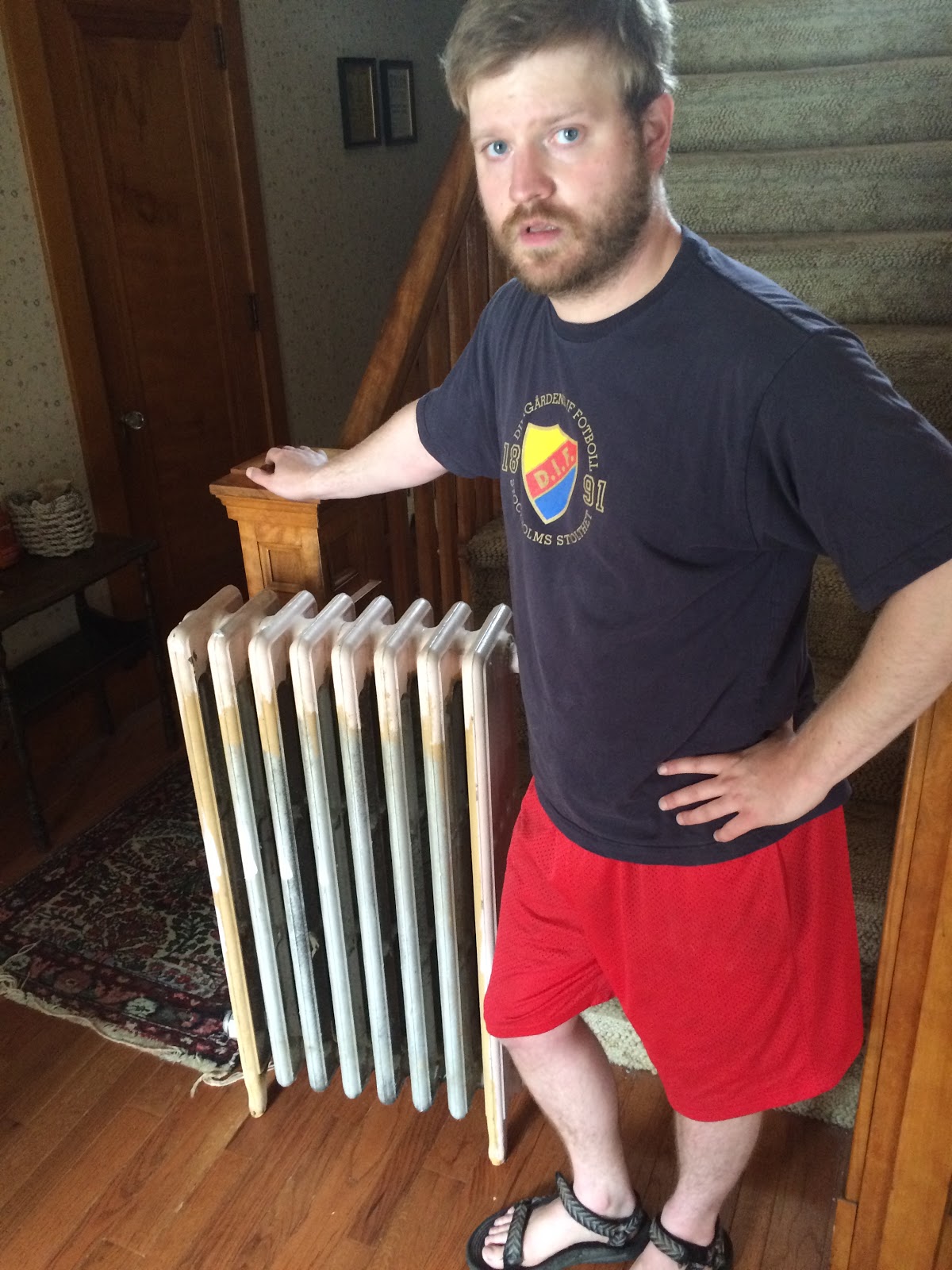
The radiator in the photos above was small, and on the first floor (my office). It still required 20 minutes of moving it 5′ at a time with precise communication so we could both lift at the same time.
This radiator was in our master bedroom. It weighs several hundred pounds. It took 45 minutes to get it downstairs and out the front door. We did it step by step, and Matt’s face basically says how thrilled he was with the process.
Remember what I said about ugly paint? This is the side that was facing the wall. Ack.
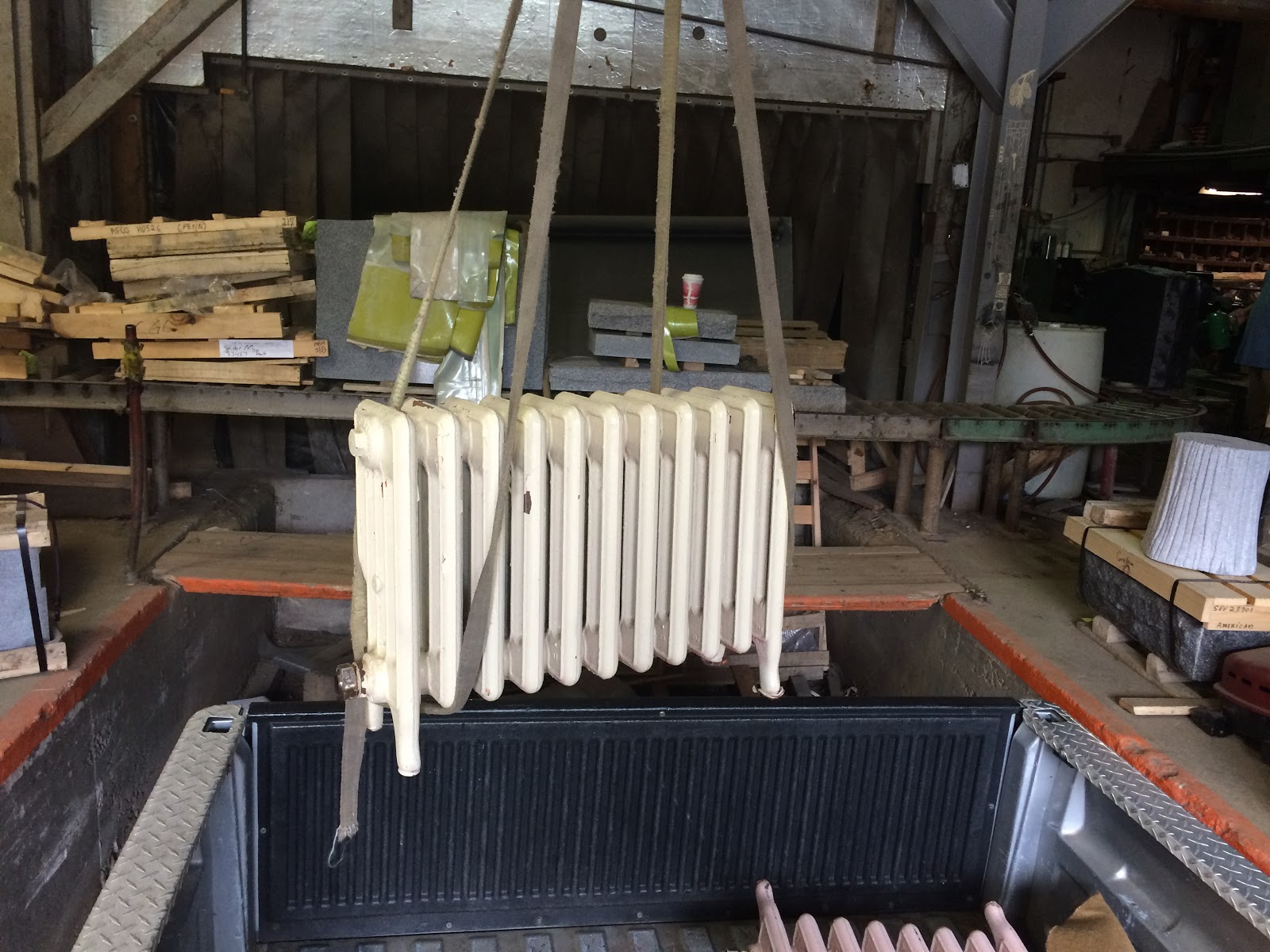
We put them on the front lawn, which slopes quite a lot, and I was able to finagle my truck so as to back it up directly to them. Then we just moved them forward a few feet into the back of the truck.
Then I drove them half a mile to the sandblasting place. They had a magnificent hydraulic lift that ran the length and width of their entire shop – a necessity, as 99% of what they sandblast is giant granite slabs.
Seriously, we need one of those at our house.

The guy who took charge of them for us was amazed at both the really ugly paint and how much of it there was. He shook his head in awe, and told us that they would be dramatically more efficient once he sandblasted them. Huzzah!

So now we await part 2: re-painting.