nutrition · trailering

Feeding Beet Pulp

Tristan has not been drinking as much as I would like lately, and with plans to take him on the road on Sunday, I wanted some extra tricks up my sleeve. I’ll incorporate electrolytes into his feeding plan over the next few days, but wanted something to give him on Sunday while we’re away.

Enter beet pulp. Beet pulp is basically the shreds of what’s left over after all the sugar has been processed out of beets. Sounds delicious, right? It’s actually nutritious (for horses, anyway) and most importantly low in starch. Dr. Kellon, a leading expert on Cushings nutrition, suggests it as great safe calories. While it can actually be fed dry (another old wives’ tale bites the dust), it also absorbs a TON of water – which makes it ideal for my purposes.

I bought 35lb of beet pulp for about $13 at my local feed store (literally right off Main Street of the state capital, oh Vermont, never change), making it also pretty inexpensive. Whoo! I queried the collective wisdom of COTH to see if I could feed it intermittently, and the answer was a strong affirmative. (Let me hasten to add that COTH is not my one-stop-shop for veterinary answers, but for straightforward practical questions, they are great. When the answers all come back “yup, no problem, go ahead” I feel on safe ground.)

To be extra cautious, I am giving him a few handfuls per day in the days leading up to the ride to get his gut used to the beet pulp again. (He has eaten it in the past at other barns with no problem.)

So tonight, after puppy class, I went out to give him his first bit of beet pulp. I mixed two heaping handfuls of dry shredded beet pulp with about 2Q of water.

Dry, before adding water.
After adding water.
Then I set my timer for 15 minutes and proceeded to wander around. I didn’t want to start on any cleaning projects because I quite foolishly had not changed into jeans after work and didn’t want to completely destroy my work pants. I petted Tristan on the nose (he was BUSY with his HAY, MOM), and wandered around outside.
My pretty new car, posing in front of the dry lot paddocks, with foliage backdrop.
I checked on the water level in Tristan’s paddock: pretty good. (Not low enough to make me haul more out in my work pants…)

Then I turned around and the barn was pretty.
I brought the beet pulp out so it could enjoy the view. This is halfway through soaking.
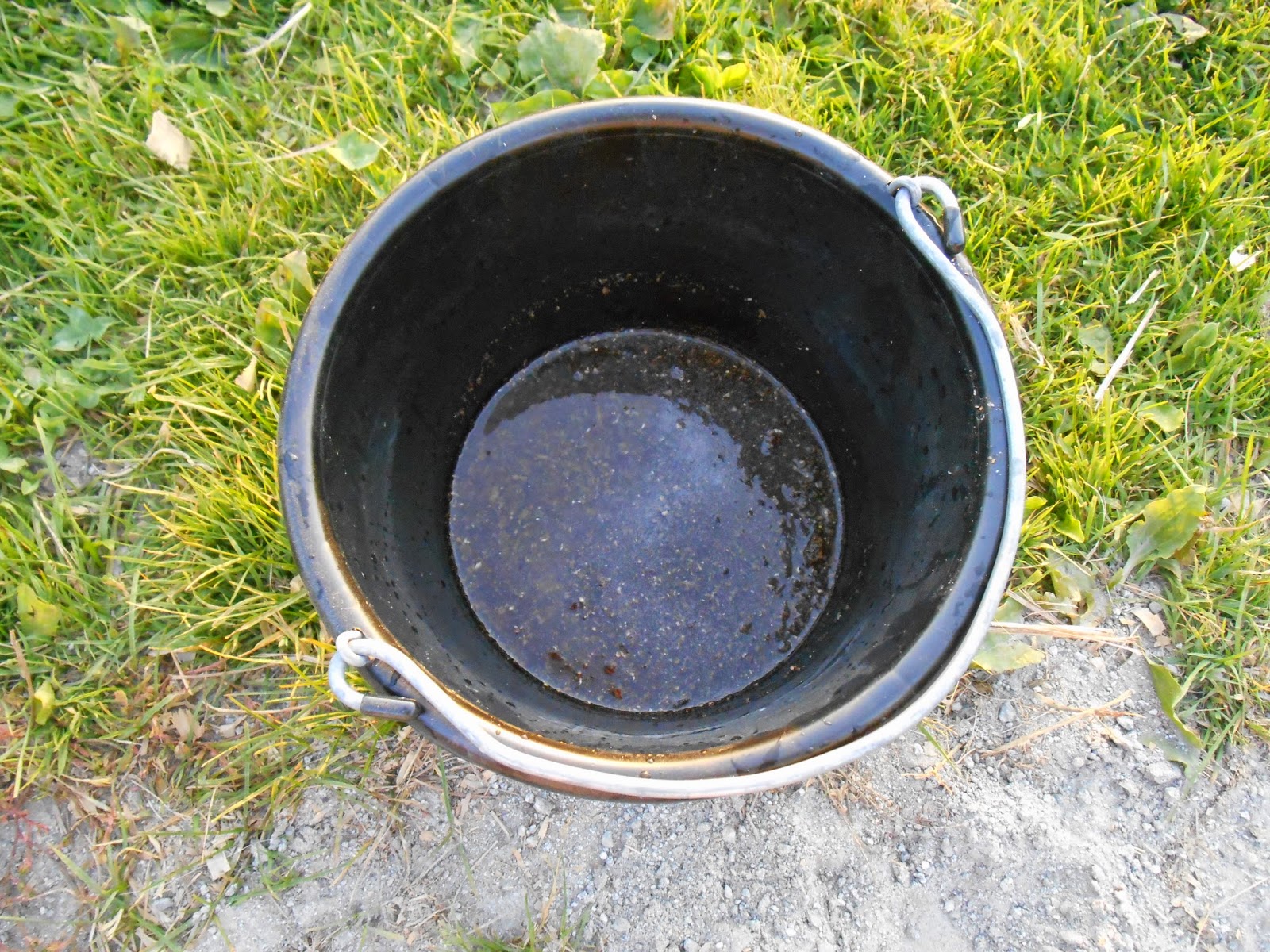
Done! This is especially soupy beet pulp, but I was still amazed at how much water it soaked up.
A+ pony approved!
Tristan ate the beet pulp up beautifully, even slurping the extra water. Victory! (For now, says the pessimistic side of me.)
He’ll get a few more handfuls Friday & Saturday night, and then half a bucket of dry + full bucket of water on Sunday at lunch. Every little bit of extra water I can get into him helps.
polls

New Poll: Are You "Out" At Your Barn?

I was semi-inspired by Lauren’s anonymous poll and kind of curious by how many people would say things about their barn if they weren’t anonymous.

So, with that in mind: how many of you have told your barn that you’re blogging? Have you ever shared your blog link? Have you done it in the past, but not at your current barn? What’s holding you back?

To answer my own question: a few people from my former barn know I blog, and read & comment. No one from my current barn knows; quite frankly, it’s a quieter barn, and while I am friendly with the people & like them quite a lot, we don’t have the same relationship. So I guess you could call me pretty much still closeted.

stupid human tricks

Hanging in There

I haven’t seen Tristan since Monday and have basically worked 24/7 since then. That trend will continue through Saturday night, when I’ll finish my last prep for the GMHA Fall Foliage Ride. No exercise for a week in crisp fall temperatures leading up to his first time off-property in 2 years? WHY NOT, IT’LL BE FUN!
I am taking consolation in this graphic, posted by the Eye on the Sky weather guys, which promises me beautiful scenery, at least.

blog hop

SFTS Blog Hop: Why Do You Do What You Do?

I know, I know, blog hops galore lately but my own horse stuff is super boring, sorry!

I want to know: Why do you do what you do?


True story: the first official horseback riding I ever did was vaulting.

Yup, exactly like that. (Well, I was 8, and it was a scruffy pony, but whatever.)
I did about 6 months of vaulting. It was required at this barn for all new riders, to get a sense of the horse and the feel for riding. I loved it, and have used skills I learned ever since: moving around comfortably on the back of a horse, and how to fall effectively and loosely. I LOVED it. I’d go back in a heartbeat. (Not as my main equestrian pursuit, but on the side, hell yeah.) After the vaulting phase passed I just basically did up-down lessons for a while. Huntseat, in theory, but mostly just trotting and occasionally cantering in circles.
I stopped riding for a while in my teens, and then started up again in college while I was studying abroad in France. I guess you could say I did the jumpers, since a lot of it was very technical stuff that I was in no way prepared for. I fell off, a lot, especially since if at the 45 minute mark no one in the lesson (10 people per lesson!) had fallen off, we dropped stirrups. You see, whenever you fell off you had to bring a chocolate cake to the next lesson. We had cake every week.
Back to the USA, I rode on my college’s IHSA team. I cheerfully occupied the bottom rung as our walk-trot rider. Obviously, I was not a beginner rider, but I had no provable show record and comparatively little recent experience. I pointed up pretty quickly! IHSA is huntseat, but it’s a very different game from actual hunters.
Then, I got Tristan. Originally, he was going to be my dressage horse; I didn’t jump a lot anymore, after my year in France left a bad taste in my mouth. My trainer at the time did mostly dressage, though she was also our IHSA coach. I still, to this day, love dressage the best. It appeals to my brain, that methodical order, the slow stubborn persistence.
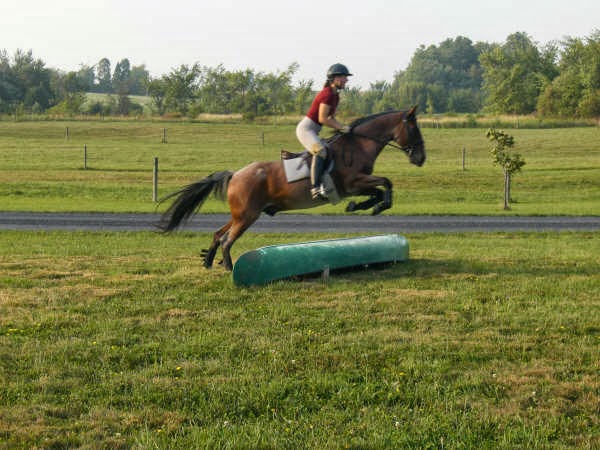
Tristan? Tristan does not like dressage. He puts up with it for short periods of time, but Tristan loves the great outdoors. He loves running fast and jumping things. So we came to eventing, which was our compromise. I got to do dressage, he got to do XC. And he’s a great XC horse: steady, willing, and a titch on the lazy side. When he gets into it he hunts the jumps, but he’s never going to be a fire-breathing dragon around course.
~9 months under saddle
Now, we do mostly dressage + trail riding. My goal is to keep him fit, happy, and supple, while enjoying riding him. That weighs in the direction of trail riding, but with the occasional dressage school.
If I ever got another suitable horse, I’d get back into eventing. I had the most fun doing that. I could never do it exclusively, though – I’d always want a horse that I could do straight dressage with from time to time, and I’d love to try my hand at some trail rides.

stupid human tricks

On Worry

I am a fretful, anxious person. Most of the time, I know the twists and turns of my own brain well enough to either quiet it or use it to my advantage.

I haven’t had the easiest time recently, with Tristan’s Cushings diagnosis and his bout of colic. I’m second-guessing every decision I make. I’m beating myself up for every extra step I don’t take. I’m staying up late reading, trying to absorb more and more information, trying to make the best decisions. It doesn’t help that my day job is at fever pitch right now.

Last night, I got to the barn and tacked up. He’d had three days off; Saturday and Sunday I was out of town, and Monday we just did trailer loading because I’d overscheduled myself on my day off. My plans were to mix in some hill work with some long and low.

Mostly, I carried them out quite nicely. We walked for a little while, then trotted up one big hill. We headed back down to the indoor and did a couple of laps of a nice stretchy trot. We did a few short bursts of canter, mostly to rev him up and stretch him out rather than to really work on the canter. He seemed to have a little more pep; he certainly started off walking with some nice swing through his back end.

We headed back out to the fields for a little bit more of a walk, and on a whim I decided to trot one last steep-ish hill. He’s trotted it more times than I can count, and cantered it a few times. A few strides into the trot up, he LOST IT. Grabbed the bit, bolted in that hard, sudden, rush of energy that horses can muster, let off a few bucks. I felt curiously calm and collected during it and never felt in danger of falling off. Mostly I gave a few hard half-halts and brought him back before he jumped the ditch and went into the road. (Which was deserted at this time of night; I wasn’t concerned about traffic, more about the hard packed dirt on his legs.) He gave a little half-rear at my final half-halt, and then stopped and blew out. Picking his front feet up in that way was really uncharacteristic of him.

The only thing I can think is that he got stung by something. It’s either that or his total 1/2Q per day of alfalfa pellets has warped his brain after only 4 days – but he wasn’t spooky at all during the ride, quite workmanlike. It was a 10 second blip in an otherwise nice and productive ride, and I dropped the reins and walked him for another 10 minutes just to make sure he had returned to normal. I still worried the rest of the night – if it had been an insect bite, was he ok from it? What if it was the alfalfa? How would I decide what too much is? What will he be like at GMHA?

I kept worrying, even after I got home and opened my computer again to work. I’m still mildly worried today. I wonder what it’s like to just ride your horse and be done with it, to feel entirely confident in the decisions you’ve made with your horse and go home settled.

blog hop

Now, That’s the Spot Blog Hop: What Do You Do Outside of Horses?

From Now That’s the Spot:

What other activities, hobbies, or sports do you do outside of riding?


I have to say, I have been reading everyone else’s answers to this and feeling boring and lazy, but here we go!
1. Reading
Lots and lots and lots of books. 2-3 books a week in a good week, for work and for pleasure both. I tend toward high fantasy, science fiction, and nonfiction. I have little to no tolerance for the sort of everyday drama that usually wins literature prizes, but I do read them from time to time, usually for book club. I’m in two different book clubs.
2. Crocheting

My grandmother taught me to crochet one Christmas. I was about eight years old. I crocheted furiously for a few years, little kid stuff, and then I left off. I picked it up again when I went to college in Vermont, and it was cold all the time and trendy to do yarn work. Most everyone else knitted, but I crocheted because that was what women in my family did. I’ve been going since then. Usually I do blankets for friends, and lately it seems I’ve done nothing but baby blankets.
3. Baking

Another hobby from my grandmother. Any and all kinds of baked things. I go through flour in 25lb bags, minimum, and can use 10lbs of flour in one day when I really get going. I bake all the bread we eat, and it comes in handy whenever I need a gift or to provide something for work. I usually bake 3-5 different things a week, usually some kind of bread or muffin to accompany dinner.
Those are the three big ones – see how boring? We also hike, watch movies, and I research side projects. I work a LOT, so that impacts my free time. No real other sports hobbies beyond walking the dog.
trailering

Trailer Loading Practice

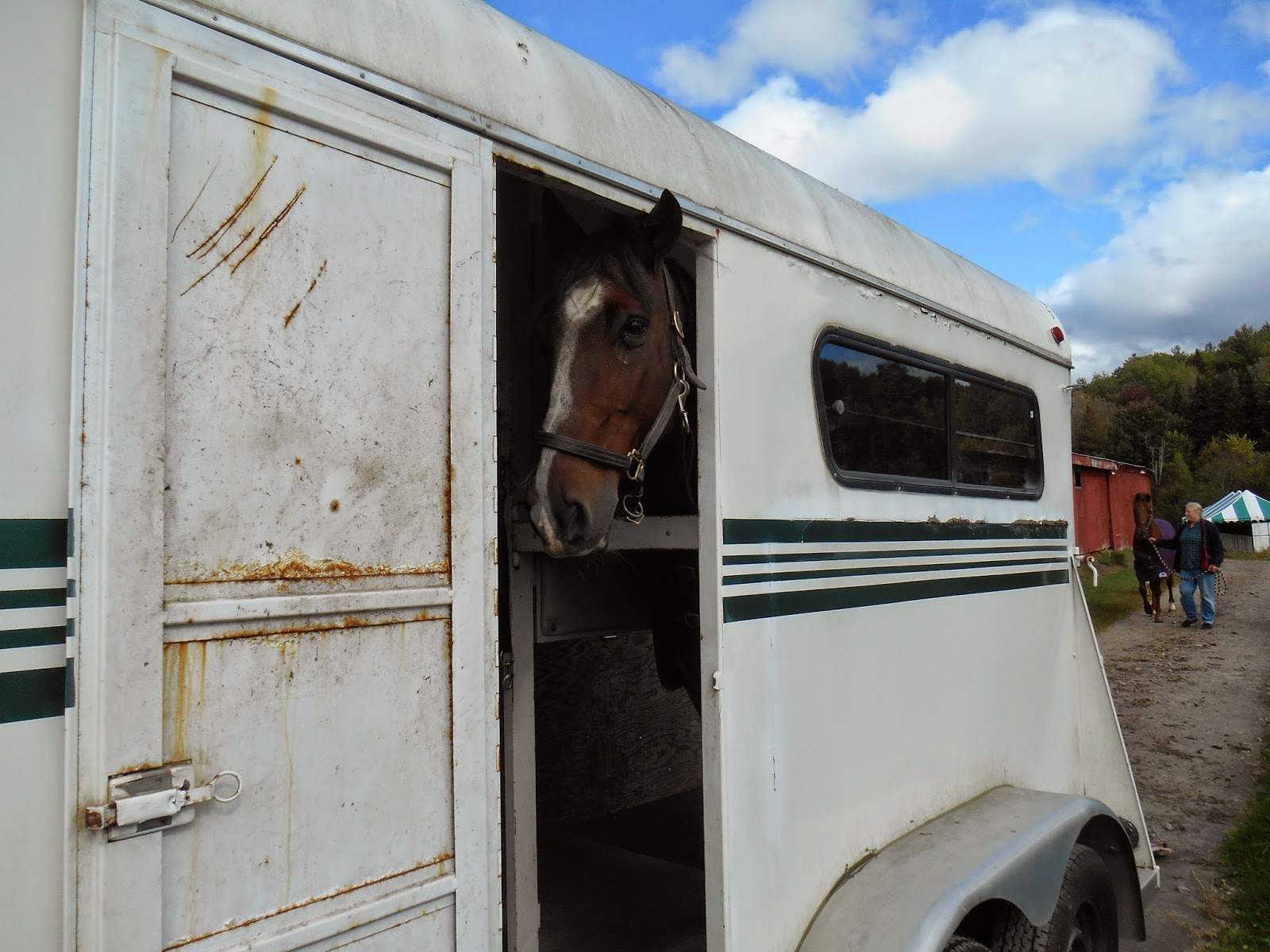
A barn friend and I are planning on hauling out to the GMHA Fall Foliage Ride this weekend. The last time Tristan got on a trailer was for his surgery, and the barn friend is leasing a new horse and had never seen him load. So I brought my truck out to the barn, hitched up the trailer, and we worked on loading with both of them.

Tristan is not great at loading. Over the years, he’s gotten much less dramatic, thankfully. Yesterday, he approached and backed off 3-4 times before finally walking on. I tend to take a very patient road with him and let him look as much as he wants. I never ask him to go forward until I see that he has softened a little bit. He only gets punished if he goes back, and then he gets shanked once or twice, hard, with the chain. Experience has taught me that if he gets away with backing up he will go from minor nuisance to full-blown dangerous in minutes, so I do not tolerate a single step back. Each of the times he “backed off” yesterday were him squirreling out to the side, and my choosing to turn and re-present rather than argue about lateral work. He only yanked back once, and regretted it.
Pawing, pawing, pawing…
We left them to settle in for just a few minutes, and I fed Tristan some treats. When I stepped away for a minute he commenced pawing, which is par for the course for him. When we’ve actually gone somewhere, he usually just chills once we’re there. God forbid, however, I load him to leave and then don’t pull away immediately. WHAM, WHAM, WHAM. I have done everything over the years to stop it and nothing has ever worked. Pawing is his annoyance behavior of first resort, whether he’s in a stall, in the wash rack, or on a trailer. It’s just part of him.
He backed off the trailer beautifully, again according to pattern: one hasty backup into the butt bar as soon as he hears me back there, I jab him in the but with a knuckle, and he steps up. Once I’m sure he’s settled, I drop the butt bar and pull on his tail and tell him “back.” He backs delicately down the ramp in mincing, careful steps, leaving me plenty of time to grab the lead rope I leave tossed over his neck.
I need to make a few purchases to update the first aid kit – instant ice bag and electrolyte paste, primarily – but other than that we should be good to go on Sunday!
nutrition

Feeding & Nutrition Update

Since I’ve put a fair amount of thought into this recently, and since I am avoiding writing a 30 minute presentation on the War of 1812 I have to give at the end of the week, I thought I’d do an overview of what Tristan is eating right now, and why I’ve made those decisions.

When Tristan was diagnosed with Cushings, I spent a lot of time thinking very thoroughly about each aspect of his diet. There are some pieces of it I still have under review, but overall, I’m happy with where we are right now.

First things first: forage. Tristan gets 2 flakes of grass hay AM and PM. When it’s cooler at night, he gets an extra flake or two at night check. When I ride him in the evening, I often (but not always) toss him an extra flake to work on.

Throughout the summer, he was on about 5-6 hours of grass turnout per day. He was pulled off the grass by 1pm each day at the latest, and because he was already going out with the other Cushings horse in the barn (he and the other gelding were until recently joint gay uncle babysitters for the yearling filly), he was always turned out in the medium-to-poor grass pasture anyway.

Grass turnouts

Now that it’s starting to frost over at night, the barn manager is evaluating each day on an individual basis. If the weather has been ok, and the grass hasn’t been stressed, they still get to go out on it. If there’s been a frost or chill overnight, Tristan and Pari are put on a dry lot with 2-3 flakes of hay each. (In effect, it’s free choice hay while they’re turned out, since it’s usually fed in a hay net or multiple small piles, and they check on it through turnout.)

I went back and forth, but ultimately made the decision NOT to test the NSC levels of the hay he’s eating right now, for a bunch of reasons: his ACTH levels were very low, he was handling the pergolide beautifully, and I didn’t have a lot of options for an alternative supplier. If he really truly needed every speck of his diet controlled, I would test the hay and then go to either soaking it (really, really impractical and darn near impossible in Vermont in the winter) or buying my own low-NSC hay through a national distributor like Standlee. I strongly suspect this course is in our future, but for now I opted to change as few variables as possible and wait for his updated ACTH blood test before taking drastic measures. The barn has also tested batches of hay from this distributor in the past, and they’ve all come back low NSC, which gave me a measure of confidence that future batches would be as well. (Yes, I realize it can be different for each cutting, but this farmer has a history of consistency, which was enough for me for now.)

LOVE these guys.

Tristan is still on his customized supplement from HorseTech. The base is their High Point Grass/Mixed Hay supplement which is designed to basically fill in nutritional needs for a horse that’s eating exclusively grass and/or hay. I worked with HorseTech to add a few things to it: I doubled the Vitamin E content up to 1,500 IU a day after quite a bit of research, in order to help support his muscle growth. I also added in 20mg of biotin a day, and HorseTech suggested bumping up the lysine and methione as well, all to support hoof growth as he continues to struggle a bit after his surgery.

Finally, his grain. The barn feeds Blue Seal feed, which is not my favorite but is perfectly fine. Pre-diagnosis, he was eating 1/2 quart AM + PM of their senior feed, Sentinel LS. Post-diagnosis, he initial went on the Performance LS but after checking in with the vet we switched him to the Carb Guard. He has been on that before and I knew he’d eat it up, even though it is more bland. Until last week, he was at 1 quart AM + PM (at 1.3lbs per quart, so 2.6lbs per day). After getting some opinions and finally talking to my friend J., we’re bumping him up to 1.5 quarts AM + PM (so a total of 3.9lbs per day).

The last addition is something else designed to help him add a little bit of weight before winter comes. He’s not skinny, but he is just a teensy bit ribbier than I want, especially headed into winter. I’m not a believer in really bulking a horse up to the point of obesity before winter, but knowing how he dropped weight last winter I want him to have a little more fat over his ribs. Right now, you can see his ribs just slightly when you look at him obliquely, and you can feel them if you press in.

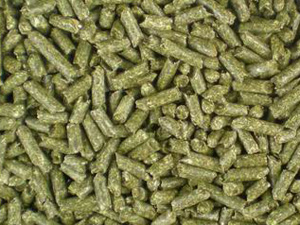
So in addition to the Carb Guard, he’s getting 1/4 quart of alfalfa pellets AM + PM. If I like the way he’s adding weight on that, and if it does the impossible and adds some energy even better! We can always keep adding that over the winter, and he can get some at lunch as a snack in the winter if he needs. I chose pellets over cubes or straight up hay because it’s easy to give with his grain, and the barn keeps it on hand already.

The biggest question area going forward is how to handle hay and grass going forward. For now, I haven’t made any real changes other than being careful about turnout when the sugar content of the grass is high. However, it’s perfectly possible that I will have to really re-examine his options going forward.

So, for now:
2 flakes hay AM + PM
1.5Q of Carb Guard AM + PM
1/4Q of alfalfa pellets AM + PM
1 scoop High Point Custom Blend AM + PM
grass turnout or free choice hay

blanketing

How to Re-Waterproof a Turnout Blanket

My good friend J. dropped off a few turnout blankets for Tristan last week. They are in need of some minor repairs, and re-waterproofing. I dropped one of the blankets off for repair (I don’t have a sewing machine that will punch through the strapping), and yesterday tackled the first of the re-waterproofing.

I thought I’d do a bit of a guide, since many blankets lose their waterproofing after only a season or two but are otherwise good blankets. Since a wet horse is almost always a cold horse, keeping a blanket waterproof is important.

Step 1: Clean the Blanket

No matter what waterproofing you choose, this is important. The waterproofing chemicals have to bond directly with the fabric. So if it’s at all dirty or dusty, toss it in the washing machine before you get started, and let it dry thoroughly.

Step 2: Select Your Waterproofing Method

Waterproofing stuff comes in a variety of options, but the vast majority are going to be a spray-on application. I went to Walmart and spent some time in their camping section reading labels. I chose this one because it had the most volume and only needed one application. I paid $5.97 for this can, which is 13.125 ounces. I used almost all of it on one 72″ blanket, so I’ll need to go back and get more!
Step 3: Apply Waterproofing

Find an airy and sunny place outside – this is the front porch of my family’s house in Maine, where I was this weekend doing wedding stuff. It’s very important that the weather be sunny and dry for a period of several hours, as this stuff really needs to dry very thoroughly or the waterproofing is ruined. It’s also really something you can’t do inside, as the chemicals stink and can be dangerous to inhale.

Hold the can about 8″-10″ away from the blanket and spray the waterproofing on. Make sure you completely coat the blanket and get the fabric good and wet, every nook and cranny. In the past, I’ve waterproofed items by spreading the out on the grass, but I had the porch here and the yard was covered in dew.

Step 4: Let It Dry Thoroughly

Most systems strongly suggest a full 24 hours of drying time. This is something that should be done well in advance of actually needing the blankets. A sunny day is really key here: you can get it a good couple of hours of drying outside at least. I pulled this blanket inside when we were ready to leave for Vermont, and it’s ready to head to the tailor to fix a few small rips on the inside lining that I discovered while washing it.

Any questions?

blog hop

Blog Hop: Move Your Hoof to the Beat

I love this blog hop, from Alyssa at Four Mares, No Money. What songs make you think of your horse? What songs do you ride to?

First, Tristan’s song, the one that makes me think of him, is “Easy Silence” by the Dixie Chicks.

The easy silence that you make for me
It’s okay when there’s nothing more to say to me
And the peaceful quiet that you create for me
And the way you keep the world at bay for me.

As for songs I listen to while I ride? I don’t listen to music, but sometimes when Tristan is fidgety, I sing to him. I always sing Cole Porter mashups, seguing from one song to another depending on the pace and what lyrics I can remember at the moment.