nutrition

Equine Nutrition on Coursera

Thanks to those who recommended the Coursera class on “Equine Nutrition” from the University of Edinburgh. I’ve signed up and will start a bit late but dig right into the first week over the weekend.
I’ll blog about it as I proceed and try and share a bit of what I’m learning, and whether I’m finding it useful.
Thanks to those who offered other resources as well – I’ll definitely be moving on to them once I get these basics down.

Here’s the syllabus for anyone who would like to join me:

Course summary 

This course will cover many aspects of equine nutrition ranging from anatomy and physiology of the gastrointestinal tract to dietary management of horses/ponies affected with nutrition-related disorders. This course is designed to provide knowledge of equine digestion and nutrition for those with an interest in this area. The anatomy and physiology of the equine alimentary canal will be studied to provide students with a detailed understanding of the equine digestive system. Nutrient sources for horses will be discussed, with emphasis placed on the health and welfare issues surrounding the inclusion of various types of feedstuffs in equine diets. Students will also discuss recommendations on rations for horses and ponies performing various activities and will be able to make recommendations on rations for horses and ponies in health and disease. 

Course learning outcomes 

The intended learning outcomes on completion of this course are that you should be able to: 

  1. Discuss the anatomy and physiology of the equine gastrointestinal tract and appraise its limitations in relation to nutrient digestion.
  1. Explain the nutrient content of feedstuffs for horses and appreciate the different methods of evaluating this. 
  1. Recognise and critically appraise nutrient sources for horses and ponies.
  1. Describe the general nutrient requirements of horses and provide general guidance on rations. 
  1. Discuss rations for horses with specific nutrition-related disorders. 

Course topics 

Course assessment 

There will be multiple choice assessments (quizzes) at the end of each week course to test the knowledge you have gained during that section. This will be graded examinations that will each contribute 20 % to your overall course mark. You have three attempts at the each of the quizzes and the best score of the three will be used for your assessment. However, you can re-take the test as much as you want to review your learning. The quizzes will remain open for the full 5 weeks that the course is running – so you can complete them when you feel ready. The pass mark for each quiz is 60 %. 

There will also be weekly quizzes to test your knowledge that are not graded, but are there to aid your learning and prepare you for the graded quizzes. If you have any questions about the assessment process please post these on to the assessment discussion board for the course tutors. Again, whilst we can’t answer individual questions we can pick up on commonly asked questions and address these in a general post to everyone on the course 🙂  

Statment of Accomplishment 

Students successfully completing all the assessment quizzes and gaining at least 60% in each quiz will qualify for a Statement of Accomplishment.  A link to this downloadable certificate will be provided to each successful student around one week after the end of the course.  Students interested in gaining a Verified Certificate should consider signing up for Signature Track during the first two weeks of the course – follow the links at the top of this page for more information and to sign up. 

mustangs

How to Identify and Read a Bureau of Land Management Freeze Brand

When I introduce people to Tristan, they always seem surprised that he’s a mustang. Fortunately, he has permanent proof of his ancestry in the form of a freeze brand on his neck. All mustangs that have been rounded up by the Bureau of Land Management (BLM) as part of an approved gather are given a freeze brand on the left side of their neck, just below the mane and about 6-12 inches below the ears.

What is freeze branding? Many people are familiar – from the movies, if nothing else – with hot branding: heating a piece of iron and then applying it to an animal’s skin. The brand burns through hair and then into skin, creating an outline of scar tissue in whatever shape is necessary: a ranch’s ID, for example, or a number. In horses, the most common are breed association brands. There’s a good list of them on the NetPosse website. It’s not a painless process, but it is relatively quick and very common.

In freeze branding, the iron is super-frozen using liquid nitrogen, dry ice, or some other chemical coolant. When held to an animal, instead of burning through to the skin, it kills the pigment-producing part of the animal’s hair, and leaves the hair white in the shape of the brand. They are slower to work – you have to hold the brand on longer to get the desired result, and they don’t appear immediately, but rather as the hair grows in. It’s less painful (some resources say totally painless) but trickier: because you have to hold the iron for longer, there’s a chance of smudging.

In America, only range-gathered BLM mustangs have a consistent system of freeze branding. (In Australia and New Zealand, Thoroughbreds & Standardbreds are marked with freeze brands.) This is not to say that if you see a horse with a freeze brand, it’s automatically a BLM mustang. Some owners choose to freeze brand their horses (usually in different locations and with a different system). Some mustangs are never freeze branded (if they were born in captivity, for example).

BLM mustangs are freeze branded on the left side of their neck, about an inch or two below the crest, and about 6″ below the ears. There’s no precise measurement (Tristan’s is further down than 6″ for sure, and I’ve seen some much closer than 6″), but if you see a horse with a freeze brand near the crest on the left side of their neck, you’re probably looking at a BLM horse.

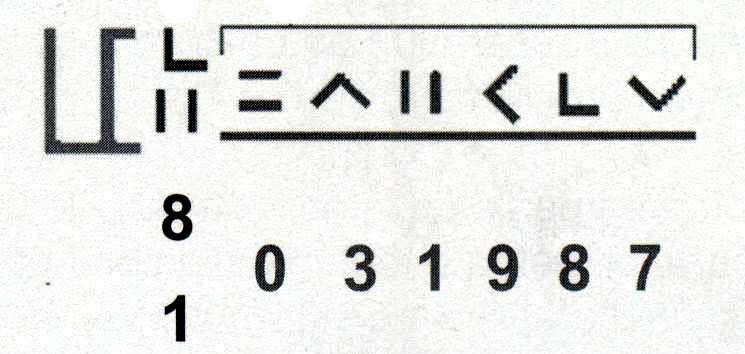
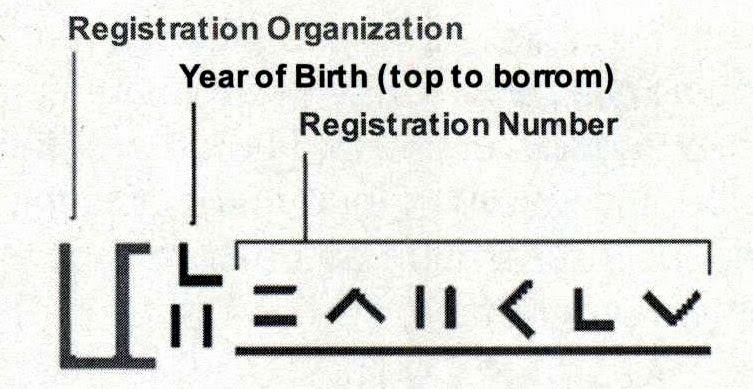
Every BLM freeze brand is unique. They’re meant as a permanent identifier of an individual mustang. Knowing how to read them can tell you a lot about the animal you’re looking at. There are three basic parts to any freeze brand. Here’s a good breakdown:

“Registration Organization” in this case is always the same: US Government. That peculiar sort of LC at the beginning of this diagram is the government-specific ID. So that’s another clue that you’re looking at a BLM mustang. (There are ID marks for other breeds and states, by the way, but I’ve never seen one in person.) But what do the angles and lines mean – how are those translated into numbers?
The BLM uses something called the “International Identification System” which they all the “International Alpha Angle System.” It was developed by Veterinary Cryobiologist (really!) R. Keith Farrell of Washington State University (along with a few others, such as an FBI agent and a few people from breed associations) and first published in the Journal of Forensic Science in January 1981. (Here’s the abstract.) 
Basically, Professor Farrell was trying to promote an international system of identification for horses that could be registered and tracked in order to prevent crime. His argument was that commonly used identifiers such as color, whorls, chestnuts, and other markings were unscientific and imprecise. He proposed his alternate angle system as a way to get everyone on the same page. As you can guess, it hasn’t really caught on widely in horse circles – have you ever seen a non-BLM horse with one? Kryo Kinetics USA LLC tries to carry on that work today, and will register your horse for you if you choose to have it freezebranded.
Anyway, enough history. What do the angles stand for? It’s a very simple system.
So let’s look again at the freeze brand above, this time deciphered using the angle system:
Ta-da! We’re looking at a BLM mustang that was born in 1981 (the first year they began using the angle system, incidentally) with a registration number of 031987. There’s one more step to learning more about this particular animal, though. The BLM assigns registration numbers according to the state the mustang was gathered from.
Arizona
80001-160000
California
160001-240000
Colorado
240001-320000
Idaho
320001-400000
Montana
400001-480000
Nevada
480001-640000
New Mexico
640001-720000
Oregon
0-80000
Utah
720001-800000
Wyoming
800001-880000
Eastern States
880001-880100

So, armed with that information we know we’re looking at a BLM mustang that was born in 1981 and rounded up in Oregon. In theory, the BLM should also maintain a database of the horses they gather, and should be able to tell you when a particular horse was rounded up based on its registration number. In practice, good luck getting them to answer your phone calls. (I’ve generally found them unresponsive in the extreme.)
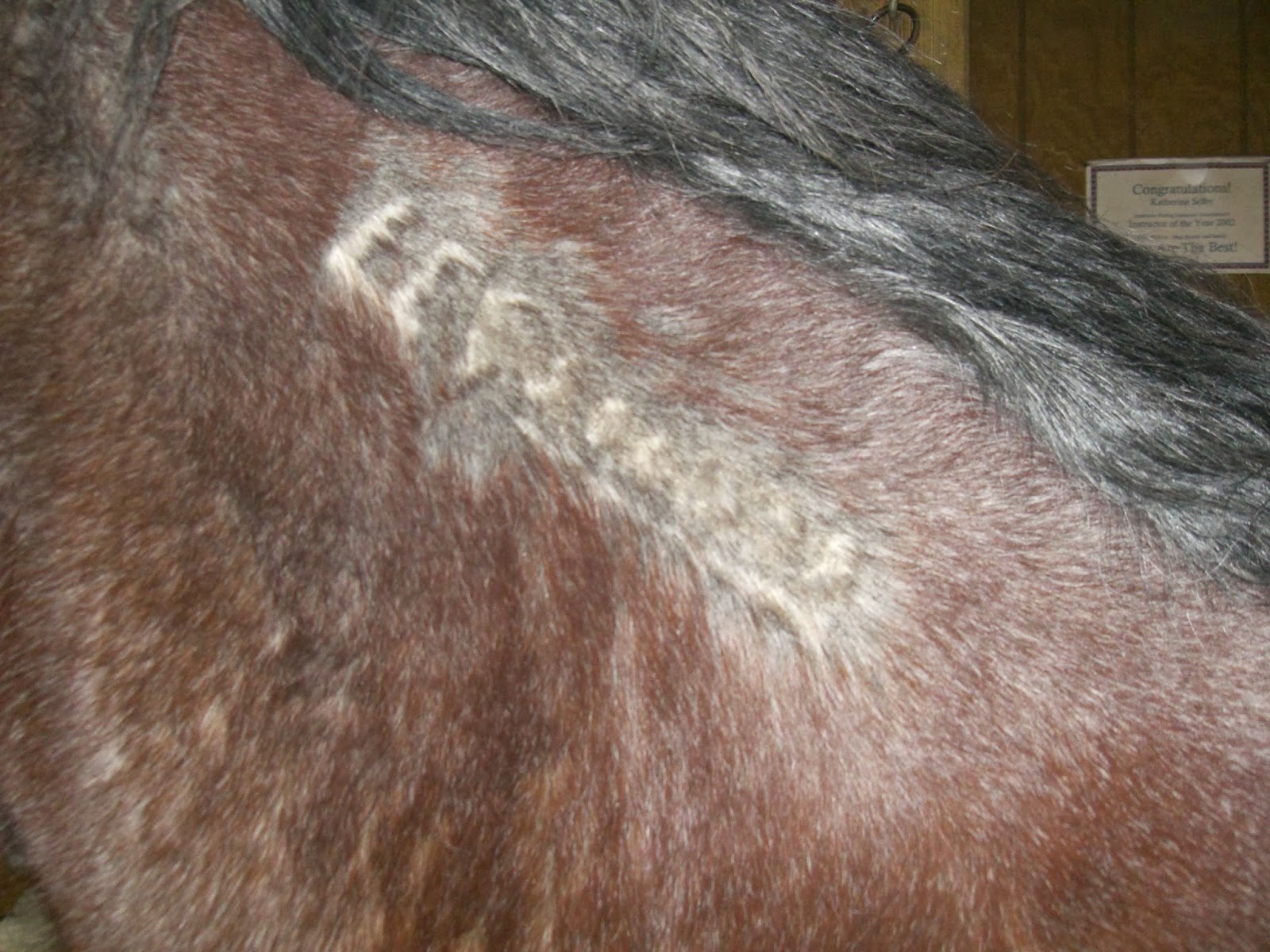
What does this look like on actual horses? Let’s use my own wild pony as an example!
Yeah, not as easy, is it? I’ll grant you that this photo doesn’t help, but I’ll also tell you that it’s not that much easier to tell in person. In fact, since he was shipped to me, I haven’t clipped down to the skin on his neck to get a good clear look at his brand. This photo was taken a few days after he arrived. You could argue that this is the best it will get. His roaning makes the numbers blur into the hair around them. Beyond maybe a flea-bitten gray horse, roans are the toughest on which to distinguish freezemarks.
The first few are easy. There’s that government LC, right up front. Then the year, 95.
Then the next two are straightforward: 5 and 5. In better light, you can tell the next one, too: it’s an 8.
After that? Honestly, the next two are kind of a blur to me, too. The last one is easy again: another 5.
I’ll take a shortcut and tell you that his full, registered, identification number is 95558535. He was foaled in 1995, and rounded up in Nevada, per that 55 number which is smack in the middle of Nevada’s range. (Some vast majority of all mustangs still wild in the west today are in Nevada, so Tris is a pretty typical example.)
That’s all the freeze brand will tell you. You can, in theory, go back to the BLM and ask them for more information. If they’re feeling generous they can look up more for you, like potentially the gather (or roundup) information, maybe the original title holder. Again – I’ve never been able to get much out of them. (I have more information on Tris that I’ll share at a future date, but I have that because of the paperwork that came with him, not because of 
But this is a start. Let’s look at one more freeze brand that’s an easier read. (Taken from a random Google Image search; I don’t know this horse personally.)
Much easier, huh?
So this one: 97 year of birth, followed by 566684. Another Nevada horse.
So now you know. Google Image search for “BLM freeze brand” to your heart’s content and learn about the mustangs that come up, or impress horse people at cocktail parties, or maybe put that knowledge to good use someday when someone needs to know more about a horse they’re looking at.
Any questions? Anything else I can shed light on?

nutrition

Recommend an equine nutrition source to me

I have to finally face facts and realize that in 2014, Tristan turns 19. He’s no longer a young horse. He’s not quite a senior (in my eyes, anyway), and he’s always been a healthy easy keeper. But that bit of scare with weight gain in late fall/early winter has made me think harder about his nutritional needs.

I’d like to learn more. I’m scouring the internet, but I think it’s time for a purposeful study.

What resources do you use to learn about nutrition? Do you have a book, a website, an online class that you’ve found especially useful?

I’m most interested in balancing nutritional needs for the working sporthorse, but I’d like to learn a bit of everything.

Any suggestions appreciated!

2014 goals

2014 Outline

Last day of subzero temps, according to the weather app! I am ready to get in more riding and less whining. (And less baking, and eating of things I bake. Yikes.)

I already wrote about my 2014 goals, but this is a more general outline with some potential dates for things – and other stuff I need to keep in the budget.

January

Stick to a consistent schedule; build topline & fitness; take a few lessons.

February

Ditto January: Stick to a consistent schedule; build topline & fitness; take a few lessons.

If all goes well, try a few jumps under saddle at the end of the month.

March

Spring shots & teeth. Get the trailer registered and potentially taken out to get inspected/repaired. Re-up my US Rider

Continue topline & fitness, but we should be well on our way by now: capable of a full 60 minute lesson without too much exhaustion on either part.

April

Start hacking regularly, whenever possible. Plan on minimum of 60 minutes out for each hack, 2x per week.

Pull shoes, if all goes well, and get back to barefoot.

Continue schooling under saddle, fine-tuning dressage. IF jumping is a go, jump 1x every two weeks minimum.

Possible events for riding or volunteering: GMHA Mud Ride (April 26-27), VT Everything Equine (April 26-27)

May

Get off property for trail rides 2-3x. Continue dressage. If jumping is a go, haul out for jumping lessons w/ instructor in Vergennes.

Possible events for riding or volunteering: VERDA Bare Bones Endurance Ride (May 11), Hitching Post Horse Trials (May 17-18), GMHA Spring Horse Trials (May 31-June 1)

June

Unfortunately I already know that most of June will be a wasteland due to a massive work event at the end of the month. The goal for this month is to keep my head above water: stick to a schedule and keep him fit.

Possible events for riding or volunteering: East Hill Farm Schooling Dressage (no dates yet), Vermont Morgan Heritage Days (June 14-15)

July

Work commitments ease considerably, and we should be able to pick up the pace here. If all is going really well we can turn the screws and think about the GMHA show at the end of the month, OR think about getting out and foxhunting.

Possible events for riding or volunteering: Huntington Horse Trials (July 11-12), GMHA Dressage Days (July 25-27),

August

Keep turning those screws, keep hauling out to jump with Vergennes trainer, keep fine-tuning the dressage. Foxhunting if possible.

Possible events for riding or volunteering: Vermont Dressage Days (August 9-10), GMHA Combined Driving Event (August 23-24), GMHA Distance Days (August 29-31)

September

Lots of options for getting out and about this month, depending on how we want to structure it. Do we want to do more low key stuff, or do we want to show off a bit? Some really good schooling show options if we choose to go that route.

Possible events for riding or volunteering: Eddy Farm Schooling Three Phase (no dates yet), Equestry Schooling Dressage (no dates yet), East Hill Farm Schooling Dressage (no dates yet), GMHA Fall Hunter Pace (September 7), GMHA Horse Trials (September 13-14), GMHA Fall Foliage Ride (September 26-28)

October

My brother is getting married early in the month, and that may basically suck all the horse joy out of the first two weeks of the month. We’ll see.

Possible events for riding or volunteering: GMHA Dressage Show (October 4-5), Lucinda Green Clinic @ GMHA (October 8-9), GMHA Fall Foliage Ride (October 10-12), GMHA 50 Mile Ride (October 18)

November

Trainer heads back to Florida. Things start winding down here. My goal will be to head into next winter with Tristan in good weight and fitness, and to have a specific series of goals to tackle through the winter.

December

Winter is coming.

massage · topline · winter

Back in the saddle agaaaaaain

I rode my horse!

Well, we walked around bareback for 40 minutes, but damn it, I sat on him and he went. 
I canceled my lesson on account of not being able to take a deep breath, but I forced myself to the barn, got a bridle and a quarter sheet, and kept Tris at a lively forward walk for 40 minutes. The last 10 I even picked up the reins and we had some small but accurate steps of leg yield and some thoughtful serpentines and changes of direction. Victory!
Then he got a massage. Despite having the previous week entirely off, J. was still pleased with his muscle tone and the places he’s added muscle. He’s clearly getting a ridge of muscle along his spine, and adding some bulk to either side of his withers. He’s starting to get that butt groove in his hindquarters that shows separate ropy muscles. He’s also added weight, finally. He was never what I would call worryingly thin, but I kept wanting just a touch more…and now he’s pretty much there. His ribs are buried, the top of his butt has smoothed out. He’ll stay on his elevated levels of grain and hay through the winter and then we’ll take another look at him in the spring when the grass comes in.
Another positive (?) sign was that he was much more sore and tight than he has been, in front of his shoulders (his usual) and in his hindquarters, particularly his hamstrings. That said to both of us that he’d been in hard work before his break. Which is kind of what I wanted to hear.
We also talked a bit about how his right shoulder is consistently more tight and sore than his left shoulder. It’s been 18 months since that first abscess but J. thinks at this point it’s residual; there’s nothing new brewing in the RF (THANK GOD) but more that it’s in the “old injury” category at this point. If he were being pointed at the Olympics or WEGs, we’d be on it every day with massages and stretches and cold laser therapy, but…he’s not. I’ll stay on top of it in our daily work and I’ll be more careful about working on it a bit before and after our rides, and we’ll see where we go from here.
Then I went home and did not move from the couch for the rest of the night. Oof. Today, highs in the mid single digits; tomorrow, the forecast keeps changing. But starting Thursday, we’ll be reliably double digits again, so back to work for both of us!
winter

Still Not Spring

This has become basically the most boring horse blog of all time. I’m sorry! Last night, it was warm enough to go ride my horse…but the sideways snow and the hacking cough got the better of me so I went home instead.

Today, I have only left the couch to accompany the boyfriend to go see Frozen. Which you should go see, if only for the Fjords, they were totally adorable. (It was a good movie too. But Fjords!)

Besides, our high was 7 for the day, and the hacking cough is way worse.

Tomorrow: work on my day off, followed by a massage for Tristan, which was supposed to be preceded by a lesson. But the high is 12 and I should probably not be engaging in athletic endeavors. Potentially by Thursday the temperatures will start to crawl back up into the teens and stay there, and God willing and the crick don’t rise (it can’t, it’s frozen) I will kick this cold.

Sigh.

Here, have a picture of our bucket ice pile. I know people say you should have potable water in front of your horse at all times, but those people clearly haven’t lived in a place without an electrical grid that will support heated buckets…in an environment in which ice forms on open water in ten or twenty minutes. They refresh the buckets constantly during the day, and swap buckets around all the time to keep the ice buildup down, but winter, it is not to be messed with.

chores · winter

As Vermont Turns

Good news! It’s back in the double digits and I have packed barn clothes and I miiiiiight be able to sit on my horse tonight.

Bad news! It’s snowing and the wind chill is way low…and I am coming down with a nasty cold.

Please oh please, weather and/or bacteria, I just want to ride my horse, even if it’s bareback around the ring for 30 minutes.

I did stop by the barn last night to kiss Tristan on the nose and commiserate with the barn manager. She’s had a very long week and I reminded myself to be grateful. Cold and cranky as I was, I have an indoor job and a warm apartment and was not mucking stalls all week.

She mentioned that they will be looking for people to fill in more frequently on shifts – particularly Sundays. My regular work schedule is Tuesday – Saturday, and to be honest, I frequently am at work on Mondays as well. I’ve worked the last three Mondays. So committing to a regular Sunday shift at the barn would mean giving up my only reliably free day, and my only length of time with the boyfriend. It would also mean no church, and while I am not a really religious person by any stretch of the imagination, I like the people and the atmosphere.

On the other hand, regular shifts would mean regular lessons, which would make a huge difference in my work with Tristan. It would add extra exercise in to my week, which I am sorely in need of. It would mean spending time with terrific people and with my horse. I’ve certainly done it before, even many days a week, but I didn’t love it.

I’m very torn. My first instinct with everything is to go-go-go, push harder, work harder, and go bigger. But I’m pursuing so many things right now that the smart choice might be to know when to back off – pick a few dates each month and not commit to a weekly shift.

Have you traded barn work for lessons? How do you keep your barn-life-work balance?

humor · video

Evention Tv

This may not be new news to anyone who reads Eventing Nation, but I finally got around to watching a few of the Evention Tv shows and I laughed until I cried. (Thanks to Saiph’s post at Wait for the Jump about finding the humor, which helped kick me out of my grumpiness about the weather and sent me to watch these.)

Here are just a few of my favorites.

They also have a variety of educational videos that are really quite well done and informative. Check them out when you’re looking for something to do on these cold nights!
Uncategorized

Movie Review: The Horse Whisperer

The Horse Whisperer (1998)
(available on Amazon to view instantly or to buy)

If you asked the average person to name a big Hollywood movie about horses, there are only a few that would come up. One of the few is The Horse Whisperer, based on the Nicholas Evans novel of the same name.

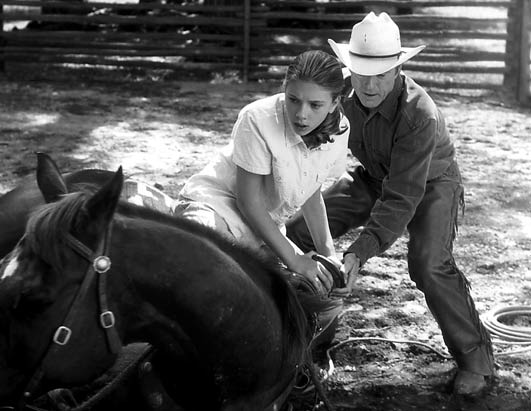
The gist of the plot is that a young girl named Grace (a very young Scarlett Johannsen!) and her horse get into a horrific accident. Both are badly injured both mentally and physically. Grace’s mother (Kristin Scott Thomas) brings her and her horse, Pilgrim, to a “horse whisperer” (Robert Redford) who will try to heal them.

On one level, this is actually a pretty good movie. It’s absolutely gorgeously shot, and the acting is outstanding. The emotions of all the characters are keenly portrayed and felt, and it’s a good human story.

On another level? The horsemanship in this movie is absolutely batshit insane.

SO MANY BAD DECISIONS.

Let’s start at the beginning. The accident that Grace and Pilgrim suffer is…realistic in the sense of if everything went exactly as wrong as it could go, it could happen. It is extremely difficult to watch, and if you’re at all triggery about injuries to horses (and their riders) you wouldn’t get past the first 10 minutes.

After that is where it flies off the hinges. Because, you see, Grace’s mother refuses to put Pilgrim down, even though his injuries are truly awful, and everyone with actual horse experience advises her to put him down. As a horse person, it made me instantly loathe her, because everyone advising her was right: she was putting the horse through incredible amounts of suffering just so she wouldn’t have to make a decision. As Pilgrim is recovering, he becomes a dangerous, unpredictable animal.

The movie then posits that the horse’s recovery and Grace’s recovery are linked, somehow. So they pack poor Pilgrim up and drive him cross-country to see the horse whisperer Tom (in a stock trailer that they haul from Long Island to Montana without, apparently, ever stopping to water or feed the horse…or check on it…since the idea is that no one can even touch Pilgrim, he’s so crazy).

Tom then natural horsemanships the poor thing, complete with aggressive round penning and a whole lot of posturing. During the whole movie-long training & bonding sequence, no one ever apparently brushes the poor horse…or treat his wounds…or touches him until what is apparently many weeks (if not months) later. So the horse survived a really really awful accident through initial at-the-scene treatment (done by sedative) and…nothing else for many months. Sigh.

There is also a typical movie ending: Pilgrim passes through crisis after crisis but after one final crisis in which he is roped and brought down by Tom, he magically becomes precisely the horse he was before the accident. Grace rides him around the ring perfectly and everyone looking on sheds a single, crystalline tear. It is a wildly inaccurate and borderline dangerous portrayal of what natural horsemanship can accomplish, and how to behave safely around a traumatized animal.

But then again, Robert Redford looks damn fine on a horse.

throwback thursday

Throwback Thursday: Sly

I think there are horses that you love, and there are horses you fall in love with.
This is Sly, aka “Sylvester Rap,” an Appendix that remains one of the most special horses I have ever encountered. By the time I met him, he had a long career behind him in nearly every discipline and was the consummate dressage schoolmaster. He had the chops and the gaits to go up to FEI level, but his heart was stronger than his body and he just couldn’t stay sound.
I leased Sly for two years and he taught me more than I can say. It was after he finally went irretrievably lame that I decided to adopt Tristan. I still worked on rehabbing Sly even as I started Tristan, and in the first few months when my relationship with Tris was still rocky, it was Sly’s shoulder I went to cry on.
Which is not to say that Sly could not be a mischievous, naughty, and spunky little brat. He was the horse that could buck for the joy of it – he could perform the most incredible acrobatics above ground while keeping you perfectly centered and balanced in the saddle – or he could buck to dump you. And when it was the latter, you were gone within a stride or two. End of story. He was the epitome of the push button horse whose buttons were very particular and very difficult to find.
He is unfortunately also my lesson in “better a day too early than a day too late.” He was let go too late, and the memory of watching him try to canter to the gate from his corner of the pasture, eyes still bright but body clearly failing by the day, still brings me to tears.
Even all these years later, I miss him.