admin · design

New blog design?

I’ve been toying for a little while with redesigning the blog. Right now, I like the physical layout for its functionality, but the “look” of it is an out-of-the-box Blogger template.

I’ve messed around with Photoshop a bit, but it’s been years since I’ve really had the chops to do much in that department – and to be honest, I never had the eye.

I’ve also got a name change in mind to make it reflect more clearly what I’m trying to do, and I’d like to do a bit of graphic design with a not-quite logo that – well, it will become more clear as I implement all this.

Has anyone done a blog redesign? Do you have any advice? I have a very little bit of money (around $50) from my tax return that I can spend for a bit of custom design but I realize that doesn’t get me very far…any advice on that end?

coursera · nutrition

Equine Nutrition on Coursera: Week One

So I signed up for the Equine Nutrition class from the University of Edinburgh through Coursera, as I mentioned.

Verdict after one week: loving it.

I’ve increased my knowledge exponentially and we’re only 1/5 of the way through the course. I’ve been thinking and looking back over my notes a ton since watching the videos. They have great information delivered in bite-sized chunks that are directly applicable to what I want to know.

I’m excited for week 2, and plan to start watching videos tonight!

Is anyone else taking it?

dressage · lesson notes · shoulder in

Lesson Notes: Shoulder-In and Counterflexion in the Canter

The plan for the lesson was to warm Tris up thoroughly over his back before it started, and then drop the stirrups and do a 30 minute lesson in shoulder-in and work on the canter a bit.

It mostly succeeded. The catch was a bit that I didn’t get him really through and supple enough in my warm up, so we spent the first bit of the lesson working on leg yield at the walk and then trot to get him connected and responding. Then we switched over to shoulder-in, starting at the walk.

Tris and I have both ridden shoulder-in before; it’s not new to us, but it’s been a long time and we haven’t really ever had good eyes on the ground when we’ve schooled it. Plus, I’m finding that most things are a bit of a re-learning, both because we were out for so long with his injury and because the new barn is much more dressage-focused than the old barn.

So, shoulder-in went reasonably well; Tris had a tendency to be overbent through his neck and not get his haunches through. I had a tendency to hunch to the inside and let my outside leg flop around uselessly. Correcting the shoulders through the outside aids and tapping with the crop helped straighten him out, and discipline corrected some of my postural problems.

It really got cooking in the trot, though: Tris had enough forward energy to really load his hind end, and when I got him lined up, BAM, I could feel the sizzle in his hind end as if I had unstuck a cork. In fact it became a bit too much at times and he got fizzy and rushed and disorganized at the end of the long side, so we then incorporated half-halts every stride or two to collect the trot more. It felt like every pass we made was better than the last and with great substantive improvement. I was feeling his body much better and able to catch when it was going out of alignment, I was sitting more deeply and through and straight, and we had some very nice passes. Best of all, I was really connecting through my core in the shoulder-in – feel the burn!

Tris was huffy and puffy from working so hard through his hind end and over his back in that shoulder-in, so we walked for quite a while, and then picked up some canter work. The goal here was not necessarily to school, but rather more to demonstrate where we are in the canter. Right canter met with approval: I am more straight and deep in the saddle, more even in my hands and seatbones. He’s more supple and more flexible and on the outside aids.

Left canter was better than it has been, but still not nearly the right canter. So we did end up schooling that direction for a bit, as he flung his shoulders around on the circle and was not nearly as sharp to the aids in the transition. Trainer had us school counterflexion and back for a bit to get control of his shoulders, and once I got the feel of it, applying it correctly really unlocked some nice things in his left canter. Basically, before each “point” in a 20m circle, counterflex for one stride; then correct flex for the “point”; then counterflex the stride afterwards. It was a way really emphasizing my outside aids, and not allowing his shoulders to rule the day.

So it actually ended up being more like 45 minutes, all without stirrups. Hoorah and huzzah! I felt great, and especially loved schooling the canter without stirrups. It’s not an all the time solution – in particular, I can’t warm him up effectively without getting off his back and I can’t do that for long enough without stirrups – but I loved pulling them for the second half and getting a workout at the same time we did more technical work.

road hacking

The Barn Sour Horse on a Hack

Tristan has always been mildly barn sour. In the outdoor, he bulges his circles toward the barn, and speeds up when approaching it. The first bit of a trail ride involves a lot of kicking and keeping him straight so he doesn’t swerve back. It’s far better than it has been in the past, mostly due to my better riding, but I think he’ll always have some of it. There is food in the barn, after all, and he can nap there and not work hard. It’s just the way he’s wired.

Yesterday, we headed up the hill to the fields. We ended up doing about three miles in an hour, which is a deceptively slow pace: 75% of it was on a pretty good incline, whether up or down. He was his usual self for a while, but then he settled in beautifully and was striding out and forward on a loose rein, interested in everything. He did have one little tantrum up in the fields, but to be fair, a flock of 50-75 birds took off from the brush and rattled it quite a lot in addition to the flapping noise of their wings. They were only about 15 feet away from us and startled rather suddenly. He danced around a few steps and swung himself toward home. I made him stand and calm and praised him for that, and we kept going.

At a certain point out, though, snowballs were building up in his feet and I could hear both gunshots and snowmobiles in the distance. The land we were on wasn’t posted against hunting, and though there were no snowmobile lanes on it, the VAST trails, a series of networked trails for snowmobiling, are a Big Deal in more rural parts of Vermont. I knew there was a loop of it about a mile and half from where we were but hadn’t seen any signs on this land – still, it was impossible to say with accuracy where the noises were coming from, but I could definitely tell they were getting louder. I did not want to encounter a snowmobile or series of them with Tris more up than he typically was.

So after I judged that we’d gone a fair distance, I turned around, and that’s when the fun started. Remember, most of the first half of our ride was going uphill; going home meant lots of downhill. And he was a jigging, snorting, recalcitrant asshole for every.single.step. I sat deep. I talked to him constantly, reminding him to waaaaaalk and stay eeeeeeasy. I gave hard half-halts every few strides. I halted him entirely when he was being especially punky. Nothing worked. I got five strides of walk, once, and that was it. I made sure to reward and praise him every time he relaxed for even a split second and he still went back to jigging and dancing around within seconds. I got frustrated, he got cranky, and with the snowballs in his feet, once we got back to more hard packed road he jigged, slipped, snorted, slipped, kicked out…you name it. I was hating how hard I was making my half-halts, even though he was going in a big fat French link loose ring snaffle – as forgiving a bit as it gets.

Eventually, when we got to the steepest part, I got off. It wasn’t worth having him fall to prove my point. We walked in hand about 150 yards through the worst and steepest part of it, and thankfully his ground manners are better than his under saddle manners. He was up and striding out and a little pushy, but not jigging or spooking. When it got flat again, I got back on, and when he was piggish about getting close to the barn I turned his ass around and trotted back up the hill about 50 yards. Then we walked calmly back, and we walked back and forth up and down the road past the entrance to the barn until he stayed on my aids and was listening to where I told him to go.

I led him into the indoor and walked around with him for about 10 minutes – he had gotten himself so worked up he was blowing out, though thankfully just warm and not sweaty.

I still feel wretched about using the bit that way. He didn’t much seem to care or notice, but that’s not how I want to ride my horse. If we’d been on flat ground, with a straightaway, away from the barn? I would’ve pushed him forward to burn some of the energy. But on a slippery downhill going toward the barn – no way was I going to let him trot or canter it out.

I love, love, love the roads we have around the barn and the near-endless road hacking we could do, but it is somewhat frustrating that there isn’t a flat road for miles. Everything is hills, up and down. It’s great for walking and building strength but only at the end of my ride yesterday, after a mile and a half uphill, did I hit a flat(ish) straightaway.

Lesson today, and we’ll see if he’s tired or sore from yesterday. Tuesday off, Wednesday longeing, Thursday riding, Friday longeing, and Saturday is still up in the air.

stupid human tricks

On Learned Athleticism & Balance

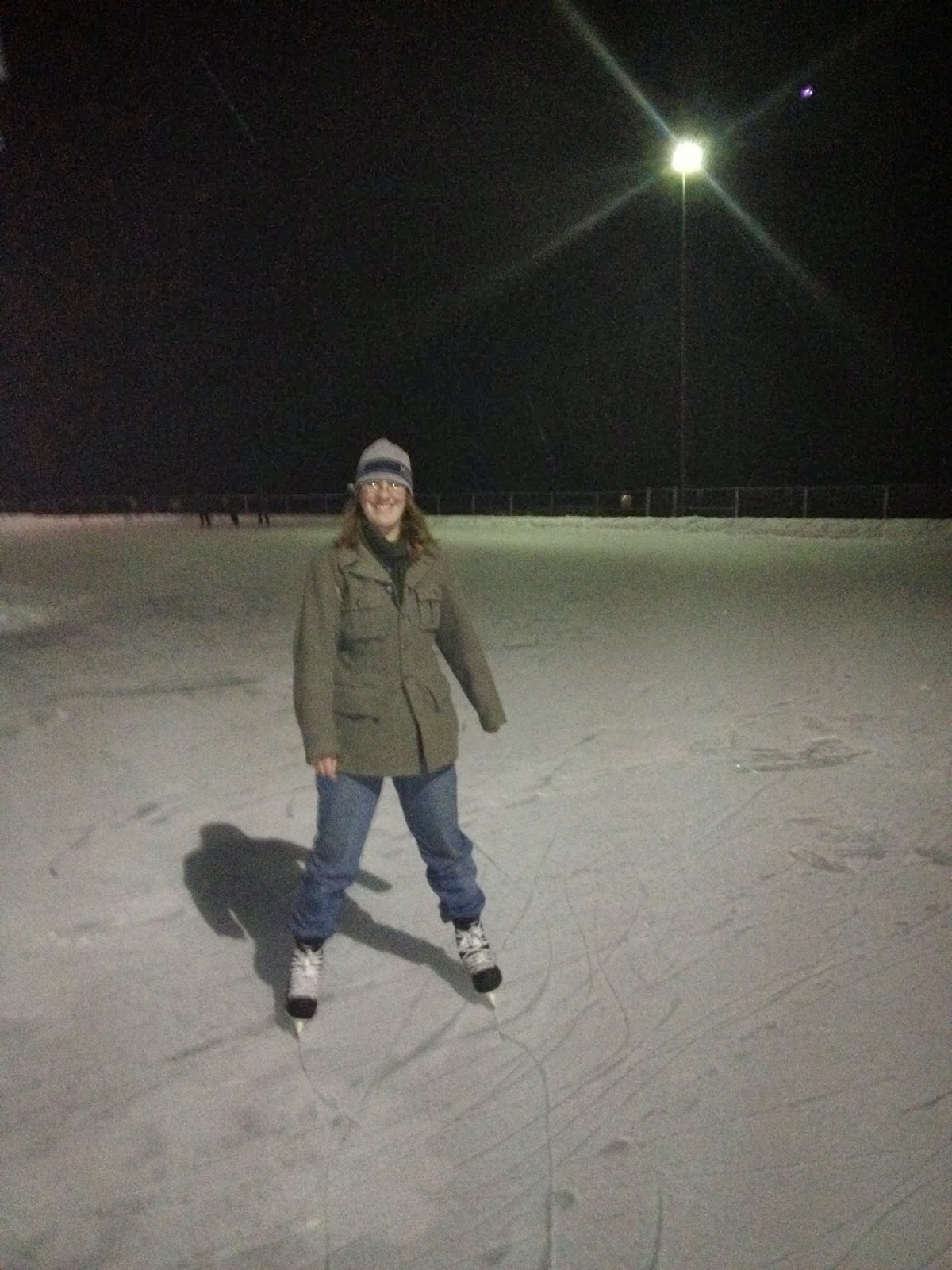
Last night, my boyfriend and I went to the family fun night at an outdoor skating rink near our house. It’s been open for a few days now – basically they flooded the giant pool and maintained it as it froze – and they celebrated the first Saturday night of its opening with hot dogs, hamburgers, and general merriment. (Vermont!)

I’m no stranger to skating; the boyfriend is a huge hockey fan and has used me to fill in an empty spot on a pickup game roster more than a few times. I grew up in New England, two towns over from Nancy Kerrigan, in the same town that the Bruins have their practice arena, and with more friends than I could count who were competitive figure skaters and hockey players.

It’s never been a focus of mine, though; more like, I have always owned a pair of skates and have enough proficiency to account well for myself, but no finesse or higher skills.

Last night, as we started to skate around, my feet cramped up badly within the skates. It wasn’t the skates, or any of my motions, and it took me a while to really figure it out but when I did it had me thinking for the rest of the night.

In short: I was applying all the body rules that I have drilled into myself while riding to figure skating. Horses are the main focus of my exercise and athletic endeavor these days, and my body has learned to associate being physically challenged with being on a horse.

I was dropping weight into my heels while skating. I was sinking down my spine, through my seatbones, and keeping weight out of my knees. Every time I wobbled or felt out off kilter, my body kicked in every horseback balance reaction it had. Within the first twenty minutes, this had really started adding up, and my feet were a tight mass of pain, as my heels drove deep into the skates but I was light in the balls of my foot, and my toes were nearly pushing against the top of the boot.

The solution was to skate correctly: put weight more into the balls of my feet and be lighter in my heel, be comfortable with balancing on the edge of the skate, bend my knees more, and tip my center of balance further forward over my knees, rather than my heels.

It was really hard. My body had learned and adapted to a certain instinct and it didn’t want to let go of that hard-won skill. I’ve never been the wildly athletic person whose body is flexible and poised and can tackle anything. I’m not exactly unathletic, either (except in the matter of hand-eye coordination, sigh), but I function best when I’m applying myself to one particular path, and disciplining my body for that.

Eventually, I repositioned myself, and my feet stopped cramping up, and motion came much more smoothly. We stayed for about an hour and the last 45 minutes were much easier than the first 15.

Have you ever tried another sport and found your riding instincts working against you?

2014 goals

February Goals

For reference: 2014 Outline & 2014 Goals

So per the outline, here’s February:

February

Ditto January: Stick to a consistent schedule; build topline & fitness; take a few lessons. 

If all goes well, try a few jumps under saddle at the end of the month.

That should cover it. Nothing fancy, just keep on keeping on. One catch is that his jump saddle is still not a great fit for him, so we might not jump after all until we have the saddle fitter out; we’ll see how this plays out in the last week or so.
The 2014 Goals will hopefully see some work on overall organization – there are a few things in our mud room that really need to be sorted through and dealt with. Ditto my own fitness. Ugh.
Uncategorized

ZOOOOOOOM

Some years back there was a mustang with a professional eventing trainer. I think he was featured on Eventing Nation. I remember him because his show name was “Must Tango.” Get it? MUSTANG GOOOOOO!

Anyway! Tris maybe was taking some inspiration last night, because he was, as they say, hot to trot from the first moment I sat on him. We had to have a conversation about standing politely at the mounting block until I settled into the saddle, even. (I know some people are ok with horses moving off as they find their second stirrup; I am not, and Tristan darn well knows that.)

It was a different challenge than I ride 95% of the time: how to manage the fired up quick horse rather than the lazy solid horse. He took a half-halt easily enough, but he totally killed the motor when he did so. It was a bit whiplash-inducing, going from a speedy horse to a stalled out one, and it took some negotiation, but once he agreed to take a half-halt and use it as intended, loading his hind end with energy instead of just expending it by going fast, he lifted his back and came through beautifully.

We did not do much fancy work, honestly: some leg-yields, some changes of direction on the diagonal. We spent some time working on staying straight on circles, and changing flexion back and forth, spiraling in and out on circles.

We had some long(ish) conversations in the canter about paying attention to me, and taking a half-halt without flinging his head up and charging off in the other direction. We worked hard on staying in the circle through the outside rein; accomplished in the right lead, mostly accomplished in the left. He was hot enough in the canter that the trainer (who was teaching another lesson at the time) laughed and remarked on it.

We finished with a long forward stretchy trot session and then a fair bit of walking. He got his wind back quickly, but was still a bit warm to finish, so he got a cooler and a bit of extra hay to keep him company until he switched to his blanket and got his grain at night check.

I admit, I’m a bit mystified as to what’s making him so forward and up the last few days. Coming back after a week and a half off? Having the round bale all day? Grain increases finally kicking in? Fitness hitting a new level? It could still fade away again, but I hope not. He’s fun to ride like this, and it bodes well for getting good work done through the rest of the winter.

book review · mustangs

Book Review: Mustang: The Saga of the Wild Horse in the American West

Mustang: The Saga of the Wild Horse in the American West
by Deanne Stillman
(available on Amazon)

First things first: this was not the book I thought it was. I picked it up out of curiosity – it had quite a few accolades on the cover, was by a talented writer, and in all honesty I began it with a sinking heart. For some years now, I have had in mind the project of researching and writing a book about the place the mustang holds in the American imagination.

This was not that book. This was not even close to that book. In fact? This was not really a book about mustangs at all, save for perhaps the last 1/4 of it.

That’s not to say it was a bad book, by any stretch of the imagination. In fact, it was quite a good book: well-written, thoughtful, far-ranging, and a good read. Here was my biggest problem: this book made no attempt to define or distinguish the “mustang,” which is to say the distinctly wild (or feral) horse that lives without human interaction or mediation in the American west.

Stillman’s title and subtitle imply that she will write a history of those horses. That’s not what she did. Instead, this book is more accurately a history of the horse in general in the American west. Which is fine! She does a nice light nonfiction job of that, telling stories about the horses belonging to early conquistadors, about cavalry horses, about cow ponies and cattle drives, about the horses in Buffalo Bill’s Wild West Show, about movie horses. She clearly (despite her personal history) doesn’t know a whole lot about horses, but she does know a whole lot about people, and does a really nice job in telling her stories.

So while I spent the first 3/4 of the book annoyed at her lack of distinction (mustang != any horse out west != free-roaming stock horses != any horse that she has decided fits a certain physical type), when I forced myself to step back and think “this is really about horses as companions in creating the history of the west” I liked the book much much better.

And then when she spends the last 1/4 actually talking about mustangs, actually parsing out the history of the wild/feral horses in the west in the mid to latter part of the 20th century? She does a really good job. Instead of an enjoyable but not gripping read it became a gripping and depressing and involved read. I couldn’t put down the last 80 pages. It took me 2 weeks to read the first 240.

And in the end? I’m glad she didn’t write the book I wanted to write, because that means it’s still out there for me to tackle.

longeing · winter

Longeing after a few days off

The cold snap has broken here in the great white north. Yesterday, it was up to 20F. Today, it will go up to 30F. I haven’t even buttoned up my winter work coat or worn gloves in the last two days. Our furnace is occasionally turning off and not working overtime in a desperate attempt to keep the apartment marginally warm. It’s amazing.

Last night, I headed to the barn. I’d spent all day thinking about what kind of ride I wanted to plan after a week and a half off. Sure, he’d walked around for about 45 minutes on Monday, but he hadn’t had any proper work in 10 days.

The more I thought about that, the more I re-thought the idea of riding at all. I decided to longe. As it turned out: good decision!

I started with a good hard curry all over to loosen his muscles and dig in to his coat, since I hadn’t been grooming him much in his time off either – the barn picks his feet out 2-3x a day so I knew he wasn’t exactly suffering, plus I felt bad pulling his blanket just to groom him for 10 minutes. (There’s no logic there, I know.)

Then I put on his surcingle and the chambon, twisted the reins of his bridle up into the cheekpiece to get them out of the way, and we headed into the ring. Almost immediately, I was very glad I had longed! He was a bit keyed up and antsy while I was attaching the longe line, but I attributed that to the fact that I’d pulled him from his stall just as the other horses were getting their grain, the poor baby.

I sent him out on the longe line, and before I even had time to bring up the whip to point at his hindquarters, he exploded. Buck, fart, crowhop, take off, you name it. Two whole circles around me! I know, some of you with very “up” horses are laughing at me right now but this is Tristan. Any bucking exuberance is extraordinary. I have to admit when he first took off I was laughing too hard to really pull him back, but he eased up nicely when I asked him too.

He was clearly a bit stiff all around, and I was glad both that I’d grabbed the chambon and that I was longeing. He clearly relaxed and came through bit by bit through the whole session, which lasted about 25 minutes. He still had some energy at the end, but I hadn’t been looking to burn energy, just to loosen him up, and he was coming through quite beautifully in both directions at the walk and the trot. He even made some attempts to stretch in the canter, something we’ve been working on a lot.

He was generally saucy through the whole session, and would occasionally stop and turn in. When I sent him back out in the direction I wanted him he would snort and let fly with his back feet and prance around a few strides before settling in. Nothing really naughty, more playful and just a touch uncooperative and spunky.

Tonight, I’ll get back on him and do a more thorough ride, probably incorporating poles.

In a horsekeeping note, after a three-round botulism vaccine (!), all the barn horses are now on round bales. Tris is very, very happy. The barn manager mentioned that she was a teensy bit worried about Tris – thought he looked a little bloated when he came in – but he laid down and took a nap and then pooped a lot. So…just a pig.