equestrian history

A Horseback Balloonist from 1798

Here, have some absurdity on a Tuesday morning. From Wikipedia:

Pierre Testu-Brissy (1770 – 1829) was a pioneering French balloonist who achieved fame for making many flights astride animals, particularly horses.

Testu-Brissy made his first balloon ascent in 1785, and the first night ascent on June 18, 1786, in a hydrogen balloon. He made the world’s first electrical observations on June 18, 1786, as he ascended into thunderclouds, and said that he drew remarkable discharges from the clouds by means of an iron rod, carried in the car.

Testu-Brissy’s first solo ascent was on September 18, 1791 from Paris. He subsequently undertook more than 50 flights in his lifetime, including the first ascent on horseback on October 16, 1798 from Bellevue Park in Paris. He and his horse made more than fifty of these documented flights.

road hacking

Sunday Hack

Quiet-ish hack on Sunday, snuck in between rain showers.

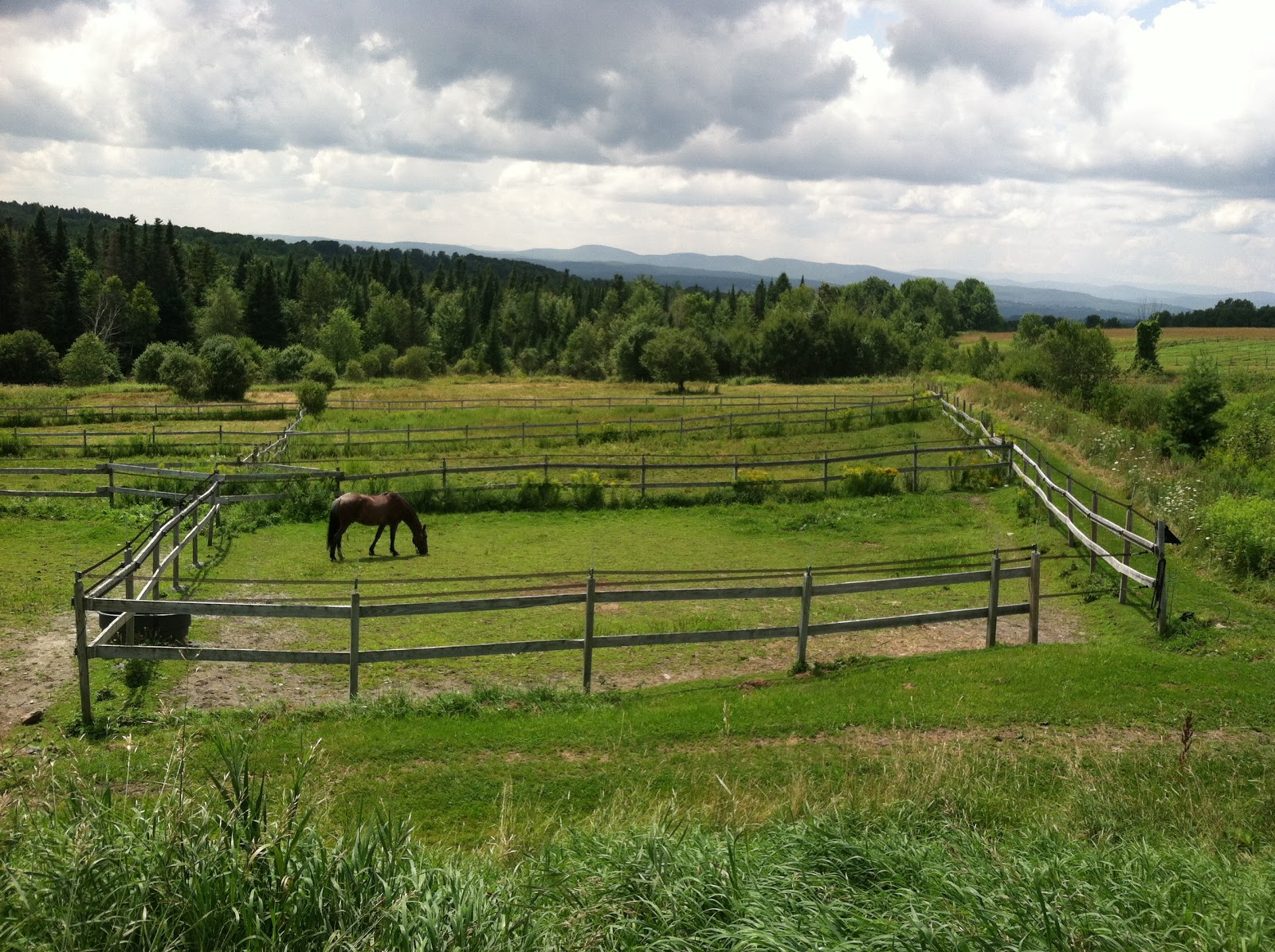
Love this field.

Summer working students on ponies, plus dog.

I…have no idea what exactly all that is. Tris was confused too.

You know you’re an eventer when! So much stuff.

Dipping my toe into the half chap world. I’ve never worn them consistently before.

Fall is coming.

The redheads.

dressage

Is My Horse Forward?

If you’ve been reading my blog for even a tiny amount of time, you may have picked up that one of my biggest struggles with Tristan is to get and keep him forward. He is a naturally behind the leg horse who feels quite firmly that unless there is a mountain lion behind him, he should be saving his energy for the moment when that mountain lion appears. (Corollary: unless there is an actual mountain lion actually chasing him, then yawn. No spooker at shadows is he!)

So, forward. There are all sorts of classical definitions but at its heart “forward” means that the horse is willing and engaged and holds in himself the energy to do what is asked of him.

How can you tell if he’s forward?

If you’re like me, and you a) have a naturally lazy horse and b) actually like having a more laid back horse because you prefer not to get run off with, it can be tricky. You get used to a certain rhythm and speed and even a tiny deviation upward from that feels way forward! Even if it’s not.

(Important caveat: forward is not synonymous with fast. Light-footed, speedy horses can be behind the leg as well. You’ll see why in a moment, hopefully.)

Here are a few ways that I’ve been taught, over the years, to help figure out forward and that have all proven useful to me.

– Can I take my leg off my horse – completely, 100% off, daylight seen between my leg and the saddle – for a significant period of time, say an entire long side, and still have him move out with the same rhythm and energy?
– Can I feel the seeds of each gait within the other – ie, do I feel like I could transition from walk to trot, from trot to canter, and back down again without significant setup, kicking, sourness, etc? Once you think about it this way, think about feeling the trot or canter that could develop from your walk, it’s actually a startlingly neat thing to have in your head.
– Is my horse willing to work with me – does he feel energized and ready for what’s next, is he with me, do I have possibilities at my fingertips and is he at least open and accessible to my aids, if not always spot on?
– How am I using my leg? Am I nagging, or keeping it completely off? No extreme is good. You should be able to keep a good firm leg on without constantly kicking OR being afraid your horse will blow up. That firm leg should feel like part of a solid foundation.
– Is it easy to post – is the horse’s movement and energy pushing me up and through so that it takes less effort to move my own body, as if I were sort of riding the wave of my horse’s energy? Is it easier to sit deep in the canter if I keep my hips open – can I follow a steady, even rhythm, or conversely, keep that rhythm without major course corrections?
– If you’re watching from the ground: what’s the overstep like? Is your horse at least touching his hind hoofs to the edge of the front hoofprints? Does that overstep increase as your horse warms up? Have a mental gauge of your horse’s average overstep: your goal in working is to increase suppleness to increase that overstep, but unless you keep those feet moving you’ll get nowhere.

Anyone else have any tips, tricks, or questions they ask themselves to help figure out whether they’re really forward?

barn car

The Barn Car is Dead; Long Live the Barn Car!

First, a story. The last time I went car shopping, I dragged my mother to half a dozen different dealerships and sat in probably twice that many cars. I thought I knew what I wanted, but I couldn’t quite put my finger on it. I kept saying “I’ll know when I’ve found it.”

Then at the end of the day, I sat in a 1997 Geo Prizm (in 2005). It had 70k miles on it already and on paper would not have been the right car. I saw it across the lot, thought “hmmmm,” and went and sat in the driver’s seat. I knew instantly that this was my car. Formalities were observed: we took it on a test drive down to the local library and looked up the Consumer Reports, negotiated with the dealership, but it was all a foregone conclusion.

I named her Callie, because I had just started watching Battlestar Galactica, and she was a far, FAR better car than she should have been. I put studded tires on her and drove her through ridiculous snowstorms when I lived in a town in the mountains in Vermont, population 831. I drove her to my first real job. I got in my first accident with her (minor rear-end, but still). I drove her to and from the barn after I got Tristan, long cold winter nights often crying the whole way because he had reared and bodyslammed me and on and on. I drove her so many hundreds of miles in stop and go traffic when I had Tristan at my old barn, parked her on practically every side street in Boston and Cambridge and Somerville. She was the car I had to stash when I stayed at my boyfriend’s apartment that had NO parking. She was the car that suffered when our downstairs neighbor keyed her and poured glue in the locks and spat on the windshield and broke off the antenna and on and on after deciding that we made too much noise. (Examples of too much noise: dropping a quarter on the floor at 6pm on a Sunday; having 4 people over for brunch at 11am on a Saturday; opening a rolling closet door at 7pm on a Tuesday. It’s a long story.)

Taken from this angle you can’t tell that she has no clear coat and a dent on literally every single panel.

Whew. If you’ve made it through that sentimental wall of text, I applaud you. I’ve also done some burying of the lead. Yesterday, I brought Callie to the dealership and left her there, and came home with a new car. She’d been declining precipitously for a good year and a half. Parts were failing faster than I could keep up. She caught on fire twice. (Well, not actual flames, but HUGE clouds of smoke billowing from under the hood within seconds; close enough!) For the first time ever, she left me stranded on the side of the road and had to be towed to a mechanic. I opted out of the substantial work she needed to pass inspection and parked her starting in April. After 9 years and 157,000 miles together, it was time.

I’m not saying I didn’t cry like a baby when I was driving away, knowing she was going to be broken up for parts. I get sentimental about these things. When I was 10 or so, my parents traded in the family van I had grown up with. I had to be forcibly removed from the car, I was sobbing and had my arms wrapped around the seat. Maybe not my proudest moment.

There, that’s a truer representation…
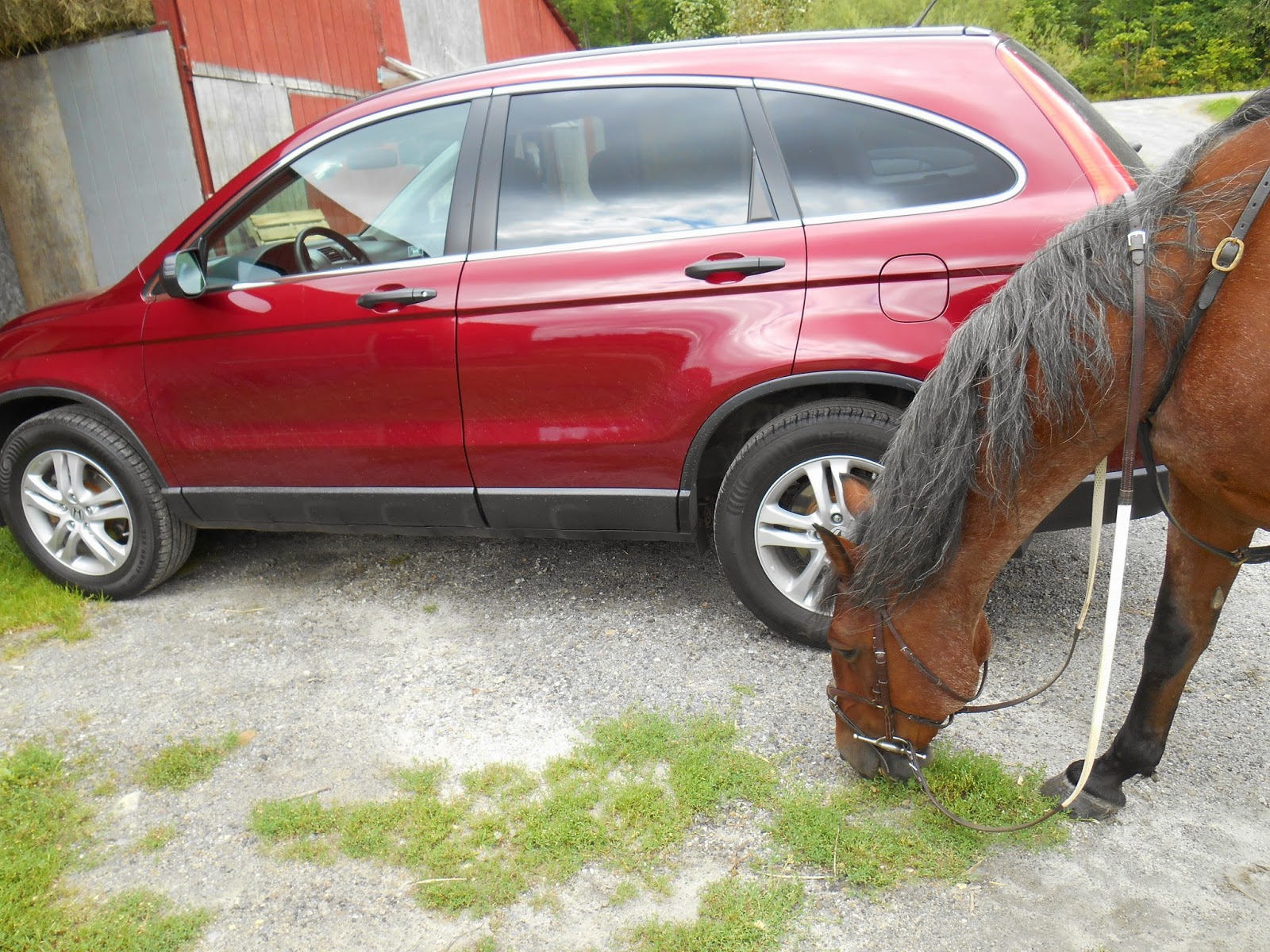
Old on the right, new on the left. Molly is a 2011 Honda CR-V, chosen because I live in Vermont and the barn is many miles of dirt road away. Also, there is an actual policy on the part of the state to plow less in order to force people to drive more safely. Yes, really. It’s not at all uncommon to have several inches of snow on the road and just go about your daily business.
So, welcome to the family, Molly! You’ll be hauling bags of grain in no time. I’ve already moved the milk crate of essential supplies to her trunk, and in my world, essential supplies means a spare halter and lead rope. (I have used it on two separate occasions to catch loose horses that I found in the road, no joke.)
Arya approves, though it may be some weeks before I’m willing to let muddy puppy paws on the freshly detailed upholstery.

stupid human tricks

We interrupt this blog…

…for me to flail around with a nasty summer cold.

I have mostly had energy only to stay on top of real-life commitments, and even with that, spent a day home sick flopped on the couch with the puppy watching Dead Poets Society.

I have things to write about, but they will have to wait. Maybe tonight.

dressage · scribing

Scribing at Vermont Dressage Days

I spent this past Sunday scribing in one of two rings at one of Vermont’s bigger recognized dressage shows, Vermont Dressage Days. I’d been to the show in the past, when I lived in Vermont before, but this year I was asked to volunteer. One of the longtime organizers is a former co-owner of my barn and a friend. I said yes, of course – I am a sucker for any kind of horse volunteering, and scribing is close to the top of my list of favorite things to do. (It’s probably a three-way tie between scribing, jump judging, and ring stewarding.)

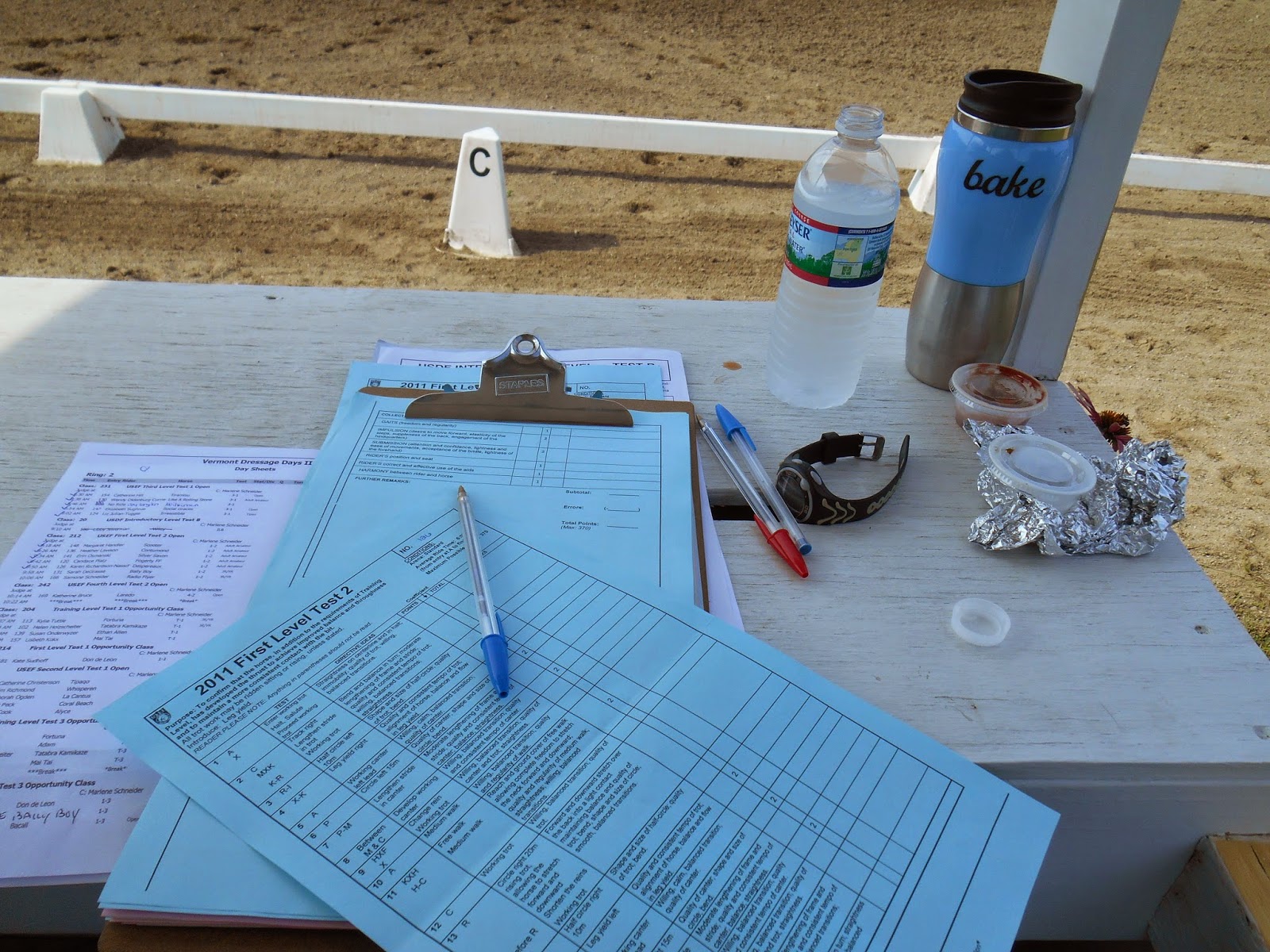
Tools of the trade: order of go, tests, blue and red pens, water, tea, watch, and the wrapper from my breakfast burrito.
I was coming down with a bad cold, and it was a very long day: tests right from 8:30 am to 4:30 pm. I’ve never scribed so many tests above Training level in my life, and once you get past Second level those movements come fast and furious. I had to take several breaks to shake my hand out.
What an absolutely phenomenal day, though. I have never scribed for a better judge, on so many levels. She was right on top of the game, and I can count the number of times I had to remind her to give me a score, or got mixed up because she gave too many scores at once, on one hand. I’ve never scribed for such an efficient, knowledgeable judge.
She also knew those tests cold. Many other judges I’ve worked with have had to take a minute or two when we switch test. Not this judge! All I had to do was give her the test, she flipped to her spot in the binder, and bam, we were good to go. Amazing. She gave a full range of scores (first time I’ve ever written a 1.0!) and I loved how she adjusted her expectations for the test in front of her. It was definitely the first time I’ve ever written “poll too low” on a Training level test!
I was also impressed and thrilled when a judge in training approached and asked to observe for the day. So not only did I get the judge’s comments – which were insightful and spot-on – but I got the conversation between the judge and the student after and sometimes during each test as they compared the scores they had given. I also learned a TON about the inside track of becoming a USDF judge. Fascinating stuff.
Lunch was fabulous, and the show had rented an RV so that judges and officials could have a quiet place to relax. I got to eat lunch with the judges. Spoiled. Not only that, but there was a cooler full of cold beverages and a basket full of snacks at our booth all day and I got an awesome t-shirt. (Photo of that forthcoming.)
I’d volunteer for them again in a heartbeat, and I’m glad I did this weekend. What an absolutely incredible learning experience!

adventures with the vet

The Eyes Have It

What do the the eyes have? My bank account, for starters.

I posted about how Tristan’s eyes went from drippy to swollen and goopy.
I called the vet on Saturday afternoon, and she talked me through initial treatment: dose of banamine, flushing them out, cold compresses, and aspirin in his grain for a few days.
Banamine + aspirin + flushing + compresses helped on Saturday but everything was right back on Sunday, so I texted the vet an she agreed to squeeze him into her schedule on Monday. (LOVE a vet that texts!)
PSA time: This is a known pattern with Tristan. I was in touch with the vet quickly and monitored his eyes constantly. If your horse comes in with a swollen and goopy eye overnight and those symptoms are out of the ordinary for him CALL THE VET IMMEDIATELY. Do not pass go, do not collect $200. I can’t stress this enough. Do not mess with eyes. Suck it up and pay the emergency call fee.
So: Monday rolls around. I am traveling for work an can’t be there, but chatted with the vet after she saw him.
1) Both tear ducts were almost completely blocked. Vet suspects his allergies kicked it up a notch, he started rubbing his head, and created a cascade effect of swelling and irritation. So she flushed his tear ducts, which he was not a fan of.
2) She gave him another dose of banamine and left steroid/antibiotic ointment for his eyes, which both have a bit of conjunctivitis, the left more than the right. He will get that once daily for a week.
3) She also left an oral antihistamine for him, which he will also get all week.
That screaming you hear is my bank account.
HORSES.
adventures with the vet

Raining, Pouring, FFS, can I catch a break?

Tristan has had issues with his eyes for as long as I’ve known them. They get irritated very easily; they swell up a bit, they drip tears, and they seem to always be itchy. He wears a fly mask to keep him from blowing them up too badly on a regular basis. I’ve had his tear ducts flushed and it makes no difference.

Part of it is the way he rolls: he always griiiiinds his head into the ground, and isn’t allowed on sand or arena turnout because he will immediately come up from a roll blinking and dripping tears after he’s worked something into his eye.

This week, his eyes have been a little drippy and irritated, but nothing to the level of concern. Starting Thursday, we flushed his eyes with saline. Friday again. Today, barn manager reports that they are swollen and goopy and did not go down after flushing last night and turnout today.

So, vet call it is. GRRRRRRRR.

abscess · adventures with the vet · farrier · surgery

What the Vet Found

You may remember that about three weeks ago, my farrier raised some concerns about the way Tristan’s RF was growing out and healing. Based on his experience, he felt very strongly that Tristan had a keratoma growing within his hoof.

Yesterday, I arranged for my vet to meet my farrier at the barn, and we did a full workup on Tristan. I also had a list of other concerns; I was worried that his topline wasn’t building the way it should, and wanted to ask about supplementing with alfalfa cubes, and had a few other miscellaneous questions. (The most important answer: yes, you can add bute while a horse is on Pentosan.)

Waiting for the vet.

We started by longeing him, and I explained that I felt he was actually moving pretty well: lazy, but evenly and without obvious hitch. Slightly stiff, and tracking ever so slightly behind on the RH, but nothing that would even rise to the level of concern. We walked, trotted, and cantered, and then tested the trot/canter transitions. Then the vet took him in hand and spun his hind end to watch how he crossed over.

We did not flex. I can practically guarantee that Tristan would not flex clean, and to be strictly honest? I don’t need him to. He is functionally sound and comfortable in the level of work he does. I’m still not sure if he’ll jump again, and he certainly won’t ever get to the level of dressage work that would require the carrying and thrust that would start to trouble him.

The vet agreed with me that he looked pretty darn good in his movement. Certainly he was just fine on that RF.

What’s the catch? Well, when I asked about his topline, and we brought him out into the sunlight, the vet was immediately concerned. Keep in mind she saw him in March for spring shots, and before that in the fall, and then the previous summer and spring every 2-3 weeks for surgery follow up. She knows him pretty darn well, and she’s a brilliant vet with an excellent diagnostic eye.

She didn’t even hesitate. “I’m pulling blood right now, and we’re going to test for Cushings. Even if he doesn’t test positive, I’d like to start him on Pergolide. He looks terrible.”

Keeping in mind that my vet is very blunt! Tris does not look like the picture of your typical Cushings horse, but he is 19 and he has a distinct lack of muscling on the topline. When we tossed the idea back and forth, other things fit with the picture. He’s been urinating much more than usual over the last 6 months. He’s been coughing more often in warmup over the last 2 months.

It’s very early days yet, and Cushings is a very manageable condition. We should have results back next week. If his levels come back totally normal, the vet wants to pull more blood for general CBC panel and make sure everything else is adding up for him.

PSA moment: yesterday was a perfect example of why you should have a vet take a look at your horse once or even twice a year. I had a vague, pit-of-my-stomach feeling that things were not trending well with Tristan, but it took the vet who hadn’t seen him in 4 months to immediately recognize the changes that had occurred in those 4 months. She had passed him with flying colors in March – even making a point of saying he looked terrific – and was able to clearly compare the horse in front of her with Tristan from March.

I admit, I was reeling a bit from her immediate diagnosis and all the research I was going to have to do to start managing him, and then we moved into part 2 of the day’s fun and games.

The farrier and vet first conferred about why the farrier suspected a keratoma: the bulge in Tristan’s hoof, and drainage holes at the toe. Farrier pulled the shoe, and we set down to work to take some x-rays.

Farrier had these super-nifty lifts rather than the vet’s blocks!
We spent a good 20-30 minutes taking shots, looking at them closely, and then taking more shots from different angles. Vet needs to take a good long look at the x-rays at home, but on initial examination, everything looks clean.
Here’s the neat thing: the farrier was 100% correct in what he detected. What he did not realize (or did not remember – since I had sent him the surgery x-rays before) was that Tristan’s coffin bone was already compromised, that it had been carved up quite a bit during the surgery. The farrier was absolutely spot on in recognizing the subtle changes that came in Tristan’s hoof once he was missing a piece of his coffin bone. I already knew I really liked the farrier, but I am HUGELY impressed.
What we’ll have to do is compare the x-rays the vet took with the immediate post-surgery x-rays to make sure there is no additional bone resorption or remodeling. Vet and farrier both agreed, however, that if a keratoma really had formed at the coronet band and traveled down to the dark spot on the x-ray, Tristan would be very lame, and he’s just not. 
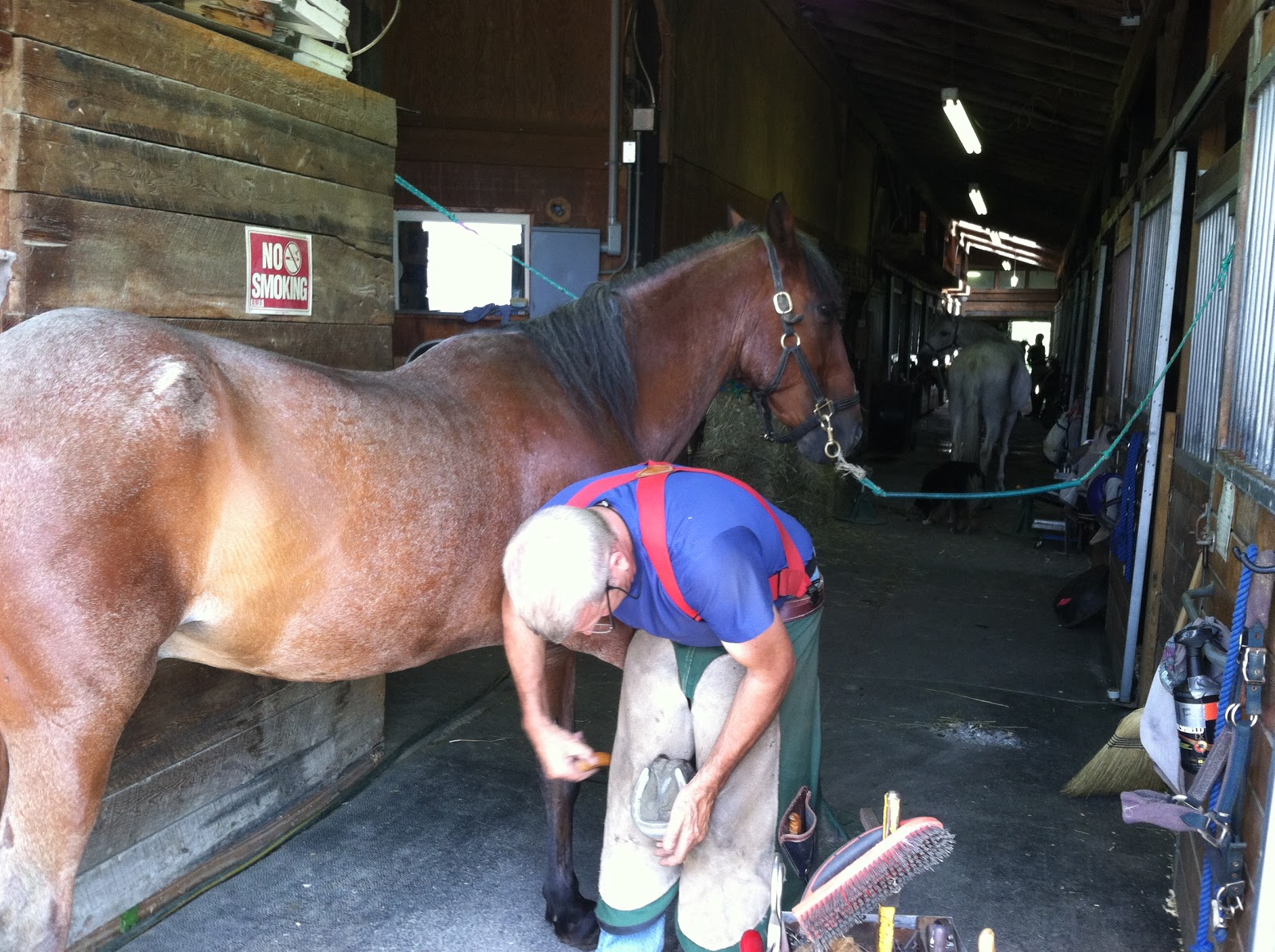
VERY good pony getting his shoe back on.
The one remaining question mark is the drainage holes in Tristan’s toe. They definitely shouldn’t be there. They are tiny, but they are there. I offered to soak, and vet and farrier thought that wouldn’t do much good. The farrier ended up packing the toe with Magic Cushion and putting the shoe back on. Vet said that if Tristan does come back positive for Cushings, that would explain why the drainage holes aren’t closing – his immune system is compromised. 
So here’s the takeaway:
  • his foot is almost certainly fine, whew
  • he almost certainly has Cushings, in the very early stages
    • bloodwork will come back next week, and then we will start him on a low dose of pergolide
    • I’ll take an in-depth look at his diet and most likely switch his grain. Right now he’s on Blue Seal Sentinel Senior, which I mostly like – but which according to some internet sources is fairly high in NSC, which he’ll have to stay away from. Look for research posts about this in the future.