nutrition · supplements

How Should I Feed My Horse Salt? Part 2

In Part 1, I looked at the different ways to feed a horse salt, and the pros and cons of each.

Here, in Part 2, I’ll go over what I’ve done for Tristan in the past, and what I plan on doing forward based on my research.

Not long after I brought Tristan, home, he started displaying one of the classic signs of mineral deficiency: coprophagia. It was winter, he wasn’t on grain, and he was out 24/7, so boredom was not really a factor. After a few days of reading and talking to people, I added a salt block to his field – a red trace mineral 50lb block. The coprophagia vanished overnight.

When he came inside to a stall part of the day about 9 months later, I scaled down to a 3lb block in holder. One of these:

It lasted about two weeks. Then he ripped it off the wall. I spent an hour sifting through the shavings to find the screw and put it back up. Lather, rinse, repeat. Soon enough, I decided that the convenience of a wall-mounted salt block was not worth the stress of worrying about him stepping on a screw. I tossed it in his grain bucket.
This worked most of the time, until he got to the end of the salt block. The little ones go faster, and break up into small chunks easier. It broke up so quickly that half his grain bucket was red salt, and he went off his grain because it probably tasted like nothing but salt.
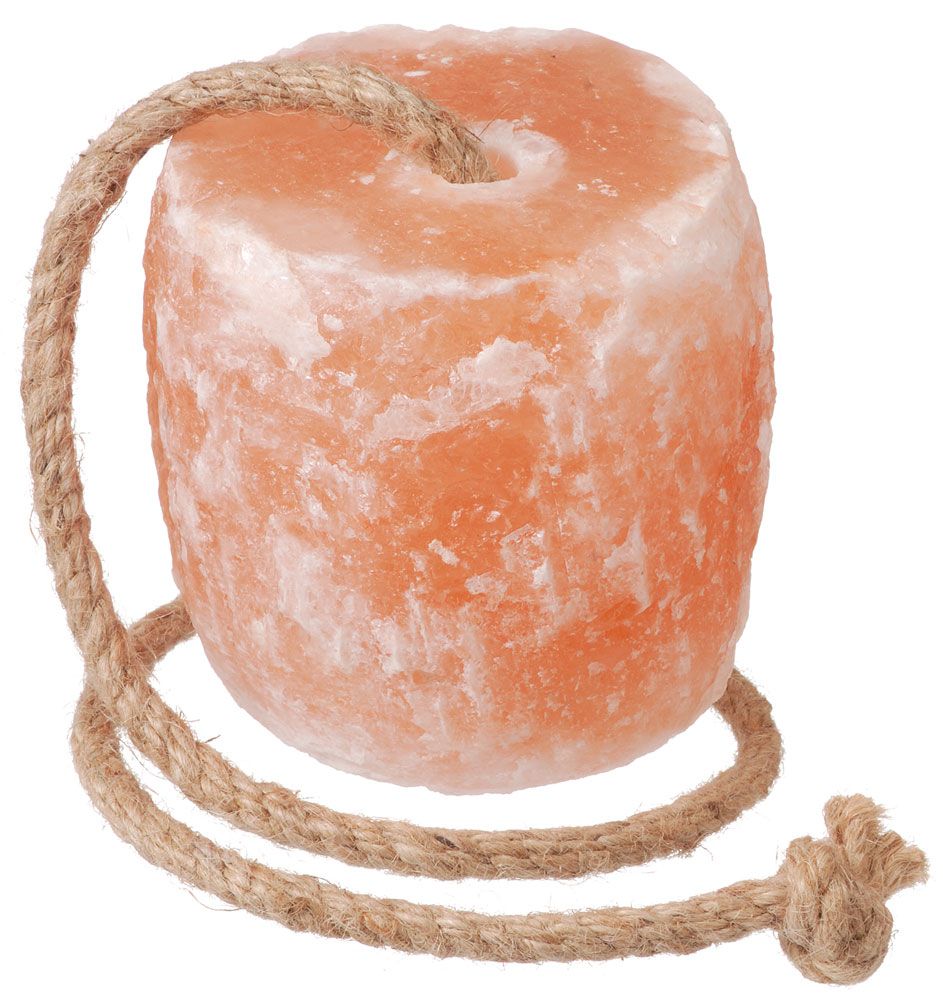
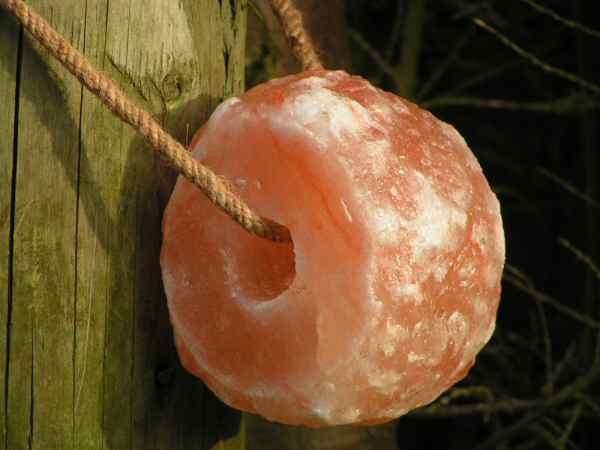
After that, I turned to the Himalayan salt licks for reason of expediency: they came on those convenient tie ropes, and I could just tie one to the bars of his stall and not worry about a salt block holder.
But jeez, they were expensive, and he went through them about once a month – or sometimes much less time. They were usually the first thing to fall off the list if I had an unexpected vet visit or farrier bill. Eventually they became an occasional treat. He always loved them, but I was buying them at the rate and price of a good joint supplement!

Enter our move to Vermont. He started again with the coprophagia in his stall, and armed with my previous experiences, I went big: 50lb salt block, with a holder, in his stall. I picked red because of the added iron, and anything I can do to get more energy into him is a bonus in my mind.

Honestly, I just bought whatever was available at Tractor Supply, and there are some other options that might’ve been better as holders: some that hang over the side of the stall, for example. That would save me time fishing it out of the shavings in the back of his stall on a regular basis. But then, they wouldn’t hold the small chunks at the end as well, so it probably evens out.
Since I’ve started doing this, he’s gone through three blocks at a rate of about one every 6-8 months. I pay about $10 for them at Tractor Supply, depending on sale prices. Very affordable! But is he getting enough salt?
Let’s say it’s the inside number of 50 lbs in 6 months. That’s 180 days, so on average 1/4 lb a day, or 4 ounces. Per my math, that’s actually a little more than the approximate amount of salt for a 1,000 lb horse in regular work of 2.4 ounces. All things being equal, Tristan gets probably a little more salt than he should!
He does not, however, get enough to cause toxicity, and the amount he eats per day is highly variable. I’m going to assume he regulates himself.
So after all that, what am I going to do about his salt intake?
Absolutely nothing, actually. I set out to find out if the red, or added mineral, salt blocks were ok to feed him, and they are. I wanted to know if he was getting enough salt – and he definitely is!
Here’s the only thing I might change: I might invest in an electrolyte supplement to add on days when he sweats more heavily in the summer. I’m talking very occasionally – once every two weeks. He’s not much of a sweater, thanks to his desert heritage. 
So that was a lot of work and reading for no change, but I feel better overall about my decisions. They were admittedly made on guesswork and instinct, but they turned out to be ok. (Not always the case!) And I hope that going through it all on the blog helped someone out there make decisions too.

nutrition · supplements

How Should I Feed My Horse Salt? Part 1

I’ve been wondering about this topic for some time myself, so I decided to do some research.

The basic premise is that sodium and chloride (the building blocks of NaCl, salt) are essential to a horse’s diet. This article on minerals from The Horse suggests that a horse in no work should be receiving 0.25% of its diet as salt, and a horse in full work, sweating regularly, should receive closer to 0.75% of its diet as salt.
So, let’s do the math: a horse should consume 2% of its body weight per day; for a normal 1,000 lb horse, that’s about 20 lbs a day. 0.25% of 20 lbs is 0.8 ounces, or approximately one tablespoon of salt. 0.75% of 20lbs is 2.4 ounces, or approximately 1/4 cup of salt. So if you have a draft horse in the summer in regular work, your horse might need as much as 1/2 cup of salt a day!

It’s tough for horses to overeat salt, especially if they have access to water – excess minerals will just pass through with urine. It is possible, though, for horses who drink briny water (in the absence of fresh, clean water) or flat-out eat a salt block. Symptoms include colic, diarrhea, and weakness of the limbs. Most people believe that horses will self-regulate, eating as much salt as their bodies need. Some horses may lick dirt or rocks, or eat the roots of plants and grass, in order to get at extra minerals when their bodies are lacking them.

(For fun again, here’s the math. A lethal dose of salt for horses is considered 2.2g/kg. That works out to 2.2 lbs, or a little more than 3 1/2 cups of salt. Your horse would basically have to eat most of a 3lb salt block in a short time period.)

Horses get salt through their regular food intake: processed grain, hay, and grass. Most of the time, though, these food sources don’t add up to enough, especially if the horse is in any kind of work and sweating. Salt is a key part of the electrolyte balance that allows a horse to function – see this article, again from The Horse, for a fairly long and complicated explanation of the role electrolytes play in equine biology. (You can do a quick Google or take a look at your grain bag label to see how much salt is in the grain, and you can almost always send your hay out to be tested for the same information, if you really want to get down into the weeds for this information.)

In short, you almost always need to supplement salt in your horse’s diet. But how do you do that? Here are the most common ways, with their pros and cons.

Loose Salt

Exactly what it sounds like: loose salt, added to your horse’s feed. You can add this in a couple of ways. Some people dress grain with it, much like a supplement, a tablespoon or two at a time. Some people leave out a bucket of loose salt for the horse to eat as it chooses.
Pros: Easiest to eat, practically guarantees a daily salt intake, doesn’t take up room in a horses’s stall or field
Cons: Salt might turn some horses off grain, overeager horses will eat too much, must be fed in a stall, could get expensive, might get skipped if you’re boarding (like any other supplement)
I found argument both ways about exactly what type of loose salt to use: iodized salt for people? loose bagged salt for livestock? something in-between? No really clear answer here.
Salt Blocks: White

These blocks come in various sizes, from the small 3lb ones that you put on a wall to the large 50lb block that’s pictured here. 
Pros: Inexpensive (usually $3-5 for the 3lb blocks and $10-15 fot the 50lb blocks), last a long time, can really take a beating, provide an entertainment value alongside nutrition
Cons: There is a school of thought that believes these blocks are meant for cattle, and a horse’s smoother tongue cannot lick long and hard enough to get enough salt off the block. This school of thought argues that horses often resort to biting the blocks, which can cause TMJ and other jaw irritation and then lead to breaking off large, unhealthy chunks that can cause salt poisoning. They also take up space in a stall, whether on the wall or on the floor.
Salt Blocks: Trace Minerals
This is a fairly wide category; if you search at Tractor Supply on “salt block” you’ll return a few dozen variations with different trace minerals. I’ve put up photos of the two most common here. On the left, a salt block with added sulfur; on the right, one with added iron. You have to look at the ingredients list for precisely what proportions of what minerals are represented. Each color typically reflects a different mineral composition. For the sulfur and iron blocks, they’re about 95-97% salt and 3-5% other mineral.
Pros: Much the same as a plain salt block, these are inexpensive (maybe a dollar or two more than plain salt), durable, and slow a horse’s consumption down
Cons: Same as above; are these really meant for cattle?
There is an interesting additional con to consider, however, and it’s this one that sent me on my original research quest. Are the added minerals bad for horses? I did quite a lot of reading, and the most reputable sources pointed out that these are still mostly just salt, and that a horse would really have to consume a LOT in one day to reach any kind of overload on the minerals. That said: there are some that really should not be eaten by horses, so avoid anything that’s specifically formulated for other animals like sheep or goats. (There are some minerals that can be overconsumed, selenium being the first among these.)
Some anecdotal reports suggest that feeding the sulfur blocks can be a sort of natural fly repellent, much like apple cider vinegar. There’s no scientific evidence to support this. Sulfur is a necessary component of a horse’s diet, but a tiny one, and they pretty much get what they need from their regular feed.
Horse-Specific Mineral Blocks

The variations in this category are endless. You’ve definitely seen these, and they are often marketed with various flavors as “treats.” These provide quite a lot more in the way of basic minerals and nutrients.
For example, here’s the nutritional analysis for the Dumor Horse Block:

Crude Protein (min.) 16.00%, Lysine (min.).60%, Crude Fat (min.) 2.00%, Crude Fiber (max.) 10.00%, Calcium(Ca)(min.) 1.50%, Calcium(Ca) (Max) 2.00%, Phosphorus(P) (min.) .60%, Salt(NaCl) (min.) 10.00%, Salt(NaCl) (max.) 12.00%, Sodium(Na)(min.) 5.00%, Sodium(Na) (max.)6.00%, Copper(Cu) (min.) 55.00ppm, Selenium(Se) (min.) .60ppm, Selenium(Se) (max.) .70ppm, Zinc(Zn) (min.) 150.00ppm, Vitamin A (min.) 10,000IU/lb, Vitamin D(3) (min.) 2500IU/lb, Vitamin E (min.) 250IU/lb, Animal protein products-free.

That’s a LOT more stuff than is in any of the other salt blocks!

Now take a look at the ingredients for that same block:

Wheat Middlings, Cane Molasses, Salt, Dehydrated Alfalfa meal, Cottonseed meal, Ground Milo, Sunflower Meal, Calcium Carbonate, Bentonite, Ground Soybean Hulls, Rice Bran, Cracked Corn, Dehulled soybean Meal, Monocalcium Phosphate, Dicalcium Phosphate, L-lysine, Vitamin E Supplement, Copper Sulfate, Vitamin A supplement, Vitamin D3 Supplement, Ethylenediamine Dihydriodide, Manganous Oxide, Zinc Oxide, Calcium Iodate, Magnesium Oxide, Ferrous Sulfate, Mineral Oil, Sodium Selenite. 2.000% Ground Soybean Hulls.

See #2? Molasses.

Pros: These really are the only salt blocks that are 100% meant for horses. Horses love them. They do provide quite a lot of nutritional kick to them. If your horses are pastured 24/7, on range, or do not get any grain, these can be a great supplement.
Cons: Molasses! Any horse with sugar sensitivities should stay far away from these blocks. Many horses, in fact, will go after these until they are gone because they reward licking with great taste beyond just satisfying a salt craving. They’re also not really salt blocks: only 10-12% in the Dumor block, as opposed to the 95%+ of a typical salt block. They are way more expensive than a plain salt block, easy 2-3x as much.

They also have a lot in them, most of which is supplied by processed grain. So if your horses is on any kind of grain, they probably don’t need what’s in these blocks. Note that many of these blocks also contain selenium, which is dangerous in large quantities.


Himalayan Salt

The newest and trendiest way to feed salt. What is “Himalayan” salt, exactly? Rock salt, or halite. Most of the pink stuff that’s mined and marketed as Himalayan comes from Pakistan.
Here’s a selection of claims about this salt: “it contains the full spectrum of 84 minerals and trace elements just like Mother Earth intended,” “The Original® Himalayan Crystal Salt® is more than salt, it’s a way of life — or more precisely, a way of approaching aspects of living your life well,” “a pure, hand-mined salt that is derived from ancient sea salt deposits, and it is believed to be the purest form of salt available.”
Does anyone else have the same knee-jerk reaction to fads that I do? Sigh.
Himalayan salt does contain other trace minerals beyond just salt. What, exactly? We don’t know. It depends. On a lot of things. It’s really not clear whether any of them are beneficial or not. Certainly it’s not analyzed before it’s sent out to stores. So believe whatever you want about its human benefits, here’s what it does for horses.
Pros: much harder than the processed salt blocks – can last much longer, often comes on a neat rope hanging thingy, your horses will look cooler and more loved than all his friends with his trendy pink salt lick
Cons: those extra trace minerals, super expensive, that same hardness might work against it (see above for arguments about effective salt intake)

Electrolyte Supplements
Last but not least: since we are feeding our horses salt primarily to aid in their water intake and exercise resources (here’s that article again from The Horse for the technical stuff), you can also substitute or supplement your horse’s salt consumption with electrolytes. (Here’s a good recent thread from the Chronicle of the Horse forums about salt v. electrolytes.)
Electrolytes never contain just salt; at their most basic, they have sodium, potassium, chloride, calcium, magnesium. These are the basic minerals that help a horse to process heat & exercise and to sweat appropriately. There are endless variations in electrolyte supplements. Smartpak currently (August 2014) carries 15 different varieties, and interestingly enough, they list basic salt as one of them! 

In the reading I’ve done, here’s the consensus: most horses do not need a daily electrolyte. If they’re in average work, they’ll replenish what they need from salt, hay, and grain. If they’re in heavier work in the heat, they may need a general supplement on that day, one dose or so. Horses in intensive work, such as endurance rides, may need electrolyte supplementation during that work. Basically, if they’re burning through it faster than average eating can replenish. It is, however, all too easy to overdose on electrolytes and cause a general system imbalance, so you shouldn’t just pour them down your horse’s throat. It’s important to know and watch your own individual horse if you’re doing high-exertion exercise. (And even then, you can get into trouble, unfortunately; horse sports are not without risk.)

The purpose of this blog post, though, is to consider ways to get salt into your horse, so with that objective in mind:

Pros: electrolytes provide a full-spectrum replacement alongside salt, which can be great
Cons: your horse probably doesn’t need them, so this is NOT the main way you should plan on getting salt into his system; examine labels carefully to make sure that the minerals you need are there, and that it’s not loaded with added sugar.

SO. Whew. If you’ve stuck with me through that, congratulations! Those are the basic ways to get salt into your horse’s diet.

In Part 2, coming soon, I’ll discuss what I have used in the past for Tristan and what I’m going to do going forward based on this research.

2014 goals

August Goals Preview

So, after the dismal failure that was my July goals, what does August hold? From the 2014 Outline:

August 

Keep turning those screws, keep hauling out to jump with Vergennes trainer, keep fine-tuning the dressage. Foxhunting if possible. 

Possible events for riding or volunteering: Vermont Dressage Days (August 9-10), GMHA Combined Driving Event (August 23-24), GMHA Distance Days (August 29-31)

I’m already signed up for a day of scribing at Dressage Days. I’d like to help at the GMHA CDE but I might have a family commitment that weekend.

How much riding I get done depends entirely on the results of the vet appointment to look at Tristan’s foot.  I won’t be able to haul out for jumping, that’s for sure; funds are too tight. I might get out cubbing, depending on how the schedule/timing/soundness works out.

Not feeling very optimistic right now.

2014 goals

July Goals Wrap Up

So, how did I do on my July goals?

July 

Work commitments ease considerably, and we should be able to pick up the pace here. If all is going really well we can turn the screws and think about the GMHA show at the end of the month, OR think about getting out and foxhunting. 

Possible events for riding or volunteering: Huntington Horse Trials (July 11-12), GMHA Dressage Days (July 25-27)

Sigh. Not really. Yes, sort of, but not really. I have been riding more than in June, but I would not describe it as turning the screws. More like flailing around and ending in tears.

I’m not feeling great about my own skills as a rider and the way Tristan is going right now. Some of that is my uncertainty and fear about the new foot problems overshadowing everything. Some of it is frustration, exhaustion, and lack of motivation. I can’t remember the last time I had a few hours to spend at the barn with Tris to just hang out.

Those two volunteer opportunities did not happen, but I did get to crew at the Vermont Moonlight ride, so that was cool.

Uncategorized

The Avanti Project: Boosting the Signal

I’m not always game for random fundraising campaigns – I work in nonprofits, I know way too much about fundraising – but I like this one. It’s been covered a little bit in the blogosphere already (thanks to Adventures with Shyloh, who featured the story here) but I just thought I’d mention it again.

Short version: Emilie from A Blonde, A Brunette, and a Redhead is raising funds to purchase a very special Haflinger stallion and take him in training down to Wellington for the winter.

I had heard the story but today I learned about something of a personal connection: she’s hoping to be a working student with my trainer in Wellington. Small, small world!

Read the full story on their Go Fund Me website, and please consider donating. (Please note, the total there apparently does not represent the total amount raised so far; they are much closer than it looks.)

budget

Heroic Budgeting for the Horseperson

I found this blog post at The Simple Dollar, on “heroic budgeting,” particularly apt right now.

I’m in the final stages of saving to replace my daily driver car, and at the same time I’ve had a difficult few months of expenses: vet bills, car bills, and other bills that just came at really bad times.

In the last few days, I’ve felt the itch for heroic budgeting: no spending! at all! ever!

Except, the truck is almost out of gas. Except, puppy is almost out of the wet food that we use to stuff her kongs. Except, except. Then I get stressed and abandon budgeting, then I get terrified, then the cycle starts all over again.

Which is to say that yes, some of my expenses should be ditched. I may have been eyeing bareback pads recently, but the barn has one I can borrow indefinitely. I certainly don’t need to buy new ingredients for fancy meals when I just threw away things that rotted in the fridge. (And my grocery budgeting would already be considered on the heroic side: $40 a week for the two of us. Yes, really.)

But if I don’t let myself do anything, then it snaps like an overstretched elastic.

The blog post at The Simple Dollar was a really good reminder of that.

Uncategorized

From the Department of Weird Dreams

I remember most of my dreams, and I dream a lot. Last night’s was a doozy.

It started as I was packing to drive to help Hannah ride at Tevis. She called and told me to bring Tristan, too – it would be fun to get the boys out together again!

I thought that sounded like a great idea, so I hitched up the trailer and brought him. On the way, I decided that if he seemed like he wasn’t up to it, I could just ride the first 12 mile loop.

(Please note, I have no idea whether or not Tevis has a 12 mile loop. I rather doubt it. I also doubt that my horse, much as I love him, could handle even 12 miles of the Tevis trail.)

We arrived and as we prepped to start the race I decided that the trail was too rocky for Tristan, and I hadn’t brought any boots, so I scratched him.

I did, however, decide to hike the trail instead. There were a bunch of people doing this, in a sort of shadow of the Western States Endurance Run.

(Note the second, it is even less likely that I could run 12 miles than that my horse could. As in, I’m not even sure I could move my body in an approximation of a jog for one mile.)

We then started out on a trail that was like some bizarre dreamworld. At one point, we jogged through a mall’s parking garage. Then we exited that to slide down an icy, snowy hill onto a river that was barely frozen over. Several people broke through the ice and were swept over the waterfall. (Yes. Really.)

Soon after that we crossed a desert, complete with cactii and camels. More people dropped out here, but fortunately I had some sort of bizarre apparatus rigged up and had enough water.

After the desert, I arrived at a check-in point and decided I’d run enough of it, and would grab my truck and meet Hannah at the next hold.

My brain is a frightening place sometimes.

Uncategorized

Forward, Forward, Forward

Short dressage school last night; started out not great and progressed to decent, which I’ll take.

Upping the Pentosan frequency was the right decision; he was much more laterally supple than this time last week, and the hopping in the trot into canter was virtually gone.

Only about 35 minutes: 15 minute walk warmup with leg yields & shoulder-in, then 15 minutes of trot/canter work. The idea was to get him forward and through and the trot had some nice moments. The canter never really got unstuck but it is still lightyears better than before the training rides, so I’ll take it.

I was hanging on to his face waaaaaay too much, and had to keep reminding myself to release. I was sad and frustrated at how much better he went when I sank deeper into my seat & stirrups and stopped flapping my legs around. I need my own fitness back to help him go better.

Today’s plan was to hack around the fields, but they are predicting severe thunderstorms complete with hail, etc. Many places are canceling outside activities starting at noon. We’ll see what it looks like, but tonight might be a quiet one at home. I’m setting a new rule about not schooling in the indoor two days in a row; it’s too nice outside and he gets too sour too quickly.

Vet scheduled for next Wednesday. Not sure how I’m going to pay for it yet – but I’ll figure something out.

Uncategorized

Ode to a Fly Mask

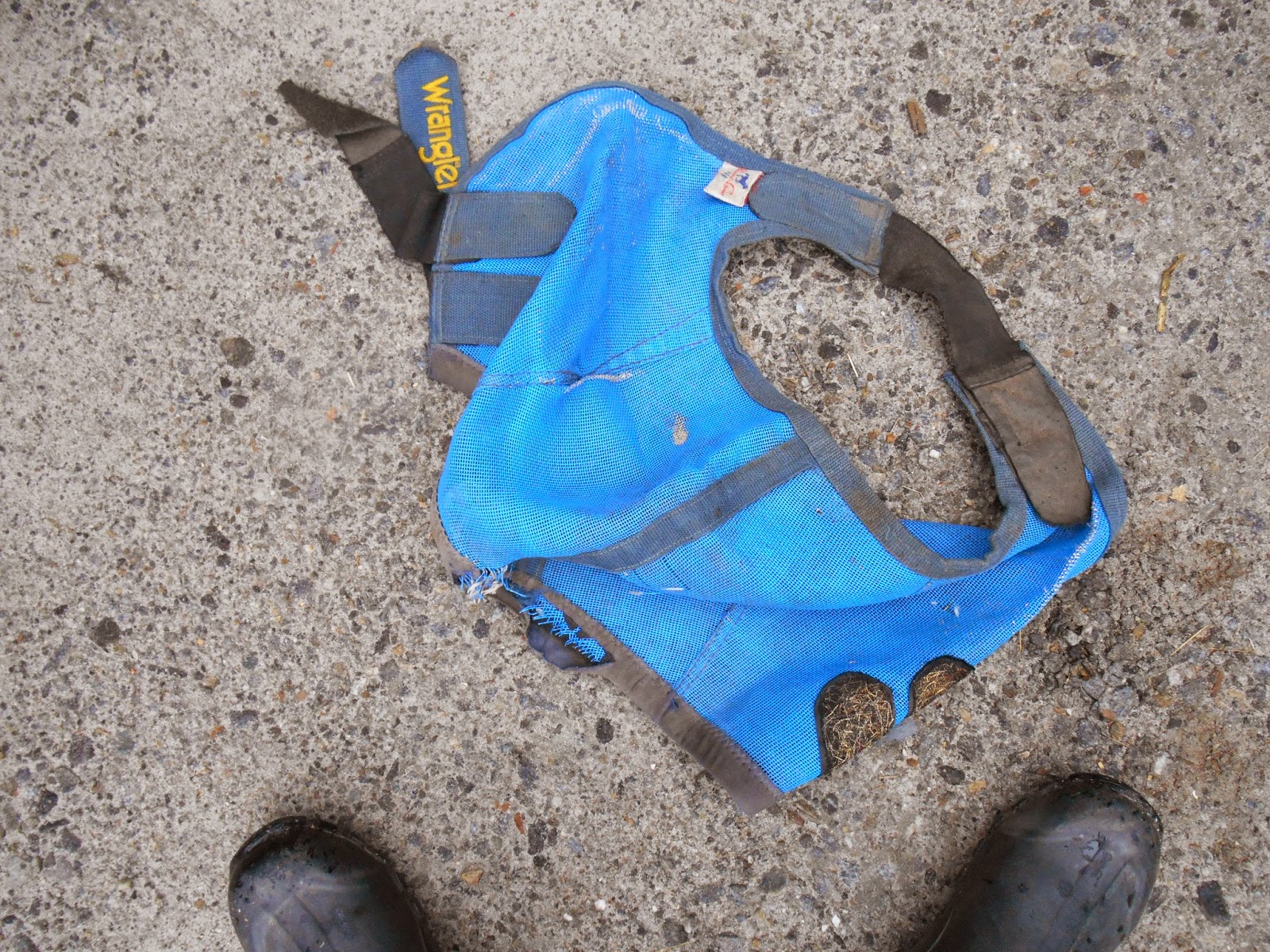
Until last week, this was the only fly mask Tristan has ever worn.

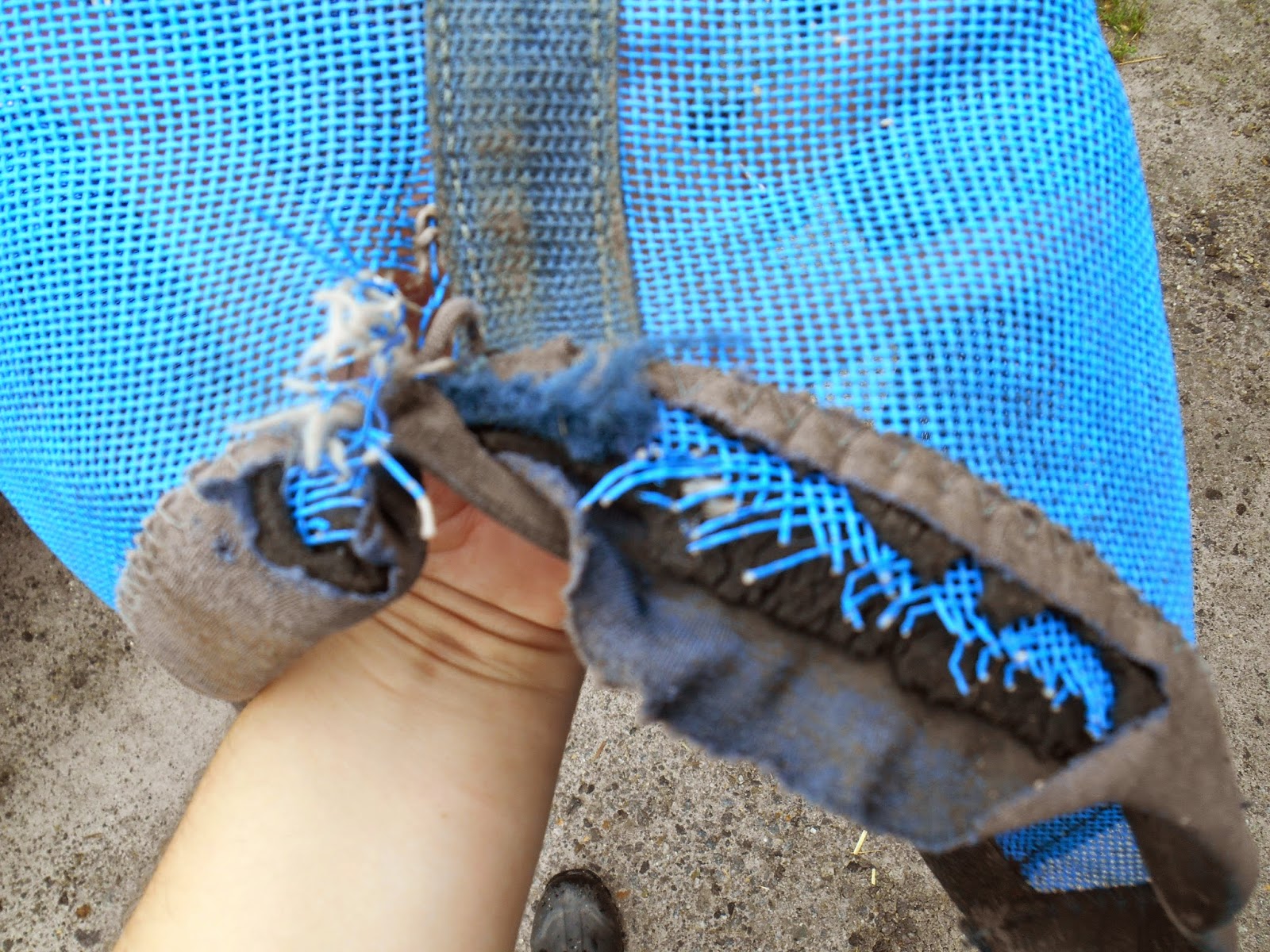
It has held up through eight years: games of halter tag, rainstorms, endless rolls, six barns, countless different turnouts. It has been retrieved from mud and puddles and knee-high grass and once, when he had an eye funkiness going on, snow.

It’s a Wrangler Fly Mask, and had I my choice, I would never buy another kind. I bought it almost by accident at first. I wanted something with a better edging over the nose, since it hits exactly at his halter scar, and this has a line of nicely stitched neoprene at the nose.

I had bought a replacement for it years ago because I loved how well it held up. They were not easy to find even a few years ago, and given that a Google search now turns up only some scattered Ebay listings, they’re no longer made.

I rode out one last time to find this one, and located it quickly in the tall grass, but upon picking it up and examining it, realized it was probably time to retire.

I won’t throw it away, because I have Issues, but it’s no longer in active use.

Rest in peace, best fly mask ever.