Of course, we are replacing a roof at the precise wrong time to do so, according to global lumber markets, but…we don’t have too much choice in the matter. Project costs have gone up 30% since we first agreed on the work in February, ouch.
It’ll be good to have done, though.
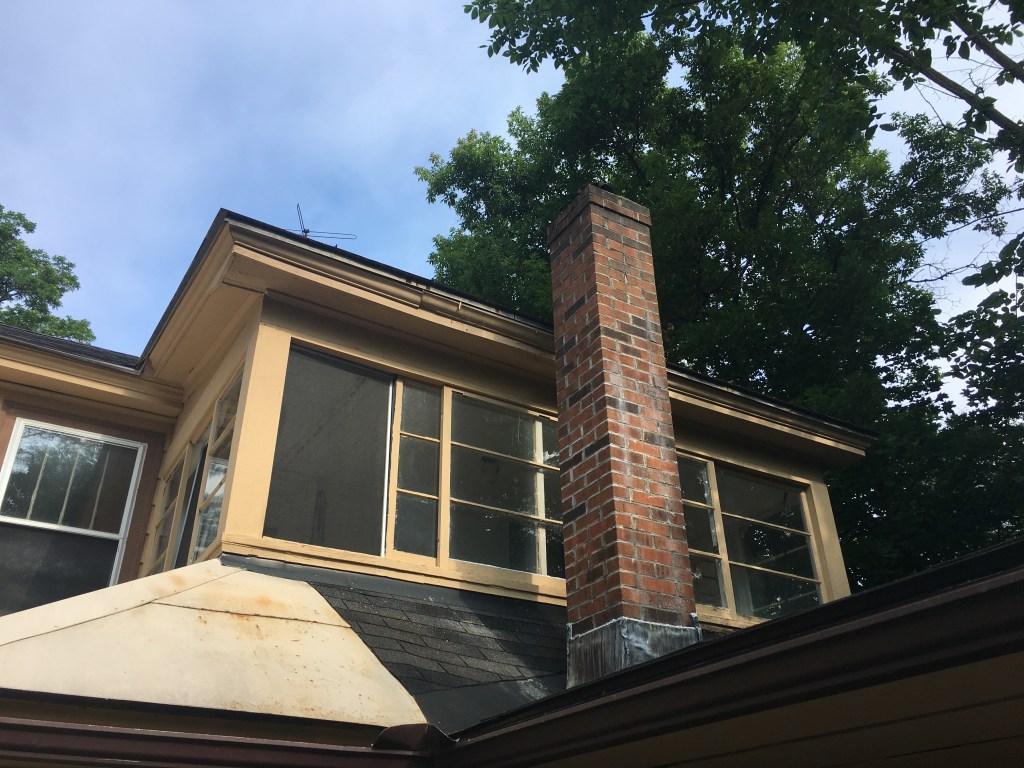
Here’s some before shots.
Here’s one sort-of in progress photo. It’s been POURING all weekend, so the contractor just did a little bit of opening it up and a lot of measuring on Friday. You can see that he took off the fascia trim to make sure he was matching it, and also get a sense of what was underneath the roof itself. It doesn’t come through in the photo, but there are – no exaggeration – at least a dozen wasps’ nests underneath the roof. YIKES.
Far from the most exciting house stuff, but in the past couple of weeks I have gotten fairly aggressive about our yard, which is difficult in the best of times.
I don’t necessarily need or want it to be a perfect manicured lawn, but I would like complete coverage, whether that is a wild strawberries/clover mix (in some parts) or grass.
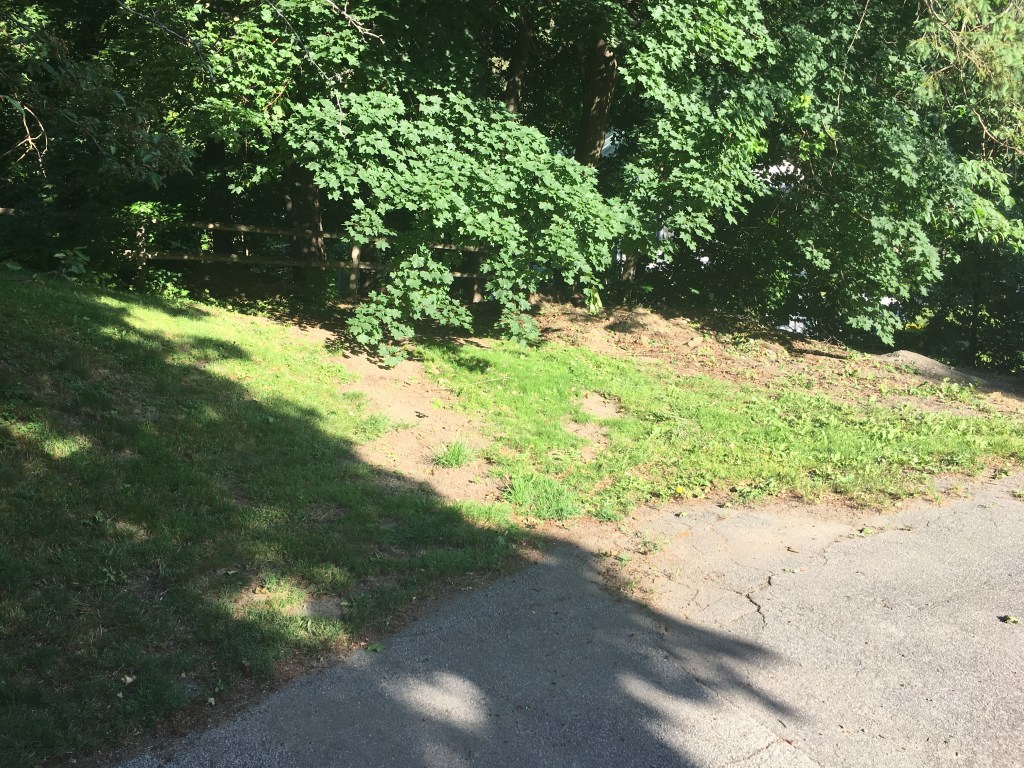
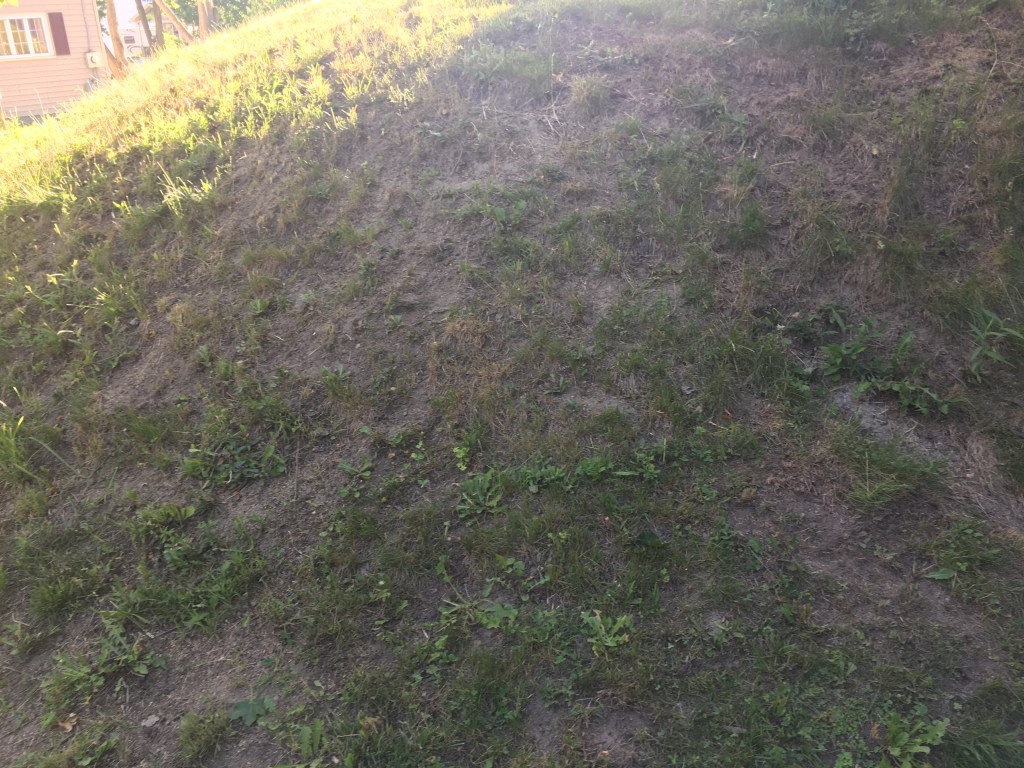
I am attacking this in phases. Right now, I have three areas I’m working on: bare patches in the back yard from dog pee, a bare patch in the side yard from my husband’s dead car being parked there for 18 months (it is a long story and not worth relating for the sake of my blood pressure; it is gone now) and the side hill from inattention, erosion, and not enough sun.
The back yard is getting tackled with an actual “patch” product and is actually waaaaaaay better than this time last year, when I started poking away at it. Basically, ruck up the spots with a metal rake and put on the patch stuff (which is seed, fertilizer, and mulch in one) and water it regularly.
The old Prius spot got a good start with just a surface application of a “dense shade” grass mixture but there are some stubborn spots, so I worked on those a bit today.
Basically: a lot of water, then mixing up the soil, then laying in a local blend of grass seed, then more water, and then straw on top. I’ve never used straw before but I gather it will help.
I did a slight variation on that same process on the hill. There, I took the metal rake and really went to town on the dead spots first, really clearing out the grass and other stuff that was clogging the soil and exposing the roots of the grass that was there. Then water, grass seed, mixing the soil, water, and straw on top.
five award nominees (Hugo, Nebula, Dragon, Pulitzer, etc.) (7/5)
two books about science (1/2)
three classics (0/3)
three books about organizing/politics (4/3)
three memoirs or biographies (2/3)
How was June? A couple of books I really loved, actually!
First: The Goblin Emperor by Katherine Addison is hands-down one of my favorite books of the year so far, maybe of the last two years. I just loved everything about reading it. It was incredibly well-realized high fantasy with everything lined up: writing, world-building, character evolution, you name it. I deeply enjoyed just being in the world of the book, and wanted it to keep going forever, and it was quite a long book. A good antidote to the “all high fantasy must be angsty and dark!” trend right now.
Deathless Divide by Justina Ireland was the sequel to Dread Nation, which I read last month and enjoyed the heck out of. The basic premise is “What if the Civil War, but zombies?” but the actual substance of the book is about race and the choices that we make and the trauma that people endure and also, yes, there is a lot of zombie ass-kicking.
Dreams from My Father by Bararck Obama was…okay? I dunno. It was fine. I did not dislike it. I didn’t particularly like it, either. If you want to bring all conversation in a Vermont room to a stop instantly, mention you’re currently reading it and don’t particularly think it’s very good and WHEW utter silence and looks of horror. If you want to know more about President Obama’s worldview and life, it’s a good look into that. If you want actual conclusions or broader theories about politics or organizing…I suppose you could dig and find some but…you’d have to dig.
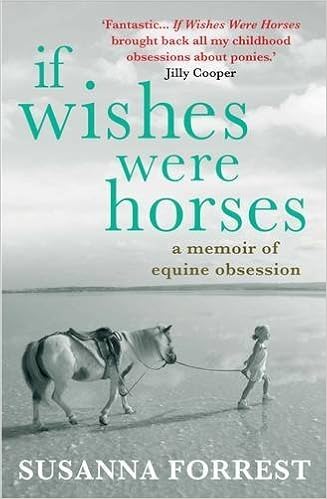
While The Age of the Horse was an externally-focused international history / travelogue, If Wishes Were Horses is much more internal. It’s an example of a very typical style of memoir: the author was a horse-mad kid who fell away from that world, and as an adult gets back, and goes on a journey of self-exploration while doing so. Some of these books are very good; some of them are not. I’m happy to say that this one is extremely good.
Many of the same hallmarks of Forrest’s writing are here: incredibly literary prose, a deep empathy for and observation of her equine characters, a finely honed sense of the ridiculous or the absurd. I would say that sometimes these things don’t work quite as well in this book; sometimes her observations about the horses in her life strike me as a bit too human-centric, and sometimes she’s trying so hard to be literary she pulls a metaphor truly out of the depths of, say German Romanticism that I’ve never heard of.
Ultimately, this was a faster read than the other book, not as dense, not quiet as absorbing. It still took me for a journey that I very much enjoyed, and was at its strongest when probing the popular culture origins of the horse girl. Forrest did a really good and effective survey of children’s literature featuring horses as well as instruction books, memoirs, and the origins of Pony Club to construct a narrative of a late 19th/early 20th century shift in horse culture that took place alongside the fading of the horse from industrial spaces. It worked well with her memoir sections, seeing as how she had grown up amidst this popular culture herself, reading and internalizing many of the books and narratives she describes.
Of note: it’s a very, very British book. That was fine by me, but that means sometimes the references take on the feel of an inside joke, especially the ways in which she travels and interacts with the British countryside. (My geography is not great for England, so I frequently got lost, which, whatever – it wasn’t crucial – but it did mean that sometimes her passages had a hypnotic quality and I just had to keep reading past the names of towns and rivers and shires without really following.)
Overall, highly recommended if you are interested in a good horse memoir with interesting and thoughtful detours.
It can be a blog hop or not, you do you, but I thought it’s a topic that everyone has opinions and their own personal variations on: bathing your horse.
Do you bathe regularly, or only before shows? What’s your temperature cutoff? Any favorite gadgets or shampoos? Any other strong opinions?
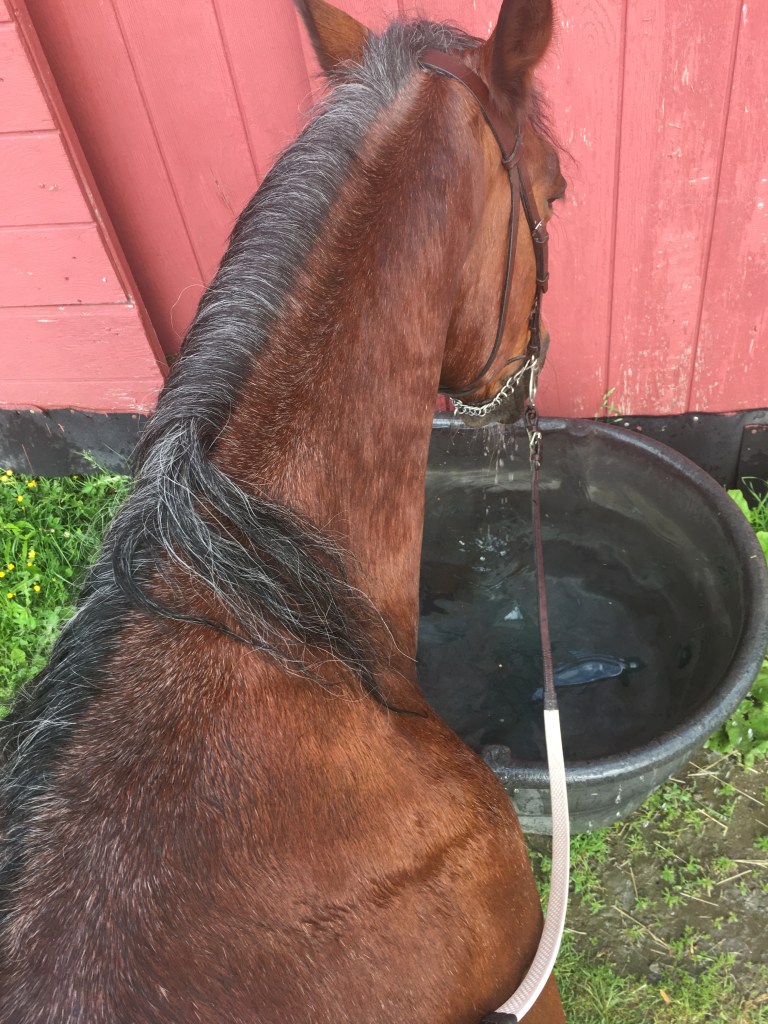
I bathe Tristan always before shows, weather permitting, and maybe a handful of other times during the summer. I’m pretty neurotic about temperatures – below 70 feels a bit too cold for me for a bath just for fun – so it’s become an activity that we can do when it’s too hot to ride too much, but I want to get some interaction with him.
He would rather I not. He’s never liked water. He stops a good 20′ away from the wash stall and glares at me, and dances the whole time. You can take the mustang out of the desert, but…
Important note here: I sponge or hose him off if he gets at all sweaty during work. So by bathtime I mean a full-body shampoo plus rinse.
I do his mane and tail maybe every other time – shampoo and leave-in conditioner. He’s got pretty thick, full hair in both spots, and they’re both salt-and-pepper so they don’t show dirt too much.
I use either a jelly curry comb (the plastic mitt ones that have little spikes on one side and bigger spikes on the other) or this fun hand mitt thing that I got from my free Saddlebox a while ago.
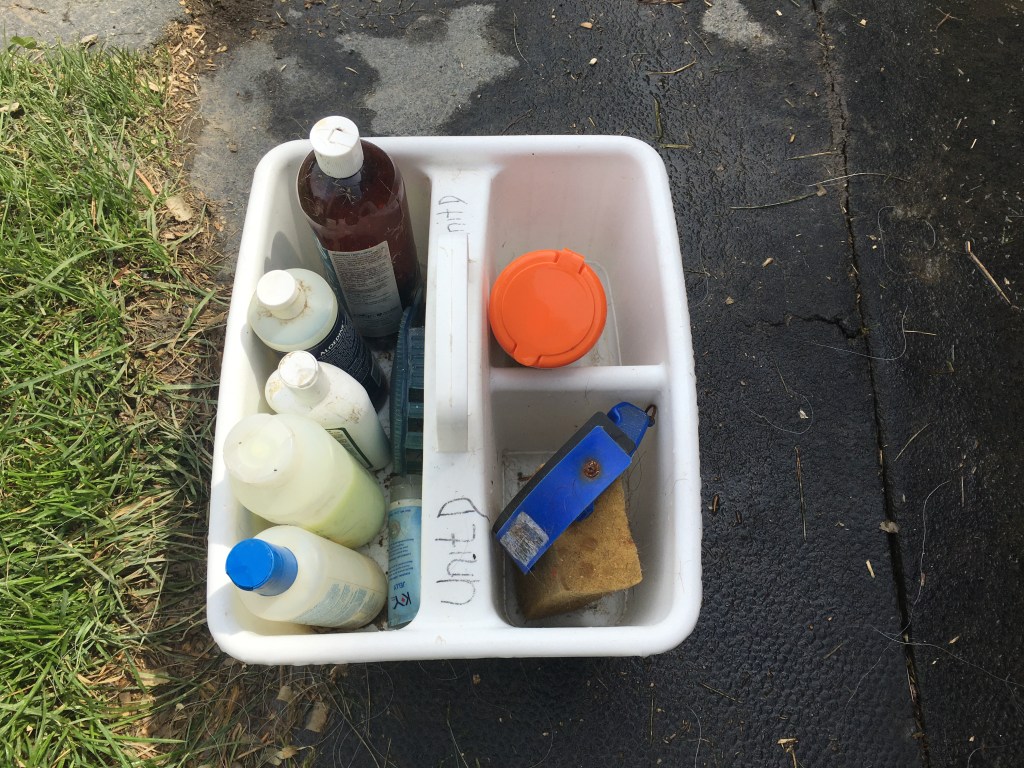
I don’t know that I have a favorite shampoo, I’ll be honest. I use whatever I have on hand. Right now, that’s fancy Sore No More shampoo because I got it on a killer clearance deal at a tent sale, but in the past I’ve used just cheap human shampoo. I do keep a bottle of Farnham’s Aloedine on hand for when his skin gets a little funky – when he gets hives, for example, he gets bathed in that. Same for conditioner; right now I’m just using cheap Suave stuff. I’m lucky in that I don’t have to get too fancy for him, usually.
I use a sponge sometimes, for his face, and like the small-size curved rubber sweat scraper I bought on impulse several years ago, because I can work it into crevices and down his legs, unlike a flat sweat scraper or the larger rubber ones.
I also have that great carrying case that as you can see used to be in a hospital. Genuinely no idea how I got it. Probably my mother.
In a lifetime involvement with an intensive sport, it would be the rare person who has never hit a bit of a wall with horses.
I’m not really there right now, though I have been in the past. I am, however, at some kind of overall life burnout. Taking two weeks off only served to highlight that there is a deep imbalance in my life right now. I’m not entirely certain of the solution, especially given my core workaholic / productivity guilt values system, but – something’s got to shift.
Central to this, of course, is the understanding that many (all?) of the balls I have in the air cannot be dropped. The day job is one I’m passionate about, and it pays the bills. The horse is obviously a non-negotiable. My city volunteer work is a source of deep pride and intellectual engagement for me. My political work is energizing, fascinating, and feels vital in a way that lots of other things don’t. My house is 100 years old and needs regular upkeep, and my brain actively fizzles out if it’s filthy. (I am sensitive to the argument that many of these weights could or should be shared, but that is simply not my life situation – it’s all on my plate. Wishing it otherwise changes nothing.)
Some things in my horse life have dropped off the radar in a good way, though. I’ve usually burned out on riding (and to be clear – I’ve only ever burned out on riding – not on owning a horse) when I’ve been focusing too hard on some goal. A show. A stumbling block in our flatwork. Some kind of ugliness Tristan is tossing at me in specific situations. A lot of those things are better right now – moving Tris to the mental state of “semi-retired” has taken away a lot of the pressure.
For me, when I know I’m approaching some kind of line, it feels like wanting to burst into tears at the thought of getting up from the couch to change into breeches. It feels like sitting in my car in the barn parking lot, talking out loud in a pep talk to convince myself to opening the car door, swing my legs out, put one foot in front of the other. It feels like tossing a bareback pad on and calling that a victory. It feels like watching the clock while in the saddle as if every step of the work is molasses, if I just get one good trot, I can call it a day.
Sometimes I try to shove through and it works. Sometimes I try to shove through and it’s a disaster. Sometimes I let myself loaf off and it’s just what I needed. Sometimes I let myself loaf off and every single second until I go to sleep is an agony of self-loathing and recrimination for not bucking up. You’d think after so many years I’d have figured out my brain but wow you’d be wrong.
So here I am, realizing that the deep rest and focused personal time of the last few weeks did nothing but heighten my awareness of some things in my life that are not what they should be. I rode or groomed every single day of those two weeks, and the week following, and it was terrific. Tonight, as I write this, I’ve opted out of barn time, feeling drained by a day at work that was a struggle and some heavy lifting for political organizing work over the last few days. It only took a few days back at work to feel panicky and trapped again.
I’m wondering: what does it look and feel like for you when you’ve hit a point of horse burnout? How do you handle it? Do you have a sense of how to wrestle with it, or like me do you feel a bit powerless?
Longer time readers will know that Tristan has had something of an evolution on being ridden outside in the last few year. As a younger horse, he was about as dependable as it gets. You could hack him anywhere bareback in a halter. That was his pattern for the first few years at our current barn, too.
Four or so years ago, he started becoming significantly less fun to ride outside: bratty on trail rides (always trying to turn home, and I mean ALWAYS), totally unreliable in the field (at any second he could go from chill to bolting), and frustrating as hell in the outdoor (got super strong and then bolted/bucked, especially in the end away from the barn).
The jury is out how much of it is attitude and how much physical. Probably both! It could be that he was getting a bit stiff/sore and that became behavioral. It could be that he just decided he was done, because this behavior would happen on short, totally flat road hacks, too..
This year, I’ve taken a careful and measured approach to re-introducing outside work, and generally so far so good.
That is not to say he’s been perfect; he’s had one or two snit fits, but they’ve been contained quickly, and the vast bulk of his work has been good and willing. I don’t need foot-perfect! I need generally cooperative.
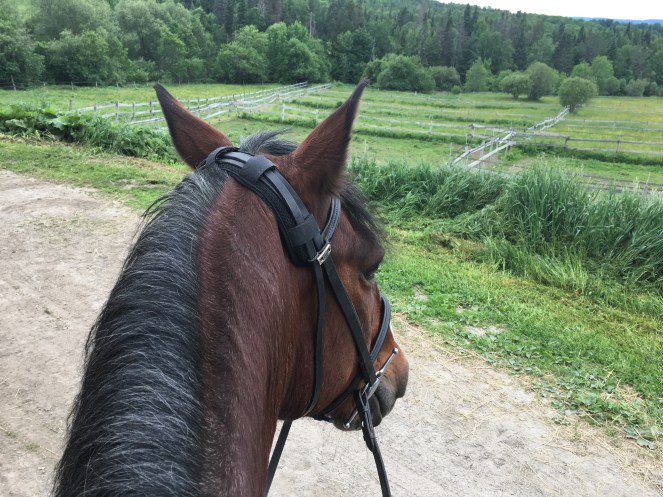
We’ve even had a few lessons in the outdoor rings, both the upper dressage ring and the lower jump ring. The night before the dressage ring lesson, I took him up just to see how he’d be; I put in his figure-8 bridle with the kimberwicke and my intent was to take him as far as he was polite. He ended up giving me 15 minutes of very chill walk-trot-canter in both directions, even in drizzly rain with thunder in the distance. And then on the walk home, within sight of the barn, 100′ away, he jettisoned every single one of his marbles and went up and sideways hard and I stuck it out through sheer determination. I still have no clear idea what was up with that.
He was good for his lesson the next day, though, and last Friday was quite good for a fun lesson in the jump ring that incorporated lots of pole work. He even got quite strong and eager (he still loves pole work, he keeps hoping we will make them into jumps someday) but was still rideable. Toward the end, when he got a bit tired, we had one canter that was…not exactly in control, but it wasn’t out of control. You know those canters sometimes where you’re sitting thinking “this is actually a great canter, I have no real complaints, but I also have zero idea how to stop it”? Or is that just me? Anyway, one of those.
Most of his naughtiness has been on the longe line, where it often is, hence this rather spectacular effort from last week, what was supposed to be a 10 minute loose suppling longe after a Theraplate session and, well, he had FEELINGS.
All in all, I have no real complaints! I will still be cautious, because I am not stupid, and I will still use the kimberwicke quite liberally, because he respects the hell out of it, but I hope to have a good outside summer.
I’ve had this idea for two years or so, but this spring finally implemented it.
Longtime readers will know that with his Cushings diagnosis some years ago, Tristan went from a horse who owned a mud sheet and cooler and that was it, to a horse that needed a full array of complicated heavy winter blankets. After a few years of fine-tuning, he now has a wardrobe that keeps him comfortable and happy all season.
That means, of course, that I’ve had a learning curve of how to care for and store expensive winter blankets. Each year I’ve tweaked things a little bit, and this year I’m really happy with the process, with the addition of some relatively inexpensive vacuum bags.
First, before I got to the storage piece, I needed to do a thorough cleaning and re-waterproofing. In the past, I’ve used NeverWet, and I still like it quite a lot, but this year I wanted badly to purchase something local rather than ordering online, so I ended up with Kiwi CampDry Heavy Duty Water Repellent. One can was enough to do one good layer on one blanket.
Left is his rain sheet, right is his medium. I sprayed them thoroughly, outside, wearing a mask, and then left them to dry for 24 hours – also outside, since we weren’t forecast for any chance of rain. After about 12 hours most of the smell of the waterproofing had dissipated.
Then came this year’s innovation, which I am delighted with: storing them in vacuum bags. I keep my excess horse equipment in my basement, which is fairly clean and dry as far as basement goes, but still gets dirty. Winter blankets especially are so bulky I hadn’t yet found a good way to store them neatly.
I bought these vacuum bags from Amazon: eight of them in the large size, after doing some rough measurements of one of my blankets folded up neatly. That size proved to be just fine for all of them, though the heavy was getting close to the max. Tristan’s blankets are all 72 or 75, so if you have anything larger than that, you might consider the jumbo size.
It really was a simple and fast process. Doing the four I wanted to store took maybe 30 minutes. They’re now stored neatly and cleanly with my other horse stuff in the basement, waiting for fall.
F
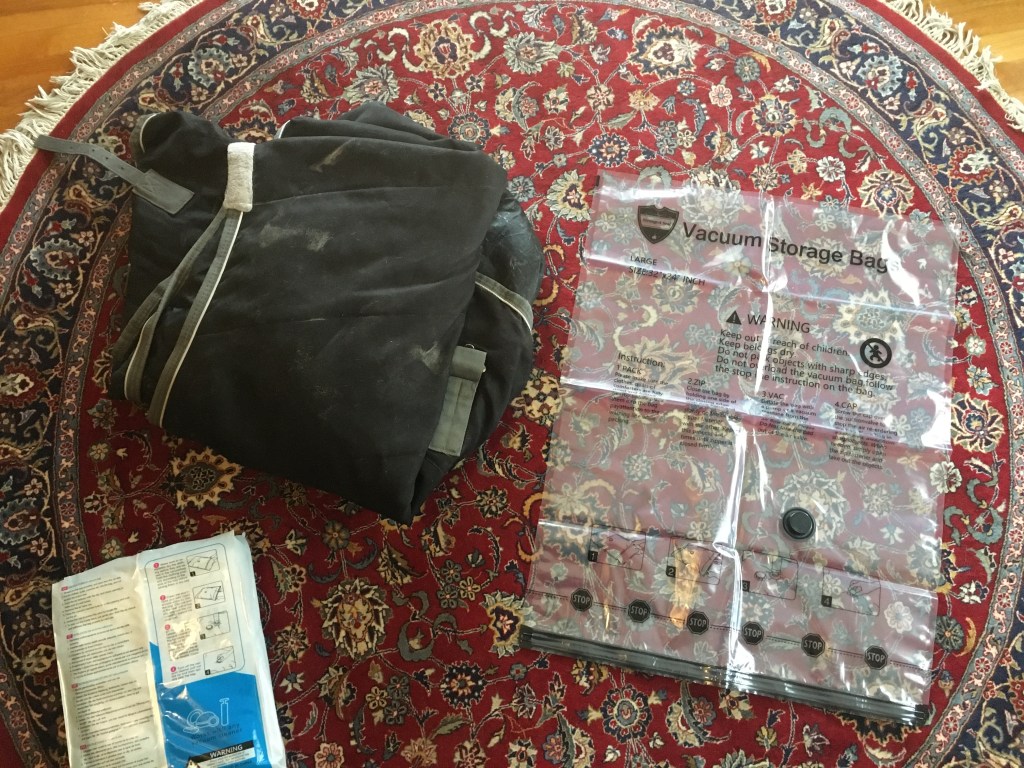
This is his medium weight stable blanket, and you can see it folded up next to one of the large bags.
Here it is inside the bag, not yet suctioned. I would say my only challenge came with making absolutely sure the seal on the zipper was good. I went over each of them 2-3 times, per the instructions. On one, I still didn’t quite get it perfect and had to go back, but that added only about 30 seconds to the process.
The kit came with a sort of reverse bicycle pump to suck air out. I used that instead of dragging out and hooking up my vacuum, and it was still pretty fast.
This is his medium, to give you a sense of one of the larger blankets I stored.
And here’s how it looked after compression! A significant reduction in size.
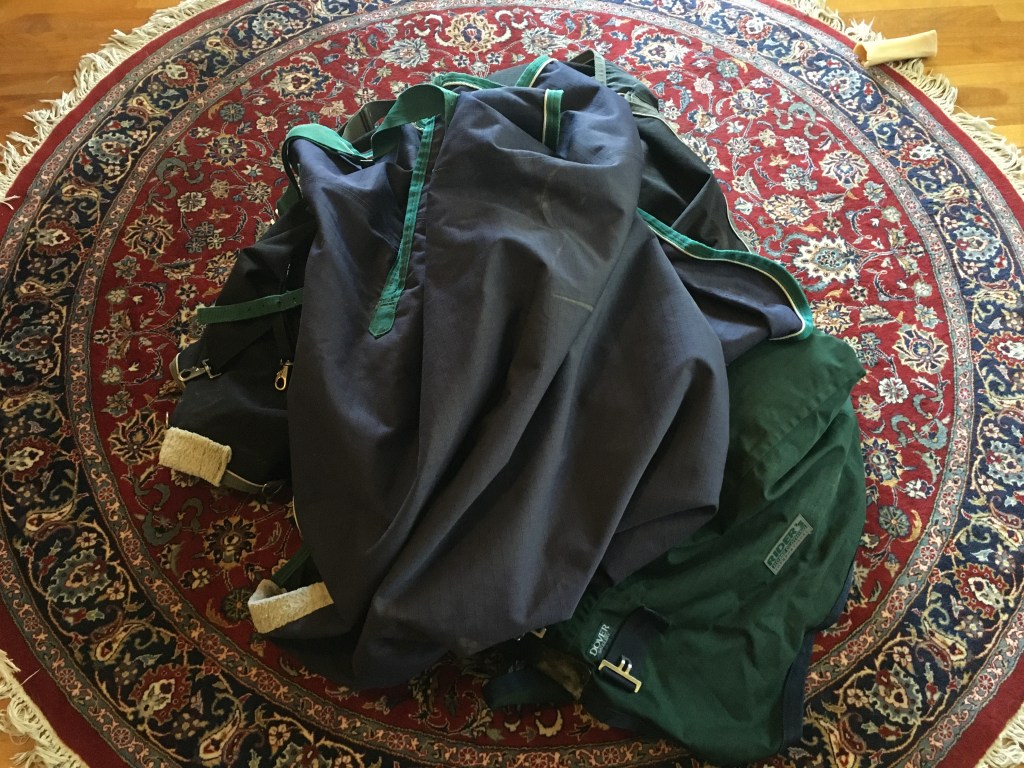
So in the end my tangled pile of blankets was transformed…
…into this neat pile of bagged and stored blankets!
All blankets cleaned, waterproofed, and stored before June 15; that’s got to be some kind of record.
At the beginning of the year, I set some reading goals in broad categories and said I’d blog about my reading generally.
Here’s my progress on my categories:
To recap my goals list:
one book in French (0/1)
five books about horses (2/5)
five books about Vermont (2/5)
five books from the “to be read” pile (3/5)
one book of poetry (0/1)
one play (0/1)
five books by authors of color (10/5)
three books about museums (2/3)
five award nominees (Hugo, Nebula, Dragon, Pulitzer, etc.) (6/5)
two books about science (1/2)
three classics (0/3)
three books about organizing/politics (4/3)
three memoirs or biographies (1/3)
Some highlights:
Firsting and Lasting: Writing Indians out of Existence in New England by Jean M. O’Brien. This had been on my TBR list for years, and I bought myself a copy in January with the goal of grounding myself better in Indian history writ large and Abenaki history more specifically. Firsting and Lasting is incredibly dense, incredibly thinky, and incredibly brilliant. O’Brien uses sources nimbly, thoughtfully, and creatively, digging deeply into local histories that have long been handwaved as not useful. She puts together a compelling argument that is both simple and nuanced: that local histories in New England (she focuses specifically on southern New England but the same narrative applies to north) constructed a shared lie about Indian habitation in order to support European-centric colonization goals. The lie went “Indians were here, and now they’re gone; our civilization is the one that matters, and is therefore first in all the ways that count.” A truly superb work of history, worth the slow, careful, long read.
A Deadly Education by Naomi Novik. Zippy, charming, smart, fun read; magic boarding school constantly tries to kill its students. Our narrator is destined to become a supervillain, but is actually a decent person, and somewhat accidentally befriends the school’s destined hero. The characters were all keenly drawn and immensely likeable.
Happy City: Transforming Our Lives Through Urban Design by Charles Montgomery. For a local book club on building better communities, and to background my work on our city’s planning commission. I absolutely devoured this; it was the perfect combination of thinky, inspiring, and readable. It’s totally changed the way I think about even my small city.
From Blood and Ash by Jennifer L. Armentrout. Along with sequels A Kingdom of Flesh and Fire and Crown of Gilded Bones. These hit my quota for smutty, compulsively readable, intensely plotted fantasy for the month. Do you like your brain? Do you think it’s kind of fun when it’s melting out your ears from all the plot twists and the character reveals and the sexytimes? Definitely check these out. Then hit me up because I’m probably organizing an online book group for the new one coming out this fall.
The deal we make with Vermont is that we put up with the miseries of winter, the weeks of below-zero temperatures, in exchange for a perfect summer that only very rarely goes into the mid-80s.
Joke’s on us this year! We’ve already had two little heat waves that have hit 90.
On Monday, I returned to Vermont after a weekend in Maine (I just…left the state! without making elaborate quarantine plans or getting a test or anything! it was GLORIOUS) and it was just too damn hot to ride, despite my commitment to riding as much as possible during my vacation.
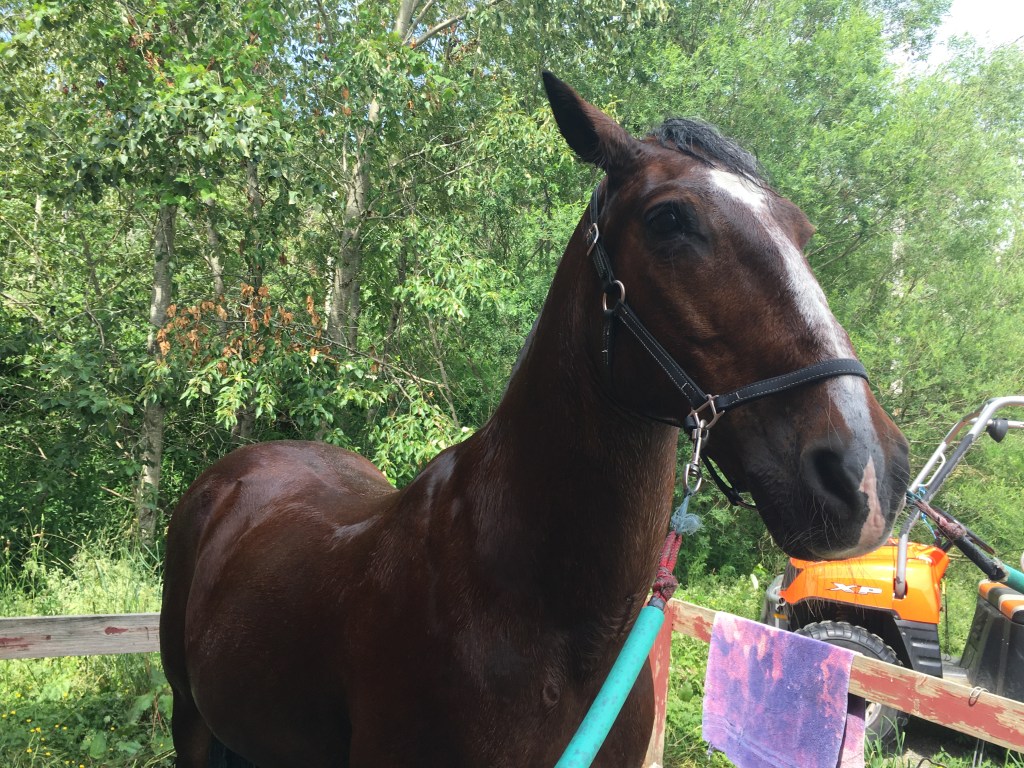
So, Tris got a bath instead.
He DOES NOT LIKE baths. Or water generally. But I bribed him with treats and really went to town, shampooing his tail and leaving in conditioner while I shampooed the rest of him.
He’s such a funny color that I always forget that yeah he really does look better after a bath. Too often the dirt just sort of blends in with his variegated coat and you can only really tell if you look up close.
Now he is bright red and shiny, and soft. He set a new land speed record for rolling after a bath, dropping 5 minutes into our handgrazing session to dry him out a bit. Oh well. At least it was only on grass.















 beljoeor.com