At some point soon I will do a review of the Two Horse Tack halter Tristan has been in for almost two years, but today is not that day. It has served its purpose admirably – to get beat up and soaked with disinfectant constantly – but I am ready to go back to a proper leather halter.
I’ve decided a really nice new halter will be Tristan’s Christmas present this year, so I am asking for advice.
I know what I want:
black leather
3/4″ leather width
good nameplate (true deep engraving, none of this surface engraving that scratches off in 3 months)
maybe gray padding?
nickel/silver hardware
clip attachment at chin, NOT bolt snap
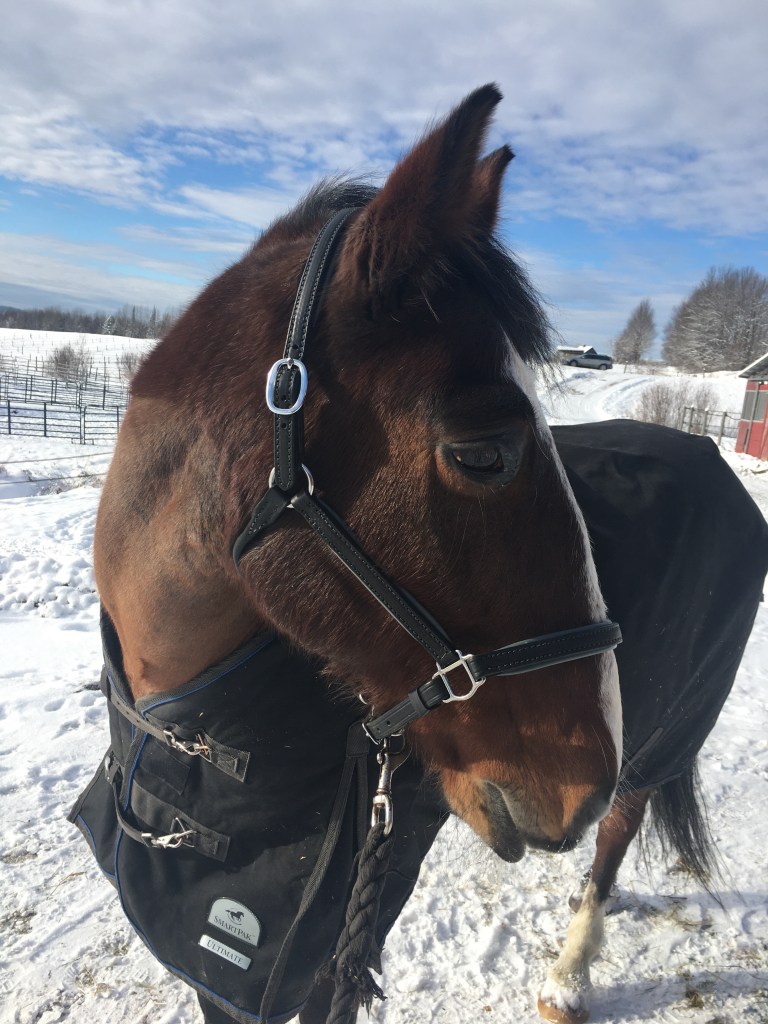
So far in perusing various websites, I can’t yet hit all of these things. The 3/4″ width leather is the trickiest. I know it’s non-standard, but it’s what I ordered his Two Horse Tack halter in and I’ve kind of fallen in love with the way it refines his thick mustang head a little bit.
Here he is in the THT halter, for reference, so you can see what I mean by the 3/4″ width just working a bit better for him.
What’s the saying? You can’t improve what you don’t measure?
It doesn’t quite apply to horses in the same way as it does to nonprofit programs, but still.
Last week, our barn hosted a sort of fun little measurement clinic. The feed rep and the vet were out. Originally there was supposed to be a big flat scale, but it broke right before I got there, sadly.
We still did a couple of other measuring type things! First up: height. Tristan measured exactly 15hh, which is about right. I’ve had him at 15hh 1/2 and usually rounded up to 15.1hh in the way that horse people do. It was fun to get the proper stick out, rather than just do the tape from the ground, which is how I’d always measured him before.
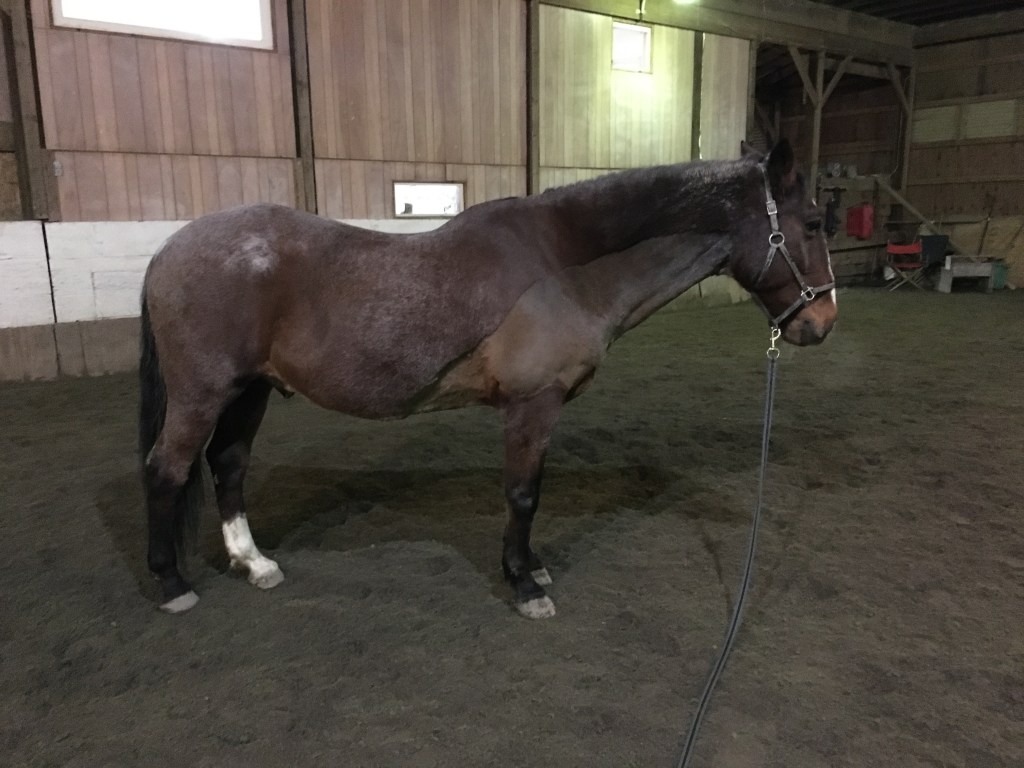
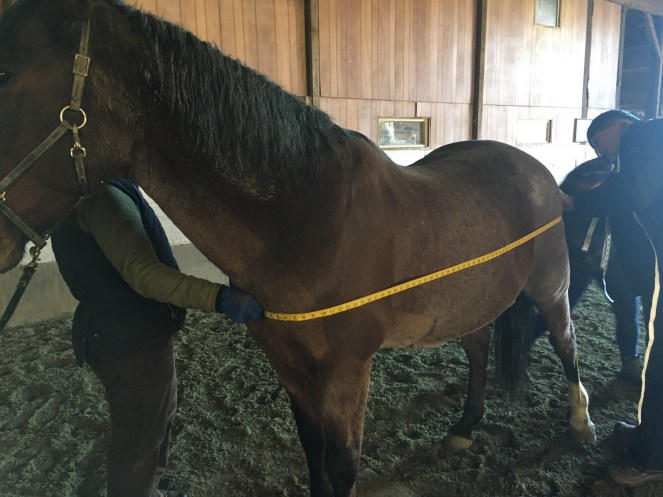
We also measured him front-to-back just for kicks. (Yeah, I probably could have knocked a little more mud off, #sorrynotsorry.)
He measured at 73″, which was as expected. He tends to be either a snug 72 or a roomy 74. Generally I order him a 72 in the Smartpak blankets, since they seem to fit his body type well.
Finally, though I did not get a photo, we weight-taped him at 996 lbs, which the barn manager thought was spot-on and I thought was a touch light. The idea was originally to compare the weight tape to the flat scale for fun. The good news is that next week the vet & feed rep will be back with the scales, so we can check again then!
So there you have it. He really is a little thing. Large for a mustang, but small compared to the big fancy dressage horses that are more typical at my barn.
I’ve made a few oblique mentions in the past to our looming window project, and it’s finally time to start addressing it.
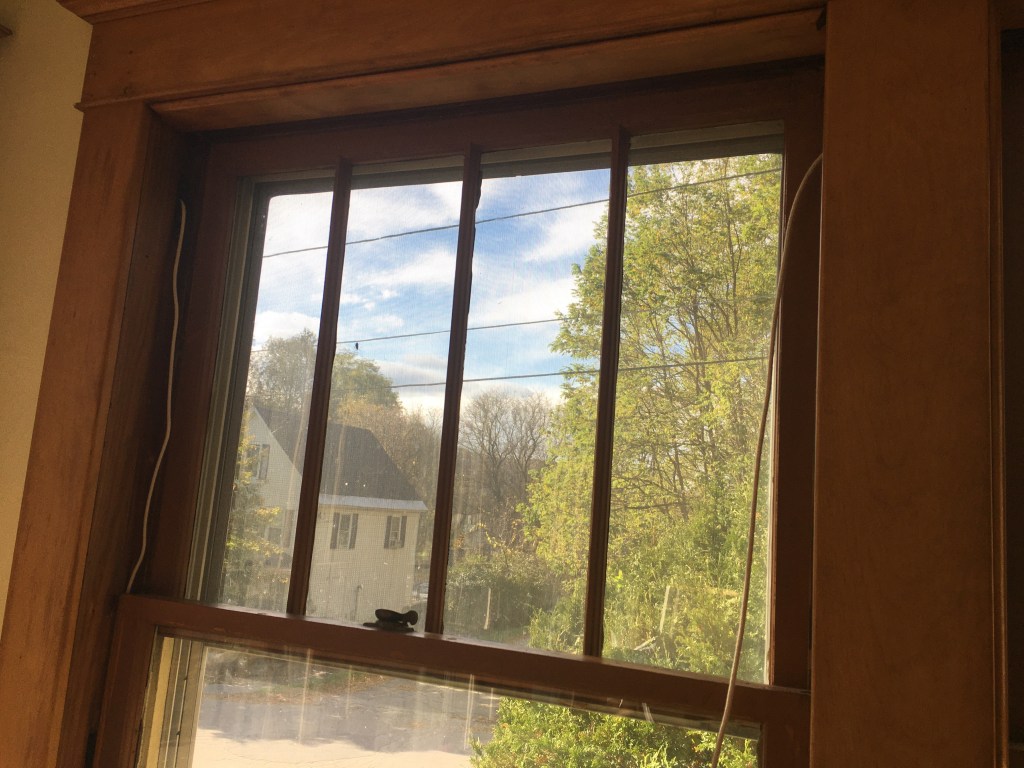
We have about 45 windows in the house, spread across two floors, the basement, and the attic. Every single one needs attention of some kind. I’ve known this since we moved in. All of the windows are original to the house (or more accurately to the construction of some pieces of the house; they are of different eras depending on additions).
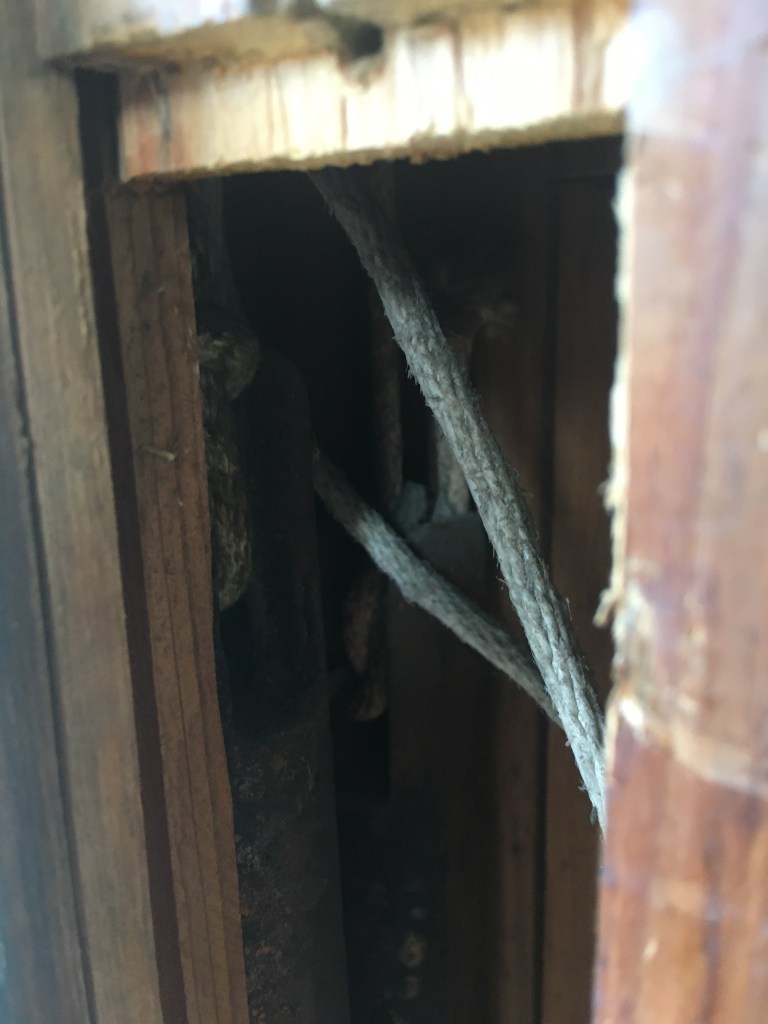
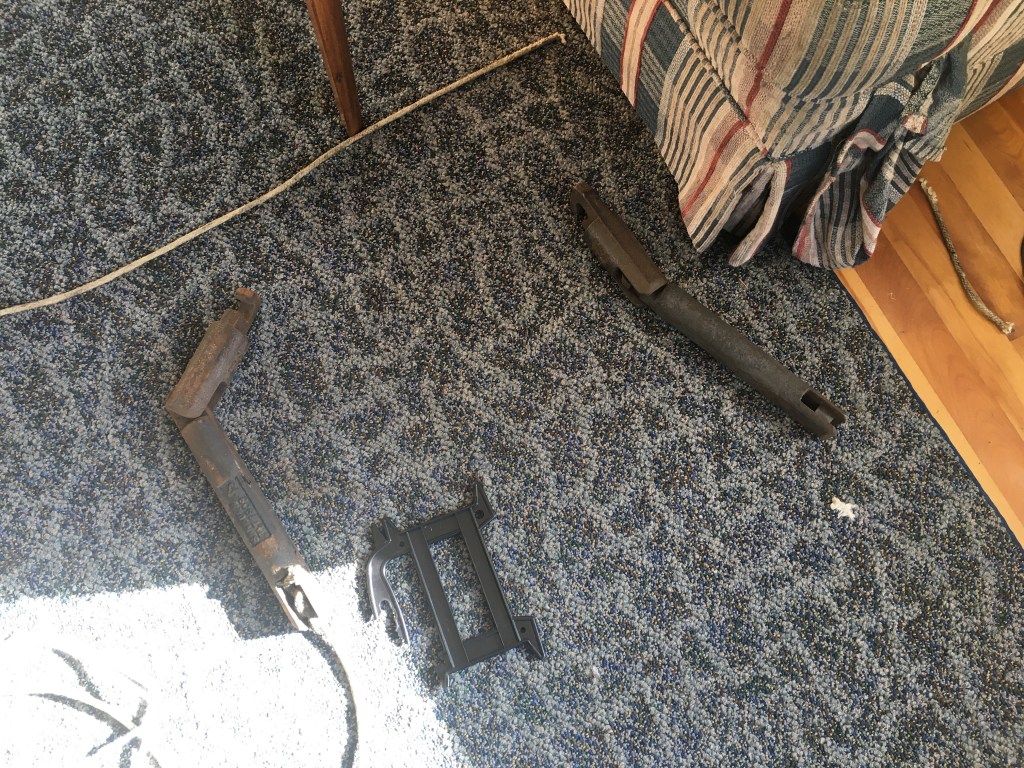
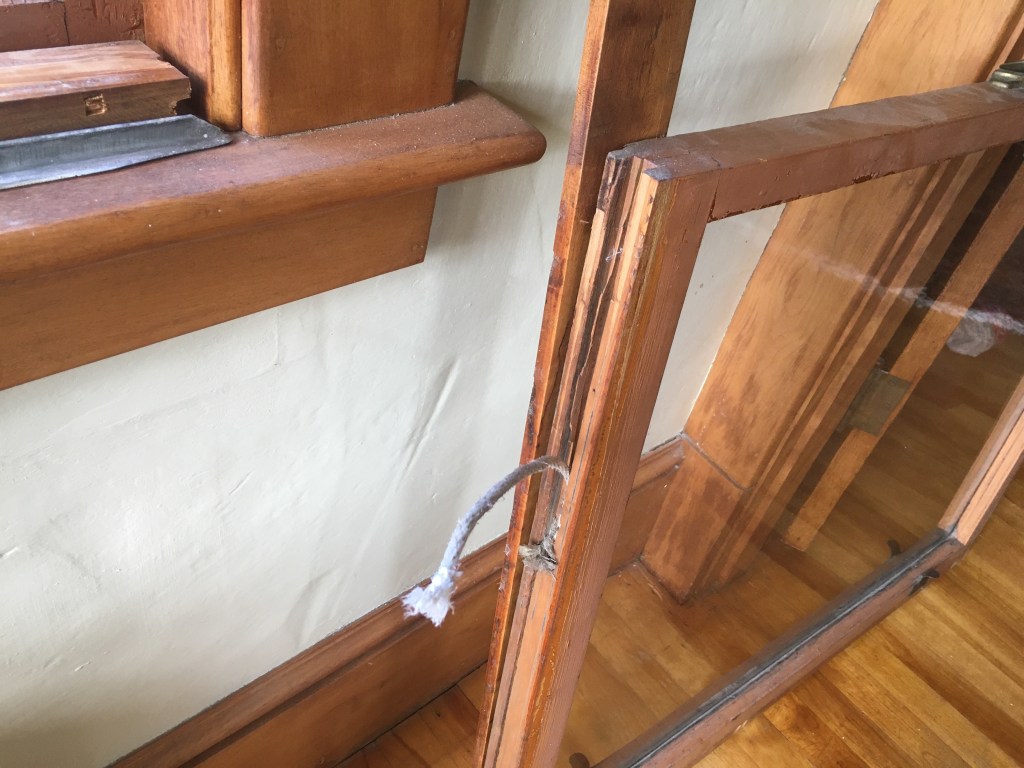
A short list of known problems includes missing or damaged caulking around the storm windows, missing or damaged glazing, broken panes, broken sash cords, missing sash weights, open & uninsulated cavities, and a wide variety of paint issues on the windows, the sills, and the framing.
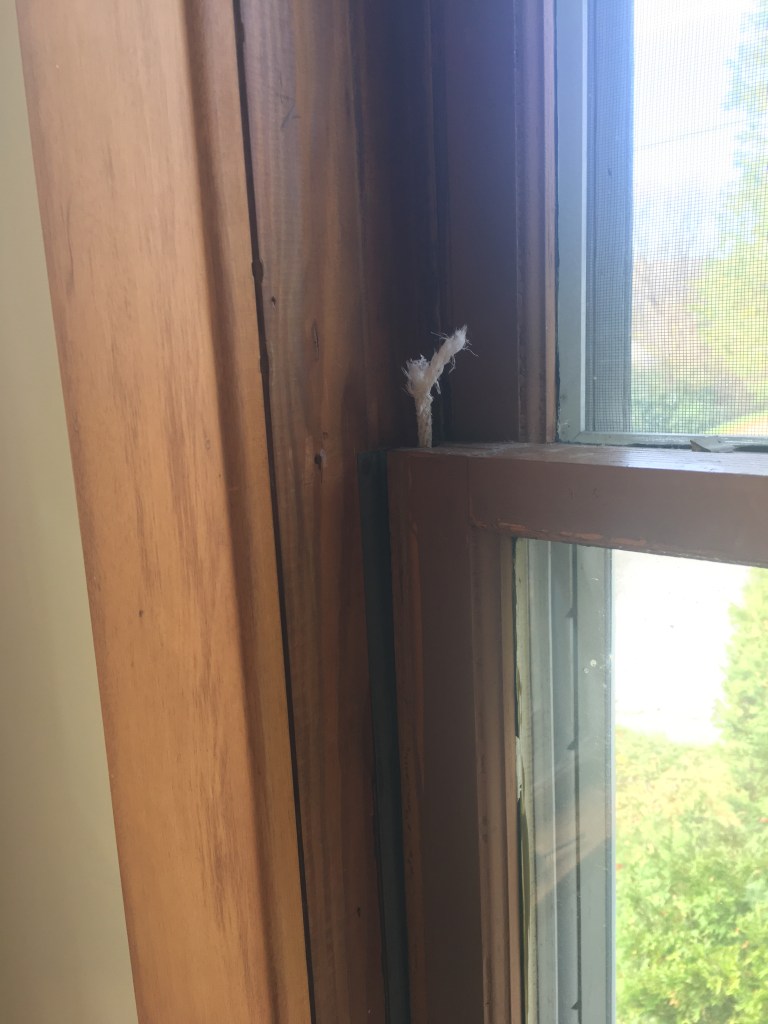
Last weekend, my father-in-law was visiting and we spent about six hours making preliminary investigation on our windows. My goal was simply to figure out how to take them apart, because that is the first step to addressing all of the other problems. While we were working, we also replaced the sash cords on the window, since three out of four were broken and the fourth was old and brittle.
I don’t expect that future windows will take six hours to take apart; we were moving slowly and deliberately in order to figure out the puzzle and make sure we could get it back together.
So now I have a roadmap forward. Next summer – when we can have the windows open or missing for a time – we will start with the sunroom windows, which face the elements the most and have taken a beating. If I can get the 8 windows in that room finished next summer, I’ll be happy.
A few weeks ago, my barn upgraded the footing in our indoor with a cool new product. I’ve ridden and longed in it a number of times since then, and it is super cool.
The product they used is called Recycle Balls Green Gold Horse Footing, and it is exactly what it says it is: recycled tennis balls!
The Recycle Balls company works with Wilson, a tennis gear maker, to turn “dead” tennis balls into all sorts of new things. If you’ve ever played tennis, you know that tennis balls lose their bounce quickly. If you’re super into tennis, you always play with a brand new ball, from a can you’ve just unsealed. (This is where I should confess to being a truly terrible tennis player, despite having two parents who were Division 1 tennis players; I have hand-eye coordination that should probably be measured in negative numbers. But I do know a fair bit about the sport thanks to years of exposure by my parents and later in-laws.)
Recycle Balls puts these bins at tennis facilities that come with shipping labels already on them. You put them out by courts and players stuff their dead tennis balls into them, and when they’re full, they get shipped off to the company, which turns them into all sorts of clever things. (One of their products: huuuuuuge boxes of used tennis balls for dogs at super cheap prices; if you have a ball-mad dog in your life, this would be a perfect gift.)
Bonus: it’s a Vermont company, and you all know how I feel about Vermont.
One of their flagship products right now is their Green Gold Horse Footing. We got two huge bales of it delivered (the smaller one is pictured above, and is maybe 50″ square), and a few truckloads of sand, and it all got mixed in to the indoor arena. The Green Gold footing is both fiber and rubber bits, all mixed up together already, so it has the best qualities of both: bounce and moisture absorption.
I’ve now ridden in it about a dozen times, longed a few times, and watched quite a few horses go in it and it is great. Tristan, who is only vocal about footing when it is really good or really bad, loves it. He’s clearly happier and more comfortable in it. I’ll be perfectly honest: for some time I’ve had in mind a draft post about “how can I tell if my horse likes the footing?” or something like that, because it’s not my strong suit. I wasn’t sure if I could tell. Well, it turns out I can tell!
So: product endorsement from the picky owner of a 26 year old senior horse in active dressage work. This stuff is awesome.
Plus, and I feel like this should not be underestimated, it looks SO. FREAKING. COOL.
That’s not a trick of the light! It really does look neon green! It’s so cheerful and bright and light and fun. I adore it.
Interestingly, and everyone who rides in it has observed this phenomenon, when you drag it you can barely see the green. Here’s what it looks like soon after being dragged.
Then at the end of the day, after a bunch of horses have ridden in it, more of the green fiber sifts to the top. Then you turn it over and the whole thing repeats.
I’m posting this first because I love the footing – I got to see it go in and rode on it and was delighted. Then I found out that they sponsored my trainer to help us put it in. Win-win.
If you’re looking to upgrade your horse arena footing, you absolutely need to talk to Recycle Balls about their Green Gold footing.
I had a lesson this afternoon with the barn owner / main trainer, who I rarely ride with for lots of reasons – most of them schedule. But I’d been hoping to get a time with her before she heads to Florida and today worked out!
I clipped Tris just a little bit before the lesson, since he is fully fuzzy and it was 75 this afternoon, and crossed my fingers that it would not set him off. It did not! And he was hot and blowing enough that I was glad I did it.
Overall, I was really happy with how it went. Some things went well, some things I was able to fix, some things I can take away and chew on. Brief notes:
– we worked on counterflexion on the long sides as a way to keep him straight through his shoulders; flex a smidge to the outside and think of the inside rein as the rounding rein, then drive him forward through that momentary channel. Keep repeating that in tiny increments and think of building power and push through like climbing up a staircase, a little bit at a time.
– my posting mechanic is screwy lately. I am lagging a hair behind him, which is making me fall too far back in the saddle, putting me out of sync with him and catching him in the mouth just the tiniest bit – but enough to back him off when my leg his telling him to go
– we worked on sitting trot for a while without stirrups, which has become a very good way for me to access his hind legs and bring them up for better collection. He is verrrrrry heavy but we integrated some of the counterflexion from earlier and he started to get softer
– need to work on keeping my hands forward. Some more. Always. Sigh.
I have been slacking on the gym and can feel the difference in my posting mechanic especially, but I am in an ugly mental place about the gym. I want badly to go back, but doing so means a very early morning wake up call (the only time that fits my schedule) and worrying about COVID exposure. So…I have been working hard to integrate more exercise in all areas of my life, but it’s not enough. In short, stupid COVID.
As readers will know, since I mention it more or less incessantly, Tristan has Cushings. He is also 26 years old and still in moderate work, which means that his body needed a little bit of extra help.
I’ve thought about joint injections many times in his past, and this summer was when all the stars finally aligned for them: I had the extra funds, he was struggling a little bit to truly sit in his hind end, and we have a team of vets who are very familiar with him and his way of going.
I want to be clear that he wasn’t obviously “off” or anything that I was dragging my feet on supporting him through. It was more like we wondered if his disinterest in really flexing deep through his hind end was some stiffness or discomfort, or a training issue.
Injecting steroids into a horse with Cushings is always a dicey thing. Cushings is a disease that greatly impacts the metabolism and many horses with Cushing’s are also exquisitely sensitive to steroids. Many are insulin resistant and prone to laminitis as well, and have to be carefully managed. Some people choose different joint therapies for their Cushings horses for that reason – whether non-steroidal injections or different treatments entirely. That’s totally a fine and smart choice for some situations! But as I’ll describe below, we felt comfortable going with traditional steroid joint injections.
There were a couple of factors working in my favor.
Tristan is not insulin resistant. Though it’s extremely common for Cushing’s horses to have IR as a comorbidity, Tristan does not – something we have verified through testing as well as observation. He is an air fern, but he does not pack on fat in the way that horses who struggle with their metabolism often do.
Tristan is not prone to laminitis or foot-soreness. Though we take great care to adjust him to grass, he has never shown even a tiny bit of heat in his hooves, indications of pain, or anything of that kind. In the past, when he has run high fevers, he has not shown any heat in his hooves (though we packed in ice just to be careful).
Tristan has been able to receive small doses of steroids in the past with no incident. Once or twice each summer we’ve had to resort to dexamethasone to control his hives, 10mg at a time, and he has shown no signs of intolerance to that.
Tristan is overall in very good health right now; he has no other stresses on his immune system except for some summer allergies. That is not always the case for him! But it is for this moment in time.
Finally, Tristan’s Cushings is well-controlled. He does not change presentation with seasons, he does not show any of the outward typical symptoms like hairiness, and his levels are consistently good. He tolerates Prascend, and is on the lowest possible dose of one pill a day.
With all of those background factors in mind, we also did a couple of extra things to be very sure it was okay.
We pulled blood for an ACTH test to make sure his levels were acceptable at the time we were injecting him. We did not want to depend on the test we’d done a little less than a year previously.
Each time he got injections, it was first thing in the morning and barn staff kept a very close eye on him through the day.
We worked closely with both of his vets – his regular vet and the lameness vet – leading up to the injection. Both of his vets know him very well at this point. His regular vet did his last round of shots a few weeks before the planned hock injections and gave him an overall clean bill of health, and his lameness vet watched him trot out, did a chiropractic adjustment, and was in the loop with our regular vet on everything leading up to the injections, including his near-perfect ACTH test.
On June 1, he had both hocks injected, and on September 7 he had both stifles injected. Both injections were without incident! In between them, he also had to get another dose of dexamethasone for his allergies, and he tolerated that extremely well too.
It was a lot of work and a lot of preparation, much more so than the average joint injection for a sport horse, but it was absolutely worth the time and planning to be sure. Part of the deal with managing a senior horse is the extra planning involved for just about everything – and honestly, it’s a privilege to be able to still do this for him, so I have no complaints.
I admit, I went into this thinking it would be a bit cathartic, a bit “oh, yeah, obviously” and I’d get a couple of good thoughts from it, much like some of the political organizing/memoir books I’ve been reading this year.
I was wrong! I wanted to stop and re-read whole sections. I wanted to highlight and take notes in the margins, which I never do. I sometimes stopped and closed my eyes and just sat with a sentence.
I say all that from the fairly profoundly privileged position of someone who has a full-time job, owns a house, does not have kids, engages in an expensive hobby, and pursues many passion projects. So I don’t even have the financial and societal pressures that are experienced by many of the people in this book. It still spoke to me, very deeply.
I also did not expect it to read so much like a manifesto. It’s not just a litany of complaints; it’s a continued, firm argument that things do not have to be this way, that you cannot fix them personally by taking a weekend off now and again, and that we need to work together for profound societal and political change.
I finished reading this a few weeks ago, and typing this, I want to read it all over again.
A coworker tipped me off to this talk, and I was able to watch it live this past Wednesday night. I thought it was really terrific – it’s a bit simplistic in some spots, but the historian is a horse person herself and she does a really good job of acknowledging and detailing the enslaved Black labor that made early Virginian horse culture work. It’s a really great way to spend an hour – grab a pile of tack to clean and tune in!
I’ve actually had this topic on my mind for a little while now, but never could quite articulate it.
Maybe it’s also something you struggle with?
Here’s the short version: in the summer, whenever I shave above my knees, the next time I ride (no matter when), I get horrible chafing and skin breakouts.
exhibit A: thighs my peasant ancestors would be proud of; I mostly am too, because they let me do all sorts of things, but fuck do they also get in the way
The longer version: I mostly avoid shaving above my knees! I have spent my whole life sucking at conventional displays of femininity, why attempt it now? I don’t like to wear shorts anyway (I spend the summer in capris or jeans or long skirts), I don’t even own a bathing suit anymore, so I just…don’t.
But then sometimes I do. Because I want to wear something shorter, or think about buying a bathing suit. And WITHOUT FAIL, even if I have the sharpest razor, the most careful preparation, the best after-care, even if I follow every internet tip I can find, within 2-3 days, basically, the next time I ride, I get horrible, HORRIBLE chafing misery. The skin breaks out, it gets irritated, I am alternately in pain and unbelievably itchy, I regret every choice that led me to that moment.
It’s some combination of even the mild irritation of my skin + my substantial weightlifting/riding thighs + the snugness of breeches and my seat in the saddle + summertime sweat and funk. Sometimes the inside of my knees also gets it, but rarely as badly, and I just deal with it. (They are almost always patchy red and irritated, sometimes a little hive-y/bumpy from extra irritation, but only rarely as bad as my thighs.)
It can happen in the winter, but it doesn’t generally, and also, I care much less about shaving carefully in the winter because I wear three to five layers at all times. There’s also less sweat, and my winter breeches are usually fleece-lined and/or less snug. Etc.
I’m just sick of it. Obviously I’m not going to just stop riding, but I’d like to think about wearing shorter shorts, or a bathing suit, without feeling exhausted and miserable and even more like I totally suck at being a girl. (Which I already know I do, but I don’t like having it so obviously rubbed in, y’know?)
Does anyone else struggle with it? Have you figured it out, or have you just given up, or am I alone in my weird body stuff?
I am still plugging away, just haven’t felt much like writing.
Tris is now pretty firmly in a 3-4 days of work per week schedule. Usually one of those is a lesson and one is a light longe. I almost never work him two days in a row – mentally more than anything it’s not right for him.
He is pretty darn fit, and still quite sassy. If I ride in the outdoor arena I can count on at least one bucking fit or attempted bolt. Lately, I’ve gotten to a better place about responding to those by saying “okay, work for it, then” and making him use all that energy to really sit.
In good weight and pretty good muscle for his circumstances!
He got his hocks done in June, and I’ve scheduled his stifles for September 7. Both are in the nature of experiments and I will have more thoughts on them later. Overall, positive, but not transformational.
Our biggest challenge has been managing his allergies; he’s coming down off his second hives blowup of the summer. I hate them – not to deal with necessarily, but because it means we have to do a whole dance of dry lot turnout or stall rest, and then slowly figure out grass turnout again. He loves grass so much and it’s so hard to see how much he wants to go on pasture, but…sigh.
We have no show plans for the fall; just keep poking along at what we’re working on, learning things and keeping him fit and healthy and happy.