blog hop · book review · marguerite henry

Readalong Blog Hop & Book Review: King of the Wind by Marguerite Henry

Welcome to the Marguerite Henry Readalong Blog Hop! Here’s my review of King of the Wind, and you’ll find the blog hop code at the bottom of the post. I’m excited to read everyone else’s thoughts. 🙂
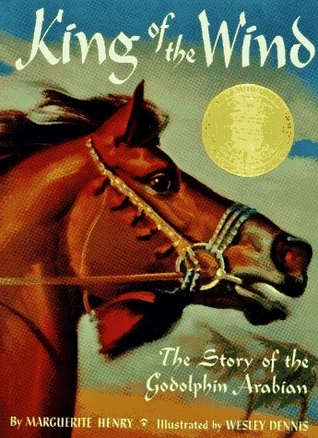
King of the Wind
by Marguerite Henry

I’m glad this was the book we voted on for this blog hop, because in some objective ways it’s the best of Henry’s work. It has everything that’s typical of her books – boy + horse, hardship, loving homes after a lifetime of difficulty, a truly special horse, Wesley Dennis illustrations, and quirky animals – and add to that some really compelling history.

If you haven’t read it, here’s the gist: a slave boy named Agba raises an orphaned colt, named Sham, in the stables of the sultan of Morocco. That colt grows to a stallion who is sent to France, and then to England, encountering hardships along the way. Agba stays with Sham throughout his life and eventually sees him become the pride of the Earl of Godolphin’s stables, passing on his speed to his offspring and becoming a founding sire of the Thoroughbred breed.

I do love this book. Reading it is an intensely nostalgic experience, and I can almost remember all the many places I read and re-read it as a child when I am in the midst of my favorite scenes. It’s an intensely sensory book: I’ll never forget the breaking of the fast of Ramadan in the opening scene.

There are some really fantastic things about this book, and one thing I noticed on this re-read was how well Henry portrays a Muslim culture. It’s dated, yes, and has a bit too much “mystery of the East” going on (see also, Orientalism, but honestly it was written in 1949 so for its time it’s pretty grat), but it’s a sensitive, forthright portrayal of a hero who is a) a person of color and b) a devout Muslim. The world needs more of that!

The cast of secondary characters are also really wonderful, and support the main narrative in note-perfect ways, from the French court to the streets of London. One character that stood out in particular was Jethro Coke, the Quaker who rescues Sham and Agba from Paris, but who caves to his daughter’s demands and gets rid of Sham after his son-in-law turns out to be a foppish, useless idiot who can’t ride. That’s so human – so often in stories like this people are wholly good or wholly bad, and the people in this book are often mixed up and acting in unexpectedly disappointing ways.

That said, there are a few things I really don’t like about this book. First and foremost, it plays way too much into the “specialest horse of all” trope. If I were presented with a horse who behaved as Sham does throughout this book, I would not think he was a magical horse. I would think he was an utter shit who needed to lose his testicles pronto. (Seriously, though, how did he make it to the end of the book ungelded? HOW?) He only answers to Agba. He routinely misbehaves. To be fair – no one actually takes the time to train him (including Agba…) so it is not entirely his fault but the book would also have us believe that he behaves when he wants to, and he doesn’t when he doesn’t, and that’s part of his charm, amirite? (NO.)

There’s also some of the usual stretching of equine physiology: are you telling me that someone thought it would be a good idea to have horses fast for Ramadan? No one colicked? In the desert? (I wonder how historically accurate that is?) All the crazy things that Sham has to do and put up with. The fact that a series of experienced horsemen look at Sham and think he’s not a quality horse, when any half-decent horseperson can look even at a starved horse and get an idea for its quality. Yes, it’s harder; no, it’s not impossible.

All in all, though, this is a wonderful book. I read it in one big gulp, and have easily read it two dozen times over the years. It’s nearly a perfect horse story, and it certainly hits all its emotional moments squarely on the head. Henry knows her horses, and the horse behavior is – naughtiness notwithstanding – compellingly described. Anyone could sympathize with Agba’s plight and his devotion to his horse. I love it. I’d recommend it to anyone looking for a good horse book to read, and especially to kids who are ready to get sucked into the horse world.
//static.inlinkz.com/cs2.js?v=115

blog hop · book review · marguerite henry

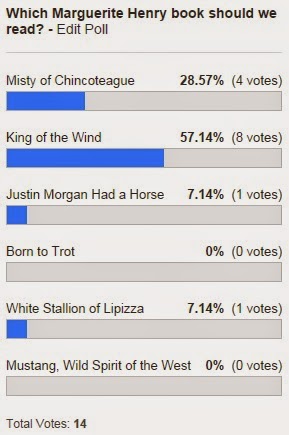
Marguerite Henry Readalong Blog Hop: Poll Results!

The results are in!

We’ll read King of the Wind, Henry’s Newberry Award-winning story about the origins of the Godolphin Arabian, one of the founding stallions of the Thoroughbred breed.
You can buy it new here on Amazon, used here on Half.com, or check it out from your local library.
Start reading! I’ll post here on Friday, November 7 with my review, and the blog hop link code. 
blog hop · book review · marguerite henry

Poll: Which Marguerite Henry Book Should We Read First?

I got enough positive responses to my poll about a Marguerite Henry readalong that I’m going to go ahead and do it. So, here’s a poll about which book we should read! Again, the idea is that everyone reads the book and publishes their review as part of the blog hop, on or around the same date. We’ll do this a few times for different books if it works out.


Here’s my proposed timeline:

October 22: Poll closes
October 23: Announcement of winner, start reading!
November 7: Blog hop post here with my review

book review

Book Review: The Black Stallion’s Sulky Colt

The Black Stallion’s Sulky Colt
Walter Farley

Oh, boy. I bought this for $2 at a used book store because of the cover: I couldn’t resist. Hands-down my favorite cover era for the Black Stallion books. I had vaguely positive memories of The Blood Bay Colt and Jimmy and Tom and ever-so-vague memories of this book, so this would be good, right?

Wrong. Oh, it wasn’t bad, in the way of that Island Stallion book with the aliens (YES REALLY), but nor was it a Black Stallion and Satan, or The Black Stallion’s Filly, either.

Let me summarize this book for you.

Tom is an asshole.
Alec is an asshole.
Henry is an asshole.
Jimmy is an asshole.
Bonfire puts up with them all.

So let me back up. This book picks up after the storyline of The Blood Bay Colt. Bonfire, the second son of the Black (out of a harness mare named Volo Queen, because why not breed your nutjob mystery stallion to a Standardbred) has moved from the county fair circuit to the big time, and is prepping for the Hambletonian. One night, Alec Ramsay decides to go see Bonfire race; it just so happens that during the race he watches, Bonfire gets into a bad wreck. Thereafter, Bonfire is nervous and jumpy and seemingly ruined for harness racing.

If you’e ever read a single Black Stallion book, you don’t need me to tell you what happens next. If you haven’t, know that Alec takes over the reins and mysteriously a) is instantly an expert sulky driver and b) gets his driving license by magic after Tom is injured. Despite unexplained and bizarre prejudices against harness racing, Henry Dailey arrives on scene to save the day. Alec and Henry help Bonfire overcome his (um, totally justified) fear, thanks to a clever mechanical hood & blinker arrangement, and then win the Hambletonian. Shocking, right? (Yeah, no.)

Things that annoyed me about this book:
– all the characters who were not horses
– Henry’s bizarro prejudices
– the way Alec and Henry came into the harness racing world and never asked anyone to explain their training techniques, simply forged ahead with their own and were of course miraculously succesful
– the deification of Alec and Henry
– how poor Tom was basically turned into a demon for plot purposes
– how horrible everyone was to the horses, while outwardly talking about being gentle and easing them along and blah blah

Things that I really liked about this book:
– Walter Farley writes a racing scene second to none; all of Bonfire’s races were genuinely exciting and tense
– quirky horse antics! I never get tired of quirky horse antics in these books
– it was a short, straightforward story told relatively well

Anyone else read this one? Thoughts?

blog hop · book review · marguerite henry

Blog Hop Idea: Marguerite Henry Readalong

I was happy to see how many people liked my review of Black Gold, and had fond memories of reading Marguerite Henry books. I’ve been looking over my collection of horse books for the last few days, thinking how many other great books she wrote.

I thought it might be fun to host a blog hop readalong of Marguerite Henry books. She wrote, apparently, 16 of them, which actually seems like a small number now that I see it in print!

I have one question – well two questions.

First, would anyone actually participate?

Second, should I do it so that you pick whatever Marguerite Henry book you want and then say 2 weeks later post a review?

Or should we all vote on a particular book to read, and do that 3 or 4 times?

So, a poll. Comment and let me know if you’d be interested in doing these, and vote in the poll to tell me how you think we should run it.

book review · horse racing · marguerite henry

Book Review: Black Gold by Marguerite Henry

Black Gold
by Marguerite Henry

Otherwise known as, god damn you anyway, I wasn’t doing anything with that heart, you go ahead and shatter it into a million pieces.

So for various reasons that I will talk about in a little while, I found myself at the town library seeking out Marguerite Henry books. I had zero intention of re-reading Black Gold, but there it was on the shelf, in the big hardcover edition, with Wesley Dennis illustrations. I couldn’t not. (There oughta be a law about publishing Marguerite Henry books without Wesley Dennis illustrations: I’m looking at you, current crappy paperback editions.)

Black Gold is one of Henry’s YA re-tellings of a true historical story, which actually sums up most of her canon, now that I think about it. It has the requisite boy who falls in love with the young horse, clever personalities, quirky details, and really wonderful writing. The real Black Gold was maybe not so mythical or personable, but in many essentials, the story is the same.

In summary: Black Gold is the son of the sprint mare U-See-It, owned by Al and Rosa Hoots and trained by Hanley Webb. U-See-It was banned from the track after Hoots refused to give her up in a claiming race, and so the decision was made to breed her to Black Toney.

Black Gold proved to be an excellent racer himself, and won the 1924 Kentucky Derby, among other stakes races. He was groomed and ridden by J.D. Mooney, who went on to be a celebrated jockey on other horses. Black Gold was retired for soundness issues, but proved to be a dud in the breeder’s shed, so he went back to the track at age six. He broke down in a race in New Orleans: “on three legs and a heart, he finished the race.”

Of all the things I had forgotten about Marguerite Henry – and it’s been quite a while since I re-read her books – her writing was what surprised me the most on this re-read. It’s not an easy story; while there is charm and sweetness in the early pages, the last third of the book is a heartwrenching story as Jaydee (Henry tells the story primarily through the lens of a young J.D. Mooney) recognizes Black Gold’s soundness issues and has to make the painfully adult decision of stepping away from the horse. Hanley Webb is determined to race him and Jaydee can only watch as the horse is basically run into the ground.

In many ways, the final chapters of this book are incredibly adult for the audience. Hanley Webb’s very real weaknesses and foibles take center stage and Black Gold’s story becomes, clearly, a canvas for human frailty. His is not the story of the superhorse who retired to pasture, but rather the hard campaigner who tried and tried until he finally couldn’t. In a softer story, Jaydee would have gotten through to Webb, and Black Gold would not have run that final race. Henry certainly pulls her punches in other historical stories (Justin Morgan Had a Horse stands out in particular) but not this one. The horse dies as a direct result of obviously poor decisions by people who should’ve been looking out for him.

As I said: not an easy read. But a really, really beautiful one. For example, here’s Jaydee thinking about going back for Black Gold at the end of the book:

His eyes were set far off. He was thinking that all he’d be able to do for Black Gold would not be enough. He could sit bird-light on the little horse’s neck. he could cluck to him with heart and soul. He could threaten him with the whip. But two things he knew – it would not be enough and it would not be fair.

In short: recommended, but have tissues handy.

book review

Book Sale Find

Last night, I dropped a book I’d finished off at the library (Under Heaven by Guy Gavriel Kay, which I’d thought would be more about horses given they are the catalyst for the whole plot, but…nope)

I glanced over the book sale cart because I am helpless in the face of books. And I made a GREAT find, for $1:

It is in gorgeous condition, and matches my copy of The Black Stallion perfectly (except my copy is kind of in pieces).
At one point I had dared Hannah to do a re-read of all the Black Stallion books. Maybe starting that will be a way to pretend that it will be summer again someday?
book review · mustangs

Book Review: Mustang: The Saga of the Wild Horse in the American West

Mustang: The Saga of the Wild Horse in the American West
by Deanne Stillman
(available on Amazon)

First things first: this was not the book I thought it was. I picked it up out of curiosity – it had quite a few accolades on the cover, was by a talented writer, and in all honesty I began it with a sinking heart. For some years now, I have had in mind the project of researching and writing a book about the place the mustang holds in the American imagination.

This was not that book. This was not even close to that book. In fact? This was not really a book about mustangs at all, save for perhaps the last 1/4 of it.

That’s not to say it was a bad book, by any stretch of the imagination. In fact, it was quite a good book: well-written, thoughtful, far-ranging, and a good read. Here was my biggest problem: this book made no attempt to define or distinguish the “mustang,” which is to say the distinctly wild (or feral) horse that lives without human interaction or mediation in the American west.

Stillman’s title and subtitle imply that she will write a history of those horses. That’s not what she did. Instead, this book is more accurately a history of the horse in general in the American west. Which is fine! She does a nice light nonfiction job of that, telling stories about the horses belonging to early conquistadors, about cavalry horses, about cow ponies and cattle drives, about the horses in Buffalo Bill’s Wild West Show, about movie horses. She clearly (despite her personal history) doesn’t know a whole lot about horses, but she does know a whole lot about people, and does a really nice job in telling her stories.

So while I spent the first 3/4 of the book annoyed at her lack of distinction (mustang != any horse out west != free-roaming stock horses != any horse that she has decided fits a certain physical type), when I forced myself to step back and think “this is really about horses as companions in creating the history of the west” I liked the book much much better.

And then when she spends the last 1/4 actually talking about mustangs, actually parsing out the history of the wild/feral horses in the west in the mid to latter part of the 20th century? She does a really good job. Instead of an enjoyable but not gripping read it became a gripping and depressing and involved read. I couldn’t put down the last 80 pages. It took me 2 weeks to read the first 240.

And in the end? I’m glad she didn’t write the book I wanted to write, because that means it’s still out there for me to tackle.

book review

Book Review: Great Riding Schools of the World

I am an historian by training and by profession, which means that whenever I get the chance to buy an historic horse book I snap it up. Older editions of fictional favorites, old vet manuals, you name it.

When I spied this book on the shelf at a library book sale recently for the bargain price of $1 it was a no-brainer, and I snapped it right up.

It even had someone’s horsey bookplate still in it! ❤

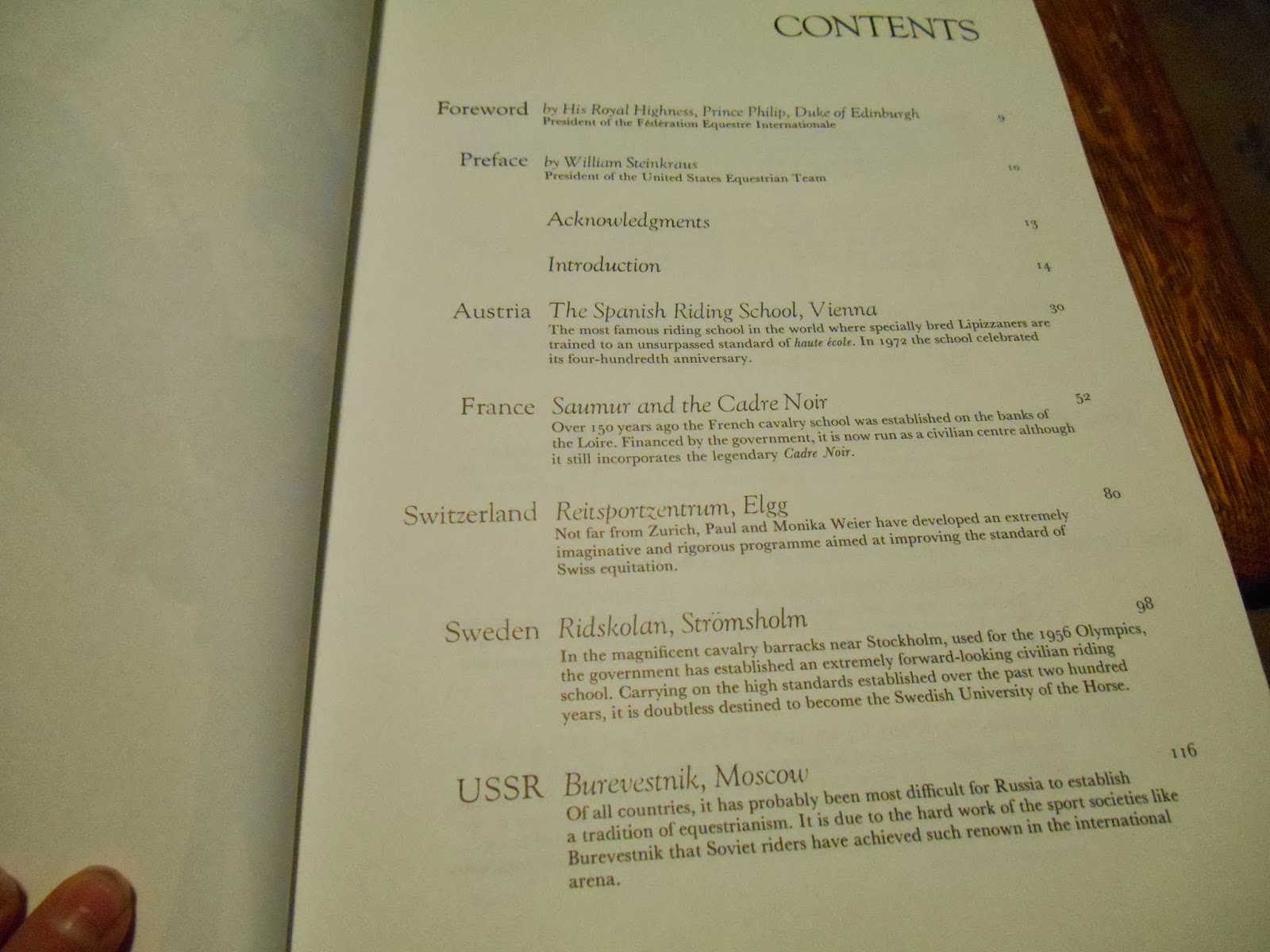
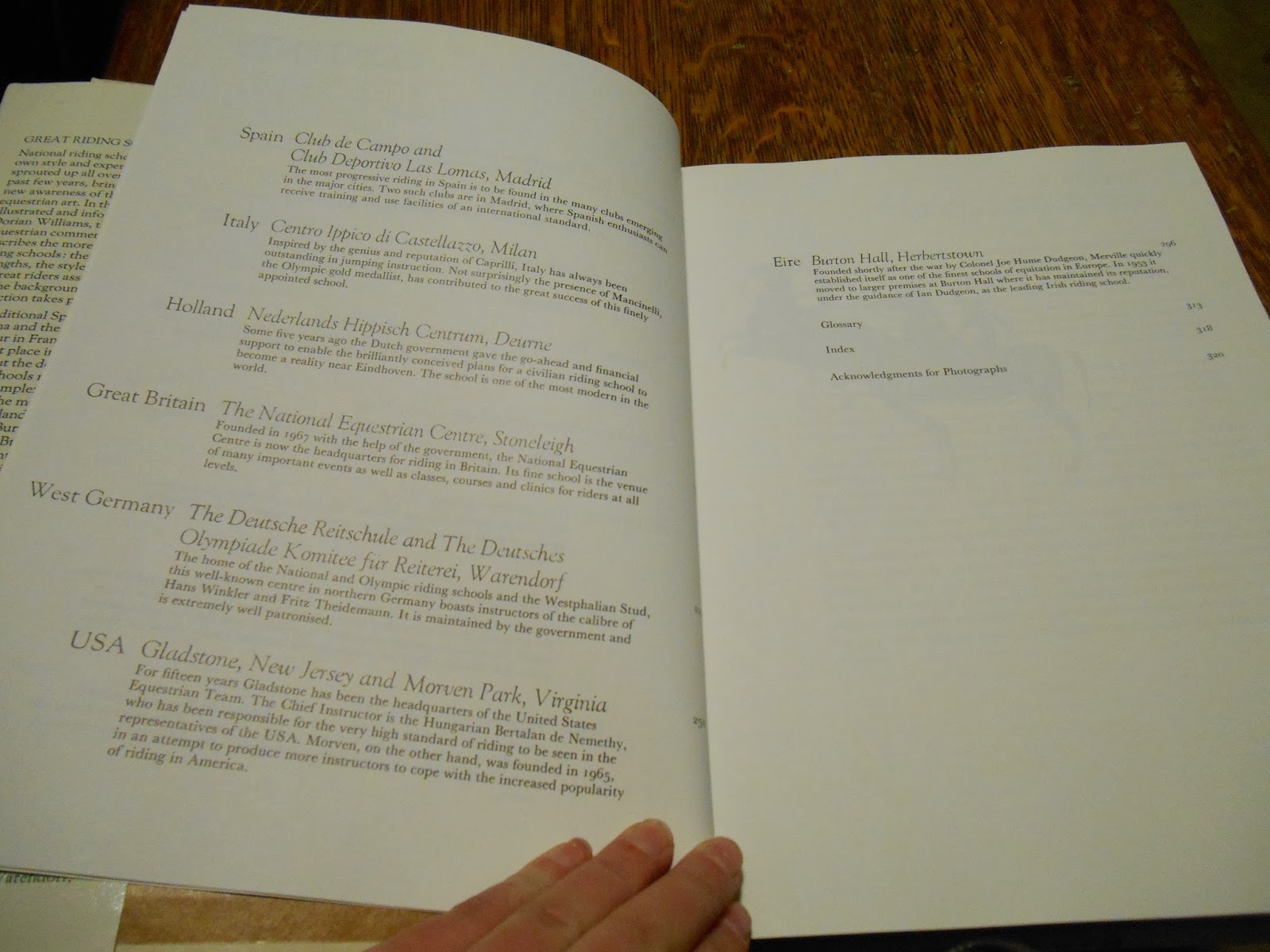
The introduction starts by saying that at a certain FEI meeting in the 1970s, it was decided that equestrian sport was on the rise, and some bright soul had the idea to bring more public awareness to the “official” schools of countries around the world as an attempt to highlight where people could receive professional training.

It ends up being a picture-heavy, information-heavy romp through some really terrific horsemanship, some gorgeous facilities, and the inevitable conclusion that most of these schools are not really for the general public – they’re more like finishing schools for pre-selected riders. Which I think everyone knew at the outset, but I am not complaining – this is a gorgeous book!

There are a LOT more riding schools than I had ever heard of, too. For instance, despite living with one of the proudest Swedish-Americans in the lower 48, I had no idea that Sweden had a national riding school!

All the Swedes! Each school is introduced by a two-page spread with their facilities and often their horses and riders. Then that’s followed by as many as 20 pages of picture-heavy text about the facilities, the program of instruction, and what each school specializes in.
Switzerland (I know, right?) apparently specializes in insane cross-country jumps. Eeeeek.
The Cadre Noir in France, they would like you to know, are able to do all their haute ecole movements in unison. Click on that picture and zoom in if you will. It’s kind of insane.
SPEAKING OF INSANE CROSS COUNTRY WHAT THE HELL.
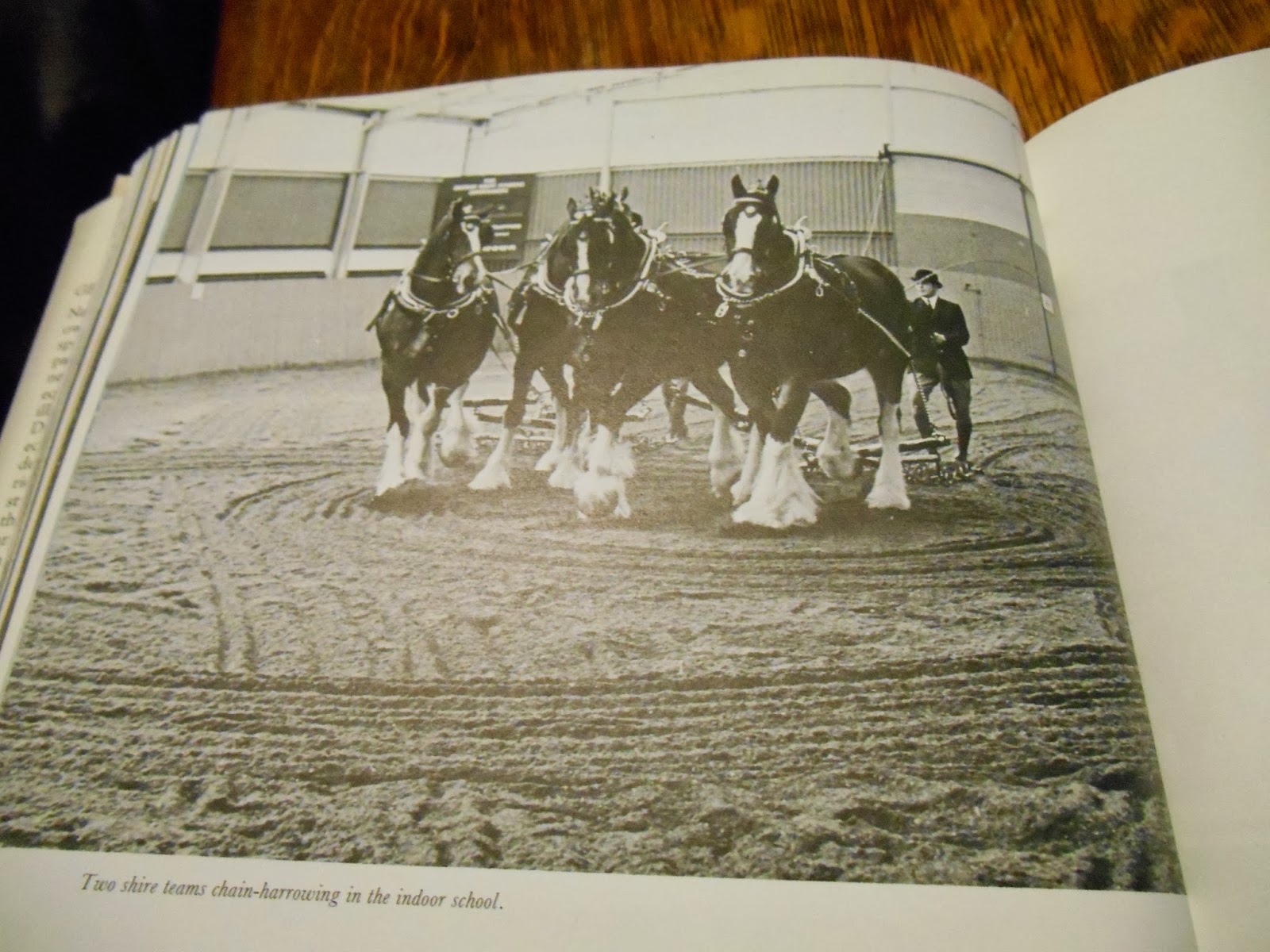
England still drags its rings with a draft horse team!
This photo demonstrates something I wish would happen more often these days. It’s a team of RSPCA inspectors getting a workshop and demonstration on carriage horses: proper handling, proper care, and how to evaluate what a healthy horse looks like generally. Isn’t that a great idea?
Aaaand we’re back to the nutso cross-country riding. England again. Please note the utter lack of helmet.
On close examination of this photograph, I believe that Michael Page and Grasshopper are jumping concrete drainage pipes. Lengthwise. I am not kidding.
George Morris, of course.

There are many, many other similar, gorgeous photos, and fascinating accompanying text. Some of it is very dated, but overall it’s a great window into its time. I’m thrilled to have found it to ad to my collection.

book review

Scorpio Races – On Sale!

Heads up!

Maggie Stiefvater’s The Scorpio Races is on sale for the Kindle today – $1.99!

This is a not-horse book, but it is not a pegasus, unicorn, or other not-horse book. These are water horses: strange, carnivorous Capail Uisce, who can be captured from the surf and half-tamed. Each year, they are raced along the beach, and each year, many of their jockeys die.

I read this…oh, over a year ago, and I was particularly struck by how nicely Stiefvater crafted her water horses, and how unexpected the book was as a whole. Even the storylines you think will be cliches duck the obvious. (Some of the pro reviews compare it to The Hunger Games; it is not much like that, except in that both are excellent reads and involve danger and young people.)

Definitely worth $1.99 and a read!