surgery

And then Tristan gave me a heart attack…

I went out to the barn at about 6pm last night to, in theory, get Tristan’s evening antibiotics into him and check on the bandage to see if there was any drainage/bleeding after the poking around we’d done that morning.

He ate his antibiotic pills when I mixed them in with some dinner mints, and then when I pulled him out of the stall I saw that he had managed to shed both his hoof boot AND the dressing on his foot and was standing barefoot, surgical site exposed. I yanked him out of the stall, wrestled the bandage back on at least over his toe, and heated up water to start flushing ASAP. I had left my sterile bucket & syringe at home (we were supposed to go to every other day!) and rinsed out the clean bucket we’d been using to mix his antibiotics, as well as the syringe from the antibiotics.

I picked out 2-3 shavings and a small piece of hay that had gotten into the hole, carefully brushed the shavings away from the rest of the hoof, and then flushed probably half a gallon of dilute betadine down the hole. Then I gently scrubbed at it with several iodine swabs, and then squirted straight betadine in, rewrapped with clean gauze, vetwrap, and elastikon, and pulled the boot back over.

I tried to get the smaller size boot on his foot, but it just wasn’t going yet – still a little bit too much padding. I latched the larger boot as tightly as I could, and wound the elastikon over the hoof as tightly as I could, but still worried about him all night. I went out about midnight to check on him, and then again this morning at 7am before work. Boot was still on both times.

I checked his temp and felt for heat in the leg this morning; both normal. I’ll flush and rewrap tonight and do so daily for the next week, and keep an eagle eye, but I think things are ok. I’ve got a call in to the clinic to make sure there’s nothing else I should be doing…but I caught it quickly, flushed it out thoroughly, and he’s still on his general antibiotics. I think we’re ok. I’m still sick about it, but hopefully it won’t impact his healing.

surgery

One Week

We saw our local vet this morning for the one week checkup to make sure his healing was looking on schedule. Overall, very positive!

The vet liked how it’s starting to granulate in with new tissue. She smelled a teensy bit of funkiness/infection but since there was no discharge, she wasn’t particularly concerned. She gave the thumbs up to my borderline obsessive wrapping procedures, which go like this:
  1. Sweep area around crossties hard, until I can’t see a speck of anything resembling shavings/sawdust/anything.
  2. Boil water, pour about 2″ into a bucket (that I bring home each night to scrub out thoroughly with soapy hot water), mix with betadine, let to sit and cool off.
  3. Set out wrapping supplies on top of a bucket for easy access: one roll of 2″ gauze, one roll of vetwrap, one roll of elastikon, bandage scissors.
  4. Cut two small squares of gauze off the wrap (to place gently in the hole).
  5. When the water has cooled, draw up a fully syringe and place it on top of the betadine bucket.
  6. Bring him out of his stall, take off both boots, sweep around again to get any bits that have come away.
  7. Cut down the bandage on his foot, two long cuts at about 8 and 4 (if the middle of the heel is 12).
  8. Pick up his foot and slide the bandage off down toward his toe.
  9. Resting his pastern on my knee and cupping the hoof with my left hand, squirt about 5-6 60cc syringes full of the dilute betadine into the hole.
  10. Soak one of the squares and place it – not stuff it! – gently into the surgery hole.
  11. If he needs it, let him put his foot down and rest on a clean white towel that I put down on the aisle. (He needed this every time the first few; now he will usually keep the foot up the whole time. This is why I cut two squares, now: since the small piece of gauze is in there only gently, it’s not uncommon for it to fall out when he puts his foot down.)
  12. Wrap the whole foot with a whole roll of 2″ gauze.
  13. Wrap the whole foot with about half a roll of vetwrap.
  14. Wrap all around the foot once with a length of elastikon, then cut a smaller piece and reinforce the toe.
  15. Let him stand on the towel while I wipe out his boot thoroughly, digging out any small shavings that get in there, drying out the pad with a towel.
  16. Put the boot back on his bandaged foot.
  17. Pick out and dry off the LF. Every other day or so I squirt a small amount of anti-thrush treatment into the frog area, because it gets quite moist in there.
  18. Wipe out the LF boot, shake out the pad, dry everything, etc.
  19. Put the boot back on and bring him back to his stall. The first few days he got treats back in his stall; now I hold off because he was getting bratty about pawing for them.
  20. Clean everything and put it away; repack the small bucket I use to hold wrapping supplies with more supplies for the next time; dump the remaining betadine solution and bring that and the used towel home to clean out very thoroughly.
The whole process takes about an hour. Add in medications, picking his stall if necessary, grooming him, cleaning up everything afterwards, and it’s about 2.5 hours each night.
Anyway. Vet approved of everything, and gave the ok to continue with every other day wrapping. I’ll still pull the boot off and check the bandage each time I see him, but my next full rewrap will be Wednesday night.
Vet was also pleased with the way he was bearing weight on that foot, standing with it much more fully under him than he had before the surgery – a good sign that he’s already doing way better!
On my way home, she called me and said she’d checked in with the clinic. They were even less worried about the funky smell than she was – surgeon said that it was a small wound that wasn’t getting any oxygen exposure and was staying moist, a little funkiness was 100% expected. They were thrilled to hear that he was looking sound and weight-bearing, and said that was the best indicator for now.
So – we’ll check in again next week. In the meantime, it’s something of a relief to know that I’ll head out tonight and tomorrow night only to do his meds, and not the full 2.5 hour process.
surgery

Gee Thanks

When I logged in to my Mint.com account tonight for the first time in a week, there was an urgent alert telling me that I had high spending in the Veterinary category.

So glad they let me know…

surgery

Surgery Recovery

So I wrote about Tristan’s surgery in some detail, and since it’s been an absolutely insane week since then, I’ll have to cover everything quickly. We’re on the right track, but between work and spending hours upon hours with him each day, I’m beyond exhausted, and not sleeping terribly well from stress and worry.

Tuesday we brought Tristan home first thing in the morning. I had bedded down his stall with two fresh bags of shavings, fresh water, washed out his grain bucket, filled his hay net, and everything was ready. He was alert and awake at the vet hospital though he wasn’t wild about his morning mash. They’d given him one last dose of IV antibiotics and bute, and went over his discharge info with me. He loaded not great, but he did get on, and rode mostly well though kicked around a bit when we were almost home.

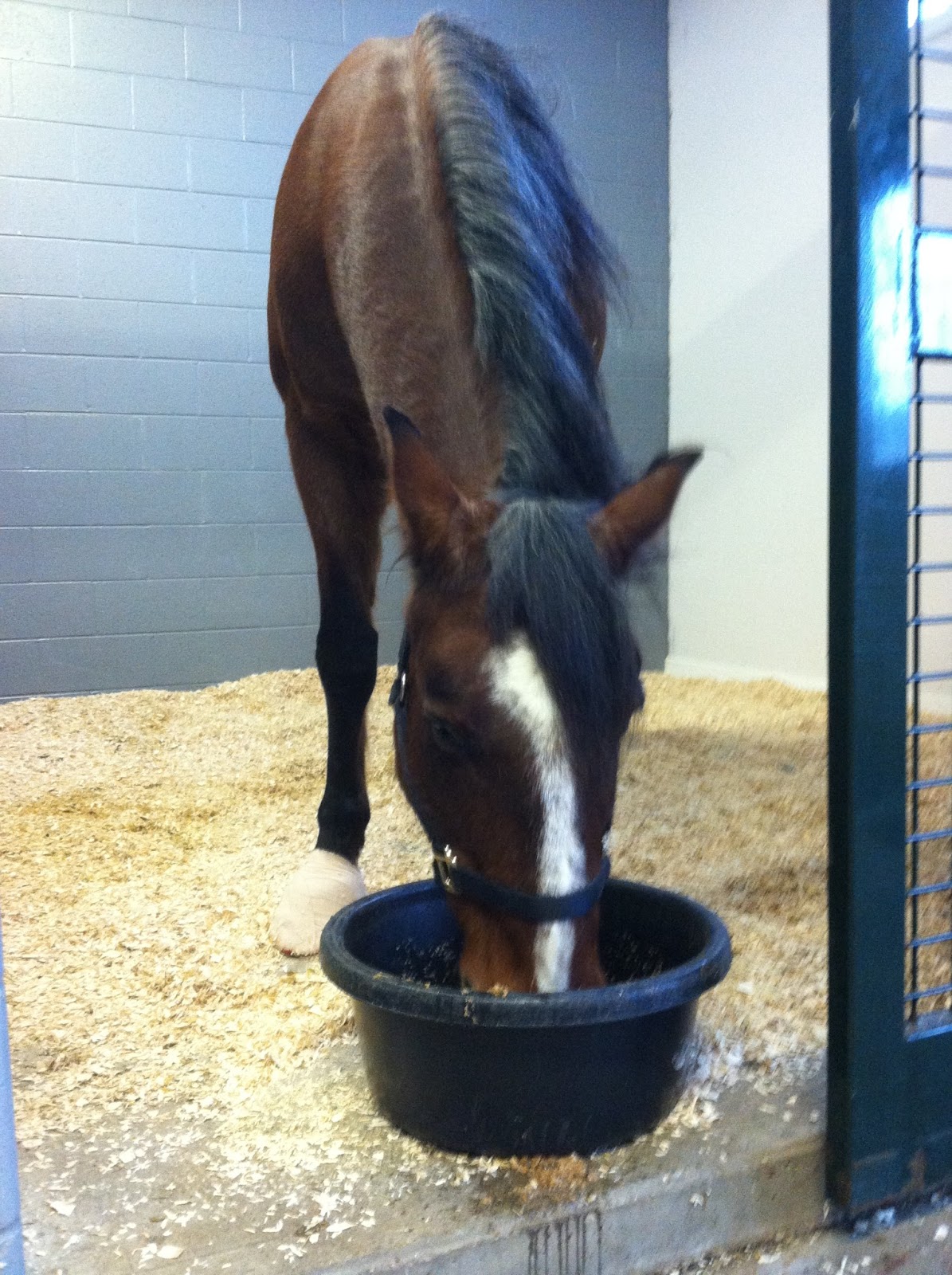
One thing I found out that morning was that I had miscalculated what size boot he would need; his size 4 boots fit great but there was a great deal more padding and wrapping on his RF than I had thought there would be, so he needed to go up to a size 6, which the vet hospital kindly sold me and sent him home in.

I stayed with him for a little while and then headed home to catch up on laundry. When I returned that night he was listless and quiet, and didn’t want to have his grain. I mixed it with everything I could think of – applesauce, sweet feed, molasses, bran, warm water, you name it, and he wasn’t touching it. That meant that he didn’t quite get his full dose of antibiotics and bute, unfortunately.

I rewrapped the foot for the first time that night so I could get him on an evening schedule. It wasn’t a ton of fun. He flailed a lot, I was terrified, etc, but in the end we got it done and I spent a while grooming and fussing over him afterwards.

Wednesday morning he was definitely not himself: dull, quiet, hadn’t finished his mash from the night before, had given up getting his hay out of the small-hole haynet. We took his temp – 99.5, normal – dumped the hay out of the haynet, and I asked the barn to get his drugs into him by syringe if he still hadn’t touched his grain. He was drinking, peeing, and pooping normally, so not in crisis, but it was hard to see him like that. By late morning, perhaps an hour or two after the barn manager syringed his meds + applesauce down his throat, he had started to perk up and eat his hay.

Wednesday night I re-wrapped again, and dosed him with his evening meds, and he was looking a little better, and was much more cooperative for his wrapping. Thursday morning a little bit better again, continuing better Thursday night. That night I noticed some mud-brown colored areas of the hole that did not dislodge with flushing, and so Friday morning I sent an email with a picture off to the vet clinic. They said it looked good, nothing really to worry about unless he went lame, ran a temp, or the area increased.

Friday night he was just about entirely back to himself. When I pulled the wrap, there was a smidge of brown gunk that had come out of the top of his abscess holes, and I scraped some more out of the same. I flushed and flushed and flushed both the surgical hole and the abscess hole, rewrapped, etc. I rubbed some of the brown gunk between my fingers: not much of it, and it felt gritty, not like pus, and smelled like hoof crud, not like infection or necrosis. The vet intern emailed me back this morning and said that the foot was probably flushing gunk out of the recesses of the hole, and to keep an eye but not to worry too much.

There’s definitely new tissue growth in the hole itself, nice healthy red granulation. I’ll flush and rewrap daily until Monday morning, when my local vet comes to look at him. Per the clinic, Friday should have been his last day with daily rewrapping, but the brown gunk makes me a bit nervous, and it certainly can’t hurt to keep up until Monday.

surgery

Surgery & After

Summary: Tris did really well for his surgery, and has been slowly improving since.

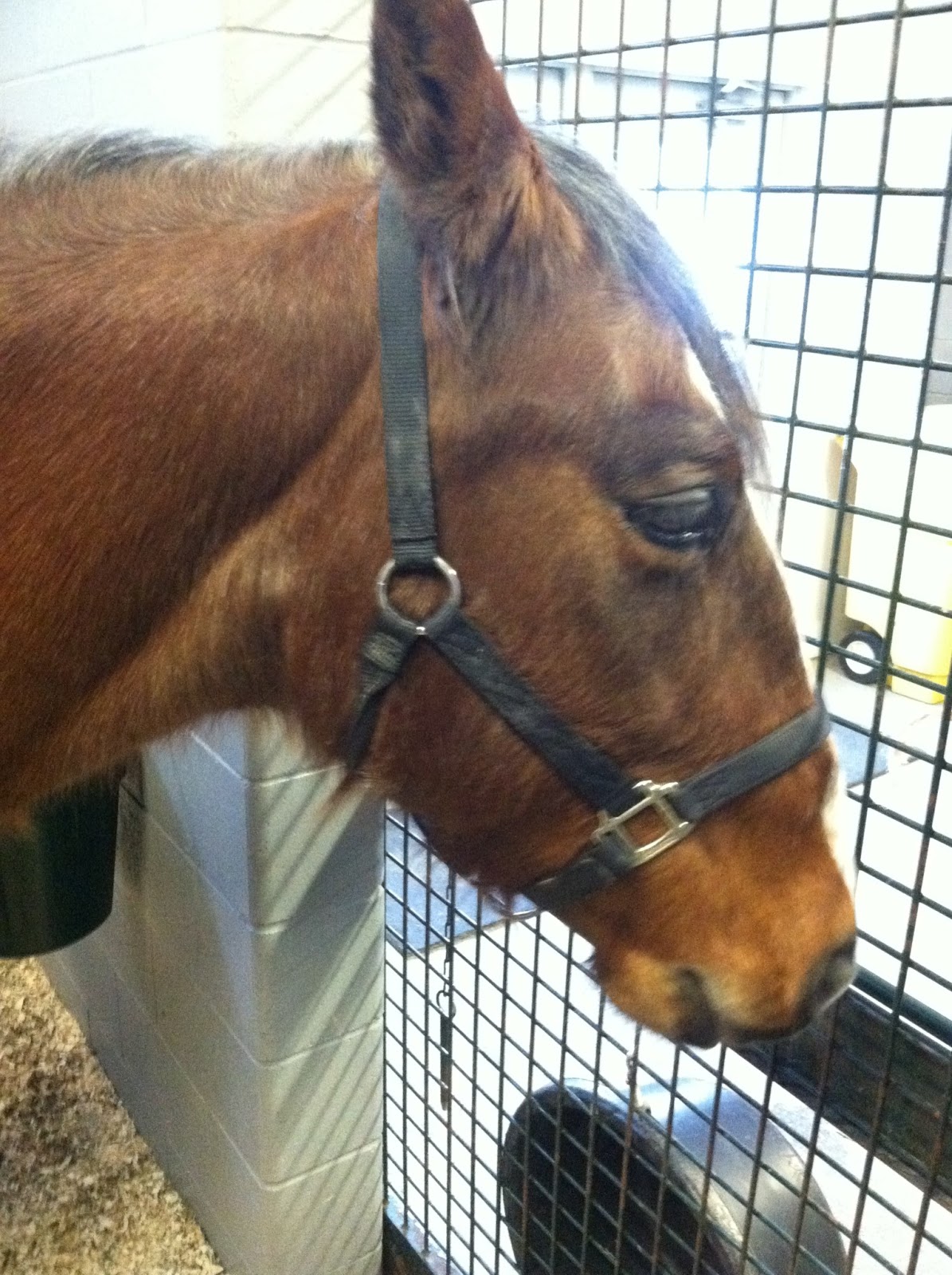
Tristan’s stall at the vet hospital.

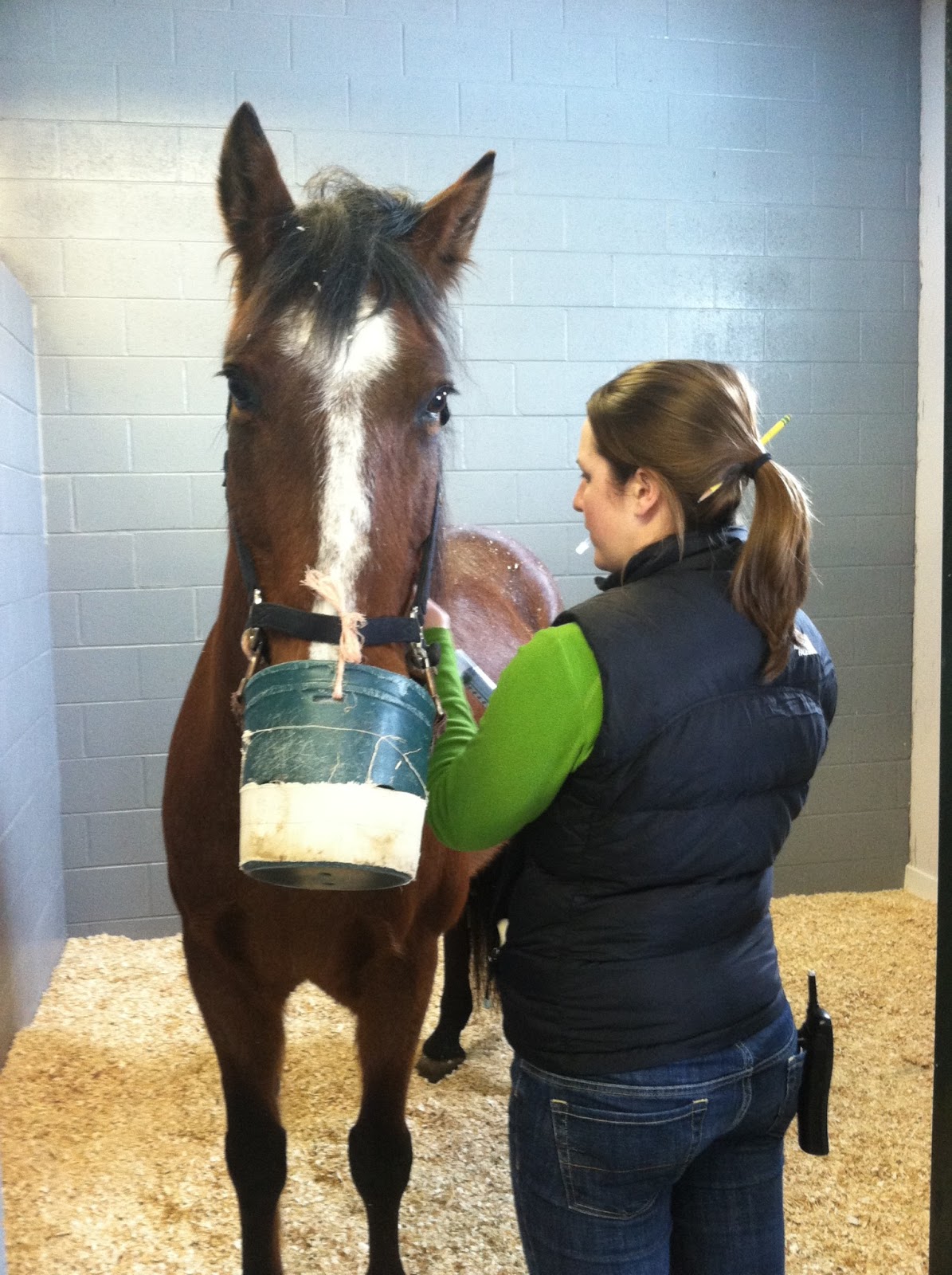
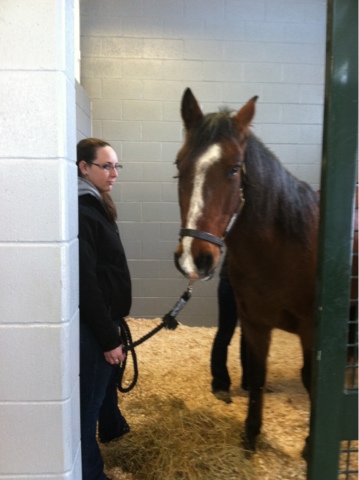
Hannah and I got there on Monday mid-morning, and Tris already had his catheter in his neck, for IV meds, etc. They had given him morning antibiotics and bute, and he was mad that he hadn’t had breakfast and pacing a bit. We groomed him thoroughly and fussed over him and then left him alone for a bit to hopefully stop his pawing. I went and checked later and he was eating shavings in search of hay – doofus. So he had to wear a muzzle until his surgery.
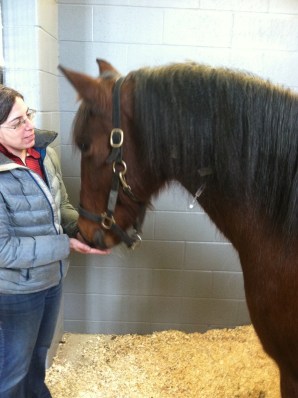
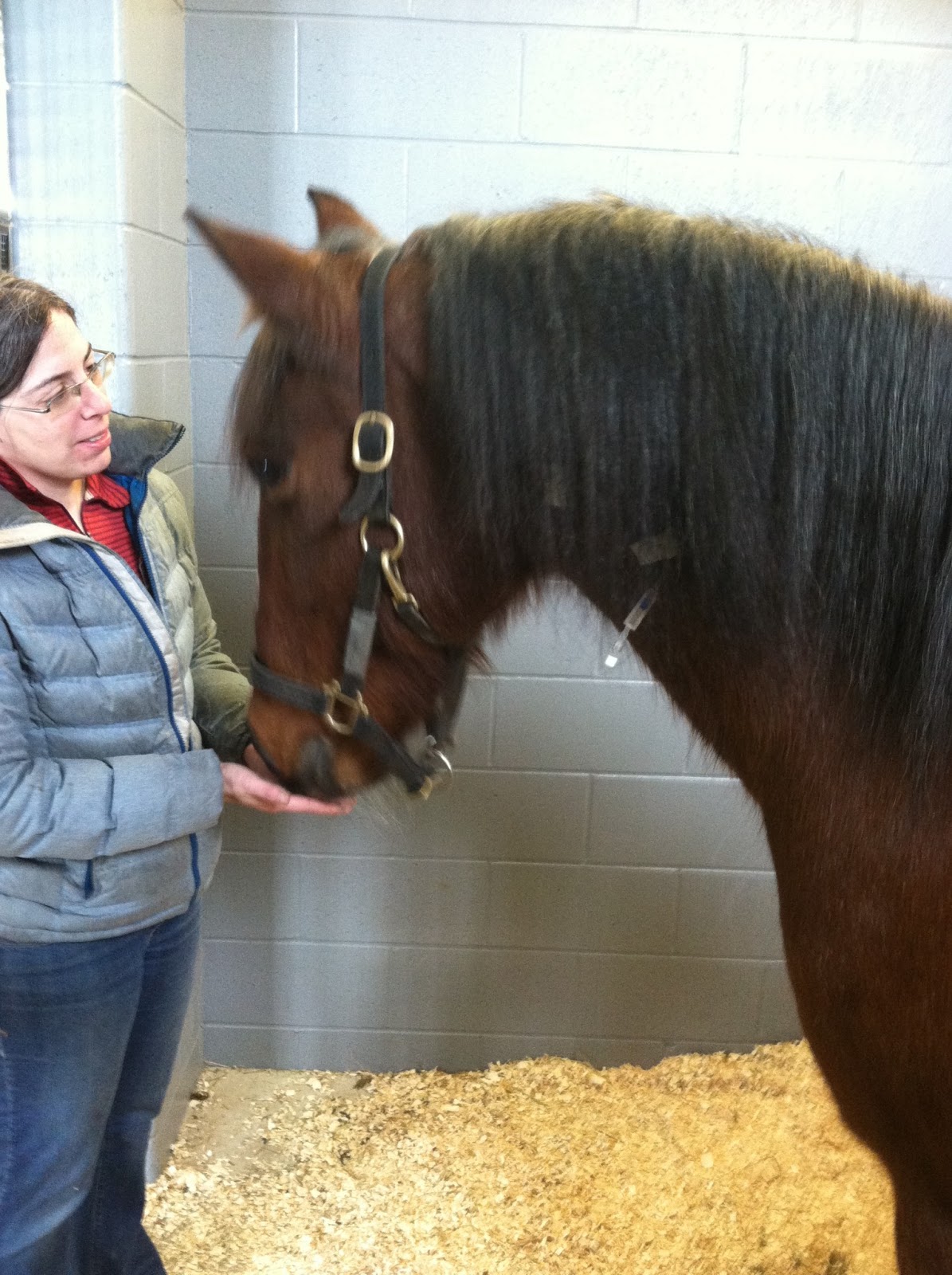
Saying hi to Hannah. You can see his catheter under his mane.

Wearing his muzzle and getting a shot of antibiotics.

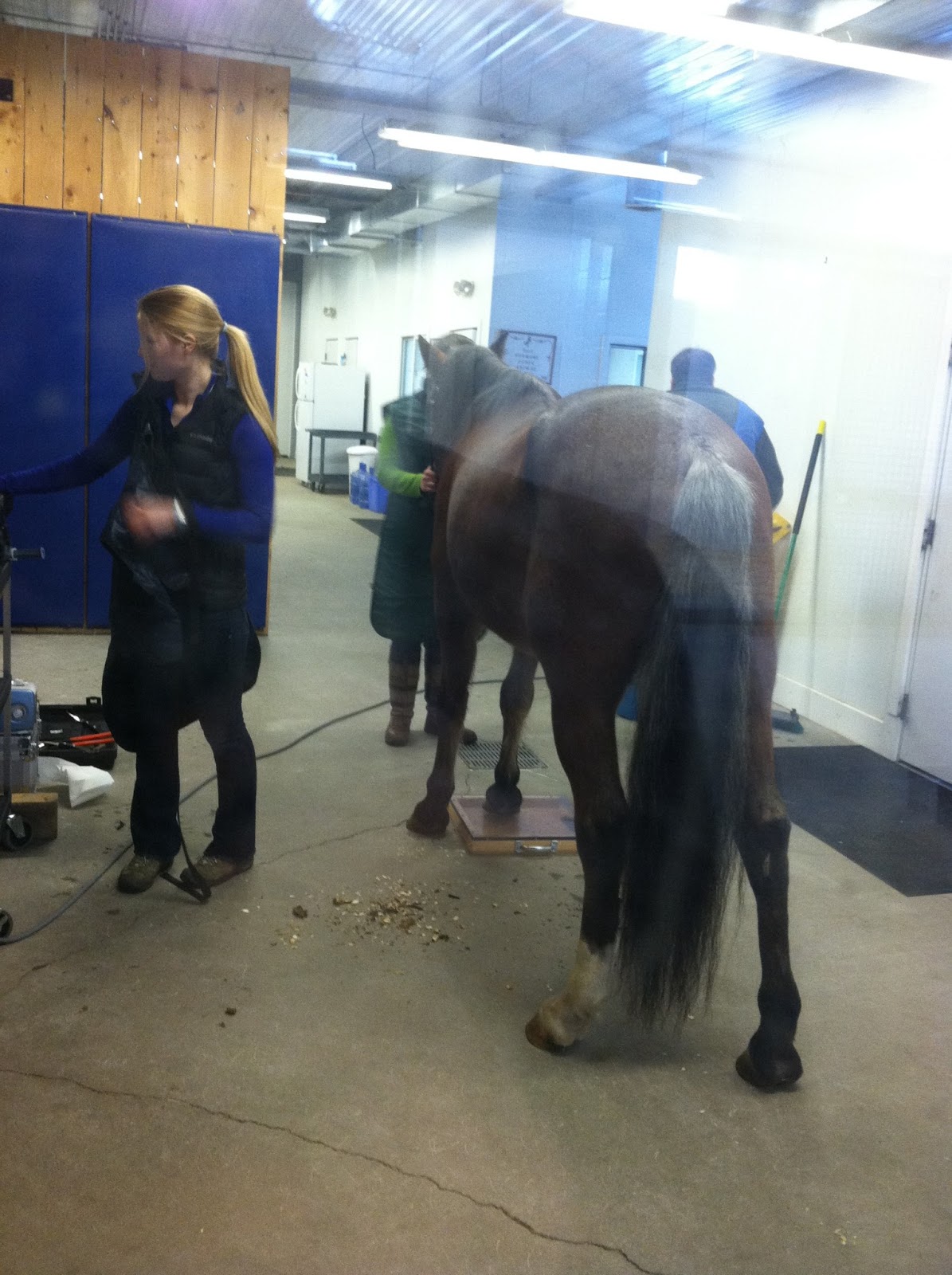
We went out for lunch and then after lunch I sat in his stall with him. He was clearly bored and a bit frustrated, standing and staring into the middle distance. The surgeon was running a bit late from morning farm calls, so they started prepping him at about 2:00. They tranq’d him, pulled his shoes, and did some x-rays to confirm everything.
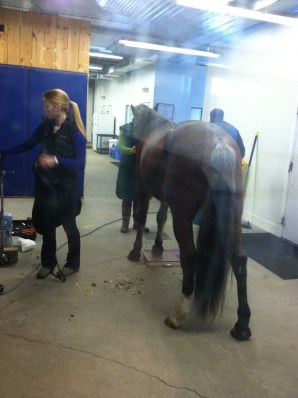
Getting his pre-surgery x-rays.

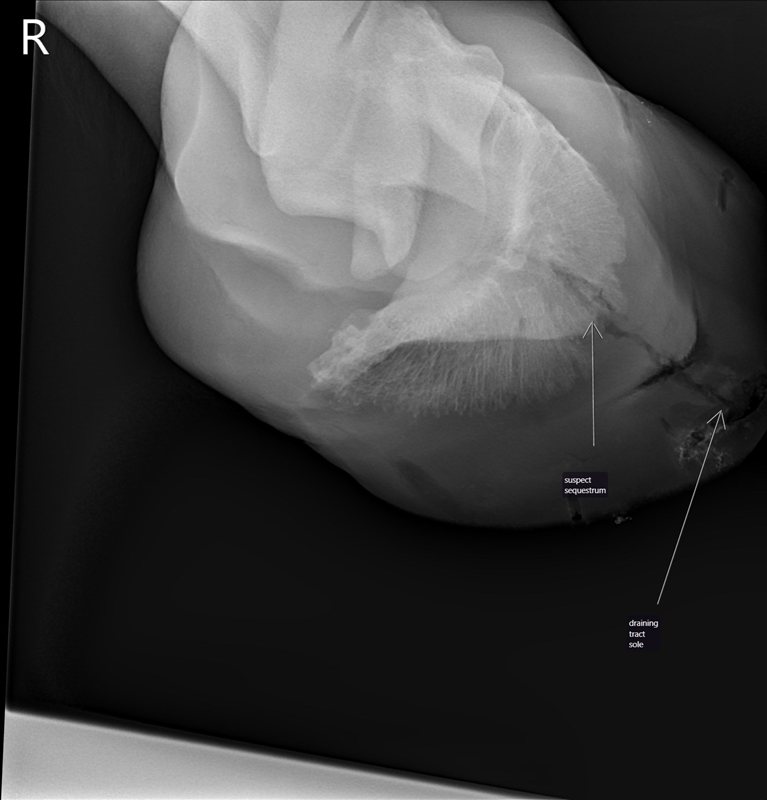
The surgeon was incredibly nice, and pointed out the sequestrum – technical term for a foreign object causing infection, in this case the bone chip – as well as how they’d get in there. He was glad that Tris’s abscess had come out the toe, too, because that gave him a clear channel to go through. He explained that he would make a hole about the size of a quarter, then go in through there with a tool that looked a lot like a very small, very sharp ice cream scoop. He’d remove the chip, and then scrape at the bone until he removed all the necrotic bone and debrided back to health bone. He described the sound of healthy bone as “crisp.” (Ew.)
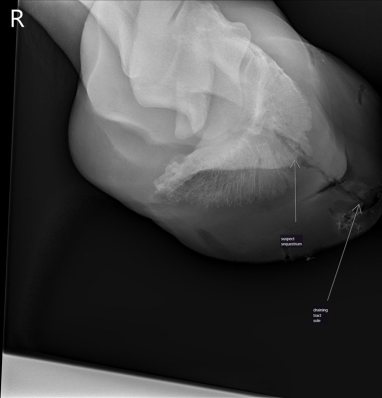
Pre-surgery x-ray with the vet’s labels.

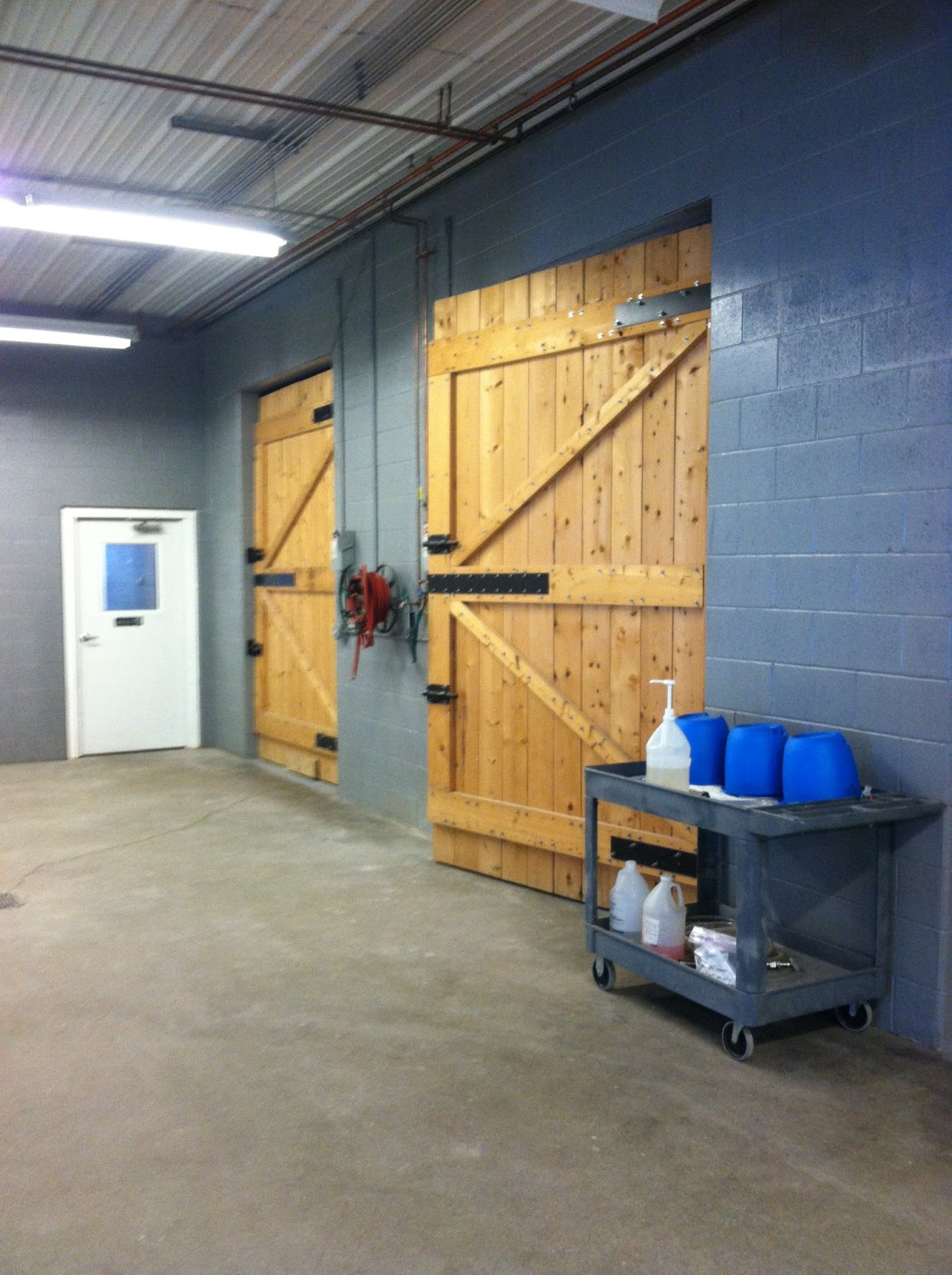
I had been doing okay all day but I got a bit teary and frightened when they led him into the room where they would tranq him for surgery. Basically, they would start the drip (he was not intubated, since they anticipated the surgery would take less than an hour) and then as he got sleepy they’d hold him up against the padded wall, encourage him to sit down like a dog, and then roll him down to his side. Then they’d hobble all four legs together and use a crane to lift him up and onto the surgery table.

Lie-down room on the right, recovery room on the left.

Hannah and I went to the waiting room for the duration, which was a very, very long hour and a half (including lie-down and recovery time). I read a YA fantasy book that basically went in one ear and out the other and checked my watch every five minutes and texted people. Sooner than I would have thought, though, the intern came in and told us that the surgery had gone well, he was in the recovery room, and they’d had to take a fair bit of bone but it was successful.
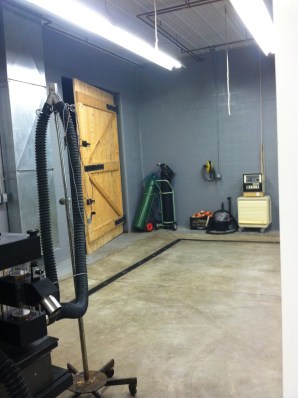
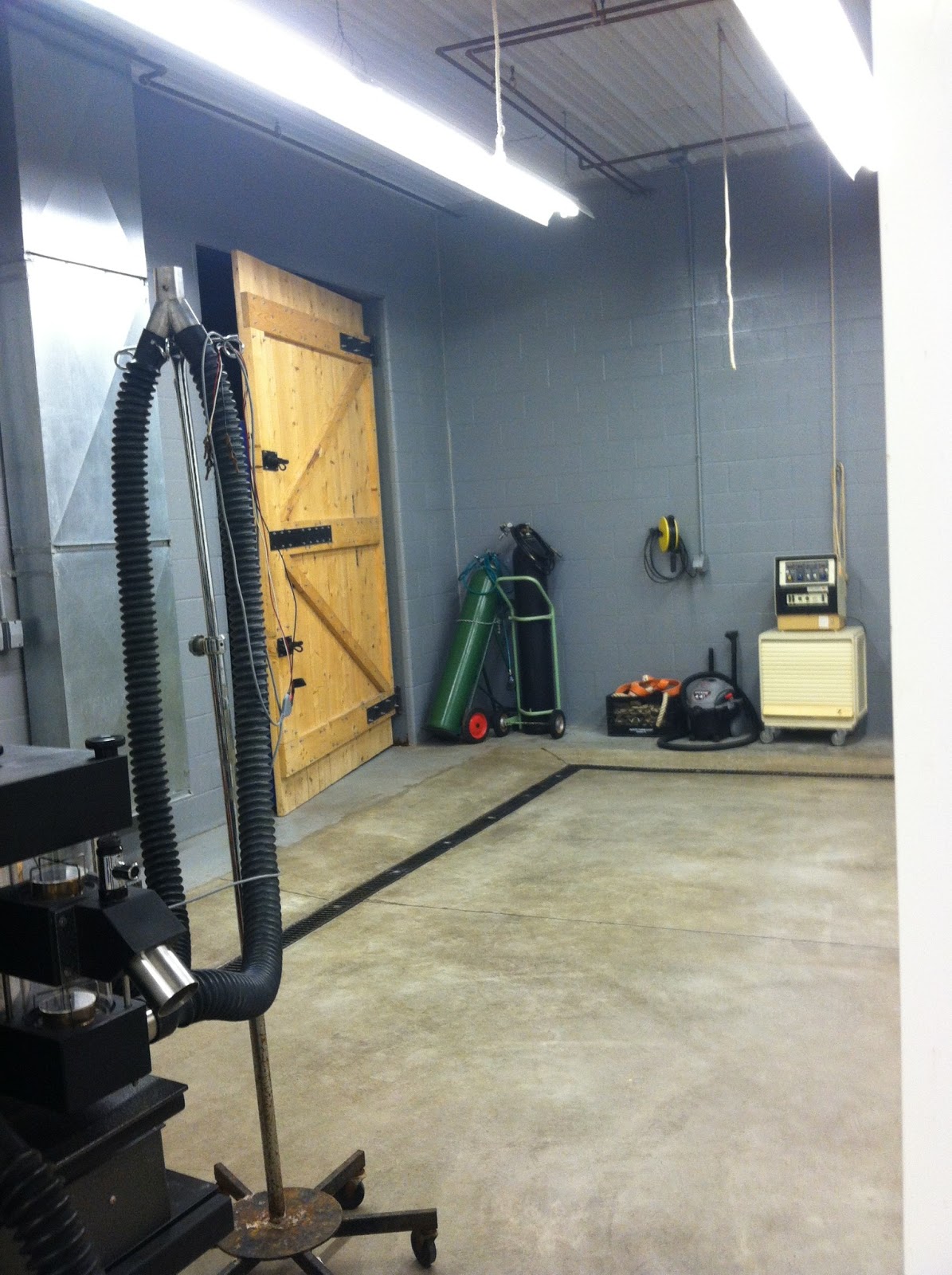
Surgical suite, with the door to the recovery room in background and the anesthesia machine foreground.

Ten or fifteen minutes later, they came to tell me that he was heading back to his stall. He’d recovered beautifully – apparently horses sometimes flail around, fall, crash into walls, etc., which is why the recovery room is padded. He’d just lain quietly until he could get up, and then stood.
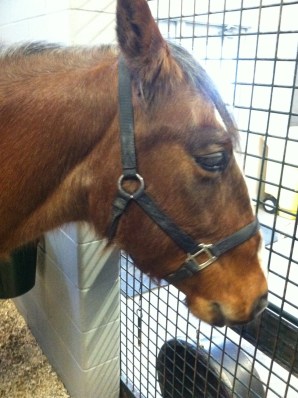
Post-surgery, not a happy boy.

I visited with him for a little while, and told him how brave he was. He was staggering a bit, and not focused, very out of it – understandably! He was also bleeding right through the bandage. They explained that they’d put a tourniquet on the foot during surgery to help manage blood flow, and once they released it the blood would leak through for a little while until it clotted.

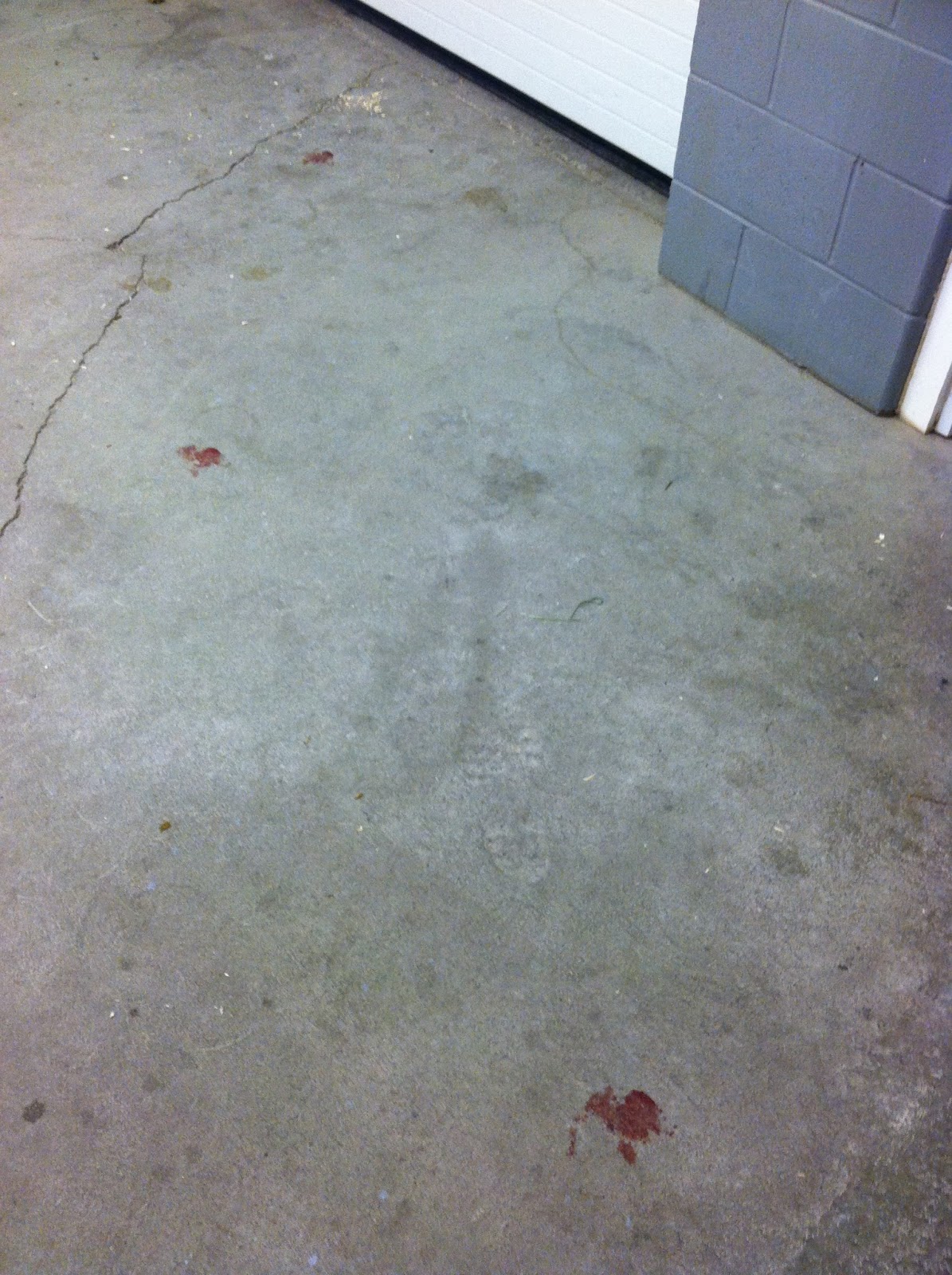
Bloody footprints leading from the recovery room to the stall.

The surgeon came to find us and show us the x-rays in a few more minutes. He said he evaluates surgery on two points: his gut feeling and the clinical signs. In this case, he said, both were good. He said he would be surprised if Tris didn’t return to 100%. Hooray!
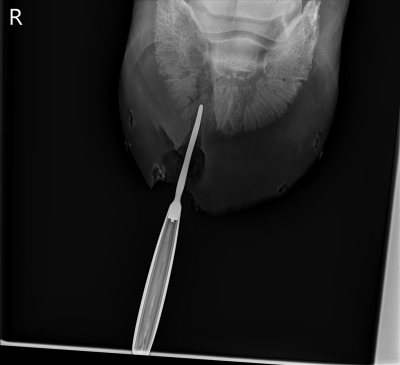
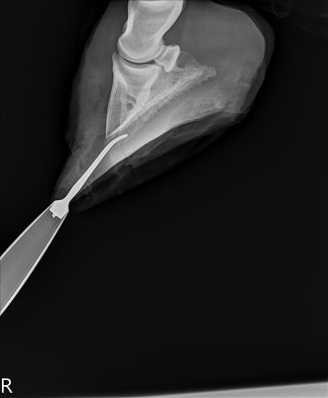
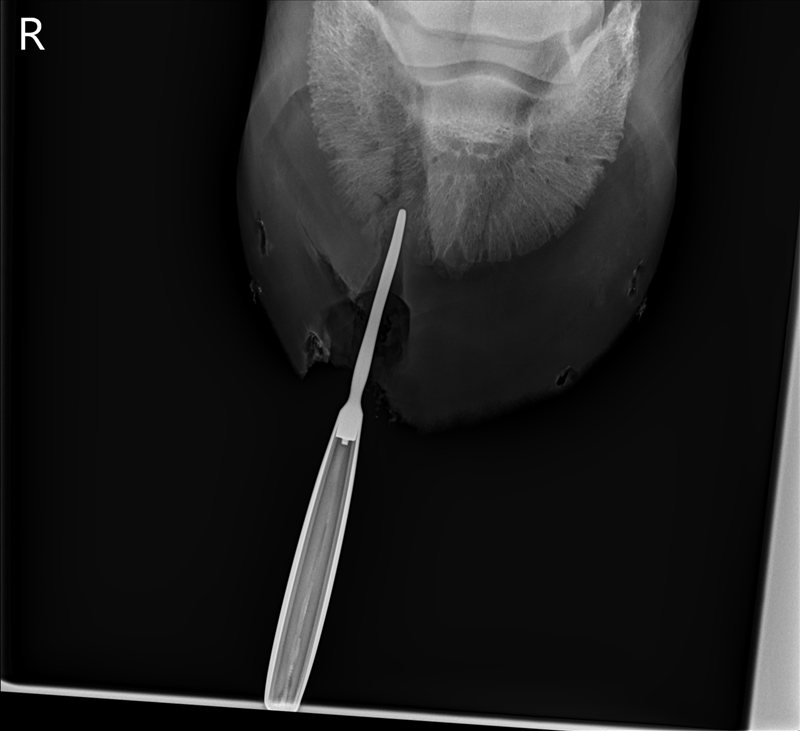
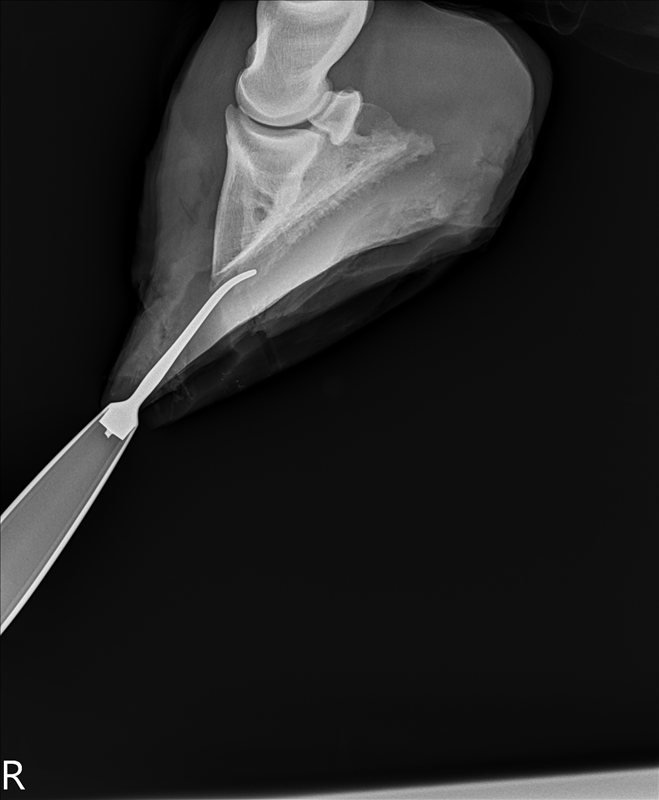
X-ray taken during surgery with a probe inserted to confirm that they were headed in the right direction.
Side view of same.
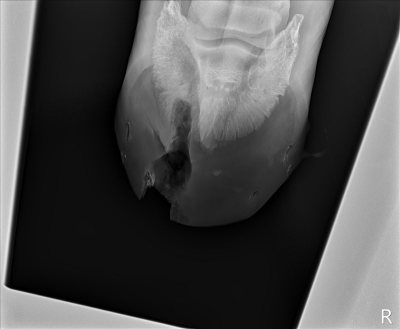
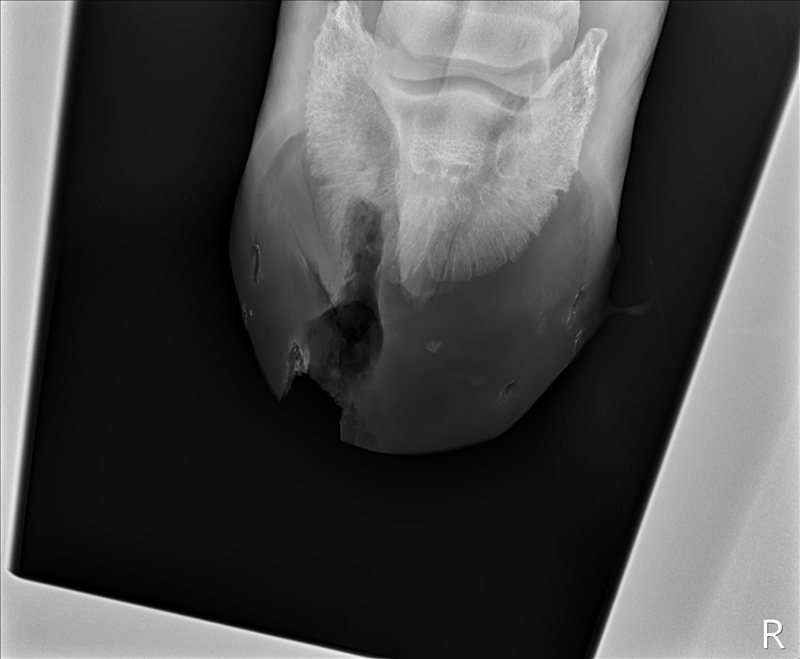
After surgery, with the hole and the missing coffin bone area. Not too bad, actually – there’s still bone in the middle, they didn’t take a clear slice out.
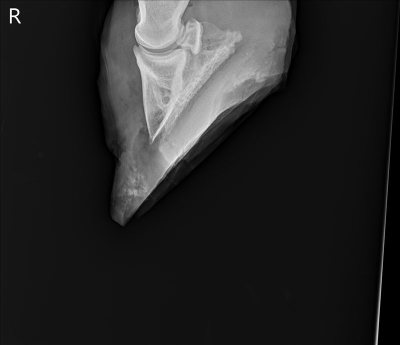
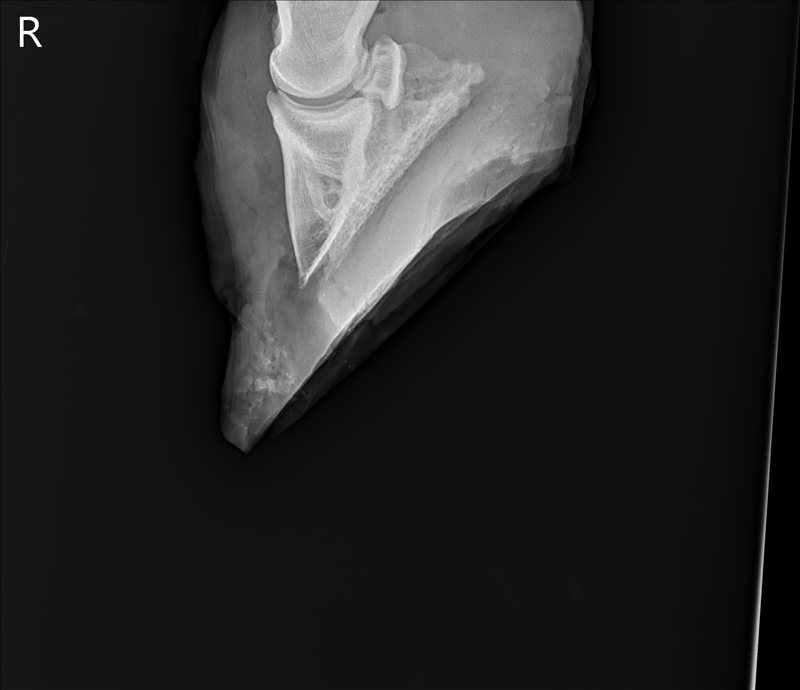
Side view of same. You can see the hole going up to the toe, and the scraping from both the top and bottom.

When we got back to the stall, we found Tristan enjoying a celebratory post-surgery bran mash.
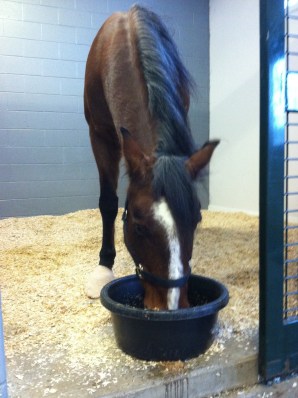
Eating very slowly and very carefully.

His protocol going forward is actually fairly straightforward:
– 6-8 weeks of stall rest, the first 2 very strict, and possible handwalking or occasional turnout based on evaluation after that
– Bute am + pm for three days, then am for three days, then back to Previcox
– TMS tablets (sulfamethoxazole + trimethoprim): 10 am + pm for 2 weeks, possibly longer pending evaluation
– flushing and rewrapping every day for three days, then every other day for the duration
– checks with our local vet 1 and 2 weeks out

Here’s what the hole looks like, basically; these pictures were taken the morning after surgery by the intern. I’ll link to them instead of inserting them because they’re a bit gruesome. Click here.

Tris will granulate in new tissue around the bone first, and then fill in the hole slowly, down through the sole, and then finally heal over the bottom of the sole. He’ll be in his new boots for pretty much that whole time, and when everything is 100% healed over we’ll see about whether he needs his shoes back on, or wait until he’s back in full work or not.

As I’m now posting this almost a week after the surgery – I’ve been insanely busy – I’ll follow up with a general post about the week since surgery, and then get back on a proper schedule.

surgery

Brave, brave pony

Tris did GREAT today: walked right on the trailer, hauled easily, and walked right into the clinic and into his stall.

I signed a bunch of paperwork, brought in his grain, and there wasn’t much else to do. He started eating his hay immediately and behaved perfectly to have his vitals checked. He’ll get a catheter for his IV first thing in the morning, and go in for surgery about 1pm. It will last about an hour. He’ll get an EWT booster, since he’s due soon, and be on lots of antibiotics and IV bute starting tomorrow.

When I got back to the barn I stripped his stall. Tomorrow night I’ll spray it down with a bleach/water mix, then re-bed with fresh shavings, nice and deep. He can’t come home fast enough.

sheath cleaning · surgery

Liveblogging!

Coming to you live from Tristan’s stall, where the Smartpak small hole haynet is proving an outstanding investment. He’s still working on his early morning hay with a fair bit left.

I ended up cleaning his sheath last night – got out a lot if gunk and a bean-sized bean. He was perfect for it – flopped his ears and cocked a hind leg in relaxation. Glad I got that done.

Everything is packed and ready and we are leaving for the clinic in about an hour. Surgery is at 1pm tomorrow. Wish us luck.

surgery

Getting ready

I am so very bad at waiting. Truly awful. I want to be doing instead of anticipating.

I am making lists – packing lists, medical history lists, lists of questions to ask.

I keep thinking I should send him with something. When our dogs went for surgery we sent them with blankets that smelled like home. Horses don’t really think like that but I keep returning to the thought over and over. There’s nothing, really. Hay and grain and water, halter and lead rope. No toys or stuffed animals or blankets.

I groomed him nose to tail last night, combed all the snarls from his name, trimmed his bridle path, curried the scurf from his belly. I kept thinking, what if I lose him on Monday? In the macro sense this is routine and will be handled by good, competent people. In the micro sense, I couldn’t bear it. I would lose my mind.

I hate waiting.

surgery

Planning

Okay.

I have ordered two boots, size four EasyBoot Rx. I called the clinic and said, sorry, I don’t mean to be obnoxious, but don’t horses with coffin fractures usually do hospital plates? They explained since they’ll be basically removing all the chips there’s not anything to stabilize. Plus they want me to have easy access to the surgical site to clean it out regularly. Which makes perfect sense, so: boots!

I also ordered a bunch of things from Smartpak: more vet wrap, a Jolly Ball, more betadine, etc. Things to keep him happier in his stall, and things with which to wrap his foot. I did an inventory of his foot-wrapping supplies and I’ll put together a tupperware with everything in it that I can grab quickly and have everything together.

I’ll go by Tractor Supply tonight and pick up a few more syringes as well as some bandage scissors because I forgot those, whoops. I’m trying to decide whether to do a sheath cleaning now or next week; he needs it pretty badly. I think probably tomorrow night, so I don’t have to make him suffer through that while he’s recovering.

I’ll put together all his paperwork tonight, Coggins, vacccines, etc. He may need a tetanus booster as he’s close to the re-up for that anyway.

I’ve asked the barn to haul him up to the clinic – my truck is more or less still stuck in the driveway. It was never intended to be a winter driver, and my trailer is solidly snowed in. I’d have to drive up into the mountains to pick up a friend’s trailer, and I don’t want to haul with a strange trailer in my unreliable truck when I’ll be so nervous about everything else.

I think that’s it for now.

abscess · pedal fracture · surgery

Sea Change

Wow. I’m not even sure how to start this post. Begin at the beginning I guess?

Before I do, here’s the very short version: Tristan has a pedal fracture of the coffin bone that is badly infected and likely has been for some months. He will have surgery for it on March 4, a week from Monday, and if that goes well he has a very good chance of returning to riding sound.

Long version.

Item #1 on my to do list came back quickly. My vet heard from the consulting radiologist first thing in the morning on Thursday and called me at around 10:30. She told me his findings: pedal fracture, with infection and bone loss. Tris would need to start on antibiotics ASAP, and would get a hospital plate put on in the next few days while we tried to decide – with more consultants’ help – if he would need surgery.

Here’s what the radiologist report actually says:

Along the dorsolateral solar margin, there is a triangular, moderate sized fracture fragment. The margins of the distal distal phalanx are moderately irregular. A focal area of osteolysis is present, medial to the osseous fragment. Smaller rounded osseous fragments are present along the lateral solar margins  A long toe conformation is present that is slightly concave along the distal dorsal aspect.  There is a small amount of gas tracking between the sensitive and insensitive laminae.  

The navicular bone is within normal limits.  The remaining osseous and soft tissue structures are radiographically normal. 

Here’s the view that made him say that. You can see the triangular fracture fragment pretty easily in this picture, as well as the irregular margins. Osteolysis is a fancy word for bony changes, which you can see between the fragment and the rest of the coffin bone. The “smaller rounded osseous fragments” are bone chips.

Long toe and concavity is something we knew we had, and that’s been present practically since day one of the abscess. The gas tracking is also due, presumably, to the massive hole of the abscess. You can see both in this side view. This view was taken before a second, more aggressive trim of the toe that we did based on the x-ray, so the long toe was corrected.

Finally: hip hooray for everything else looking ok!

I sent off the x-rays from June and September and the radiologist saw the pedal fracture on both. He also guessed that the infection in the coffin bone has been going on for some time, based on the amount of bone loss. Which leads to the chicken or the egg question: did he abscess because of the fracture & infection, or did the infection come only with the abscess, or was the abscess incidental and confusing?

I drove out to the vet’s house Thursday night and picked up the antibiotics – enrofloxacin, trade name Baytril, which seemed a good combination of easy to dose, easy on his body, and broad-spectrum enough to fight the infection and get down into his foot. I stopped by the barn afterward to leave the drugs, dosing instructions, etc., and to cry all over him.

Friday afternoon I heard back from the vet, who had a long talk with the surgeon at the Vermont Large Animal Clinic in Milton, VT. They recommended surgery without question, and offered to take him the next day – Saturday morning. The vet was headed out of town the following week but would be back and take him first thing the day he got back, Monday, March 4.

My vet said she felt comfortable with his diagnosis, liked him enormously as a surgeon, and sent me the original files of everything so I could send them down to Tufts to get a second opinion, just to be neurotic. I trust her enough that I have made the appointment at VLAC and spent about half an hour talking to the surgeon’s intern (who has discussed the case with the surgeon, who was not available at that moment), who was extremely nice and able to answer all my questions.

VLAC wants him to go home in a boot, so I called the EasyCare company and they recommended their EasyBoot Rx. I’ll measure him tomorrow and order them first thing Monday morning. I did email VLAC back to gently question the boot v.  hospital plate aftercare, as everything I’m reading (I know, I know, armchair owner) recommends immobilizing the foot with a hospital plate instead.

He’ll go in at 1pm on Monday, and stay overnight. I’ll bring him home on Tuesday. He’ll have a minimum of 6 to 8 weeks stall rest while he heals. The good news is that he has a decent chance of coming sound enough for riding if the surgery is successful, and they’ve done this surgery before and are confident in it.

So…here we go.