product review

Product Review: Nunn Finer Soft Grip Reins

Nunn Finer Soft Grip Reins

I have stubby fat fingers. Fitting anything to my hands is tough. Most rubber reins are rubber over some other material, and are thick and stiff. This is almost undoubtedly more durable and sturdier. But it meant that I could not for the life of me use them. It was like holding thick fat crayons between my fingers – there was no subtlety to them at all.

A few years ago, when I decided I wanted rubber reins, I went to Equine Affaire, and I pawed over every single pair of rubber reins I could find. I came away from that day with a solution: these reins. Out of every single pair of rubber reins at that massive, massive trade fair, these were the best: the softest, the most malleable, the thinnest, and the highest quality. I put them on my wish list and two years later, received them for Christmas. I got the white ones, which I think look awesome and which I’m pretty sure most people secretly think are tacky.
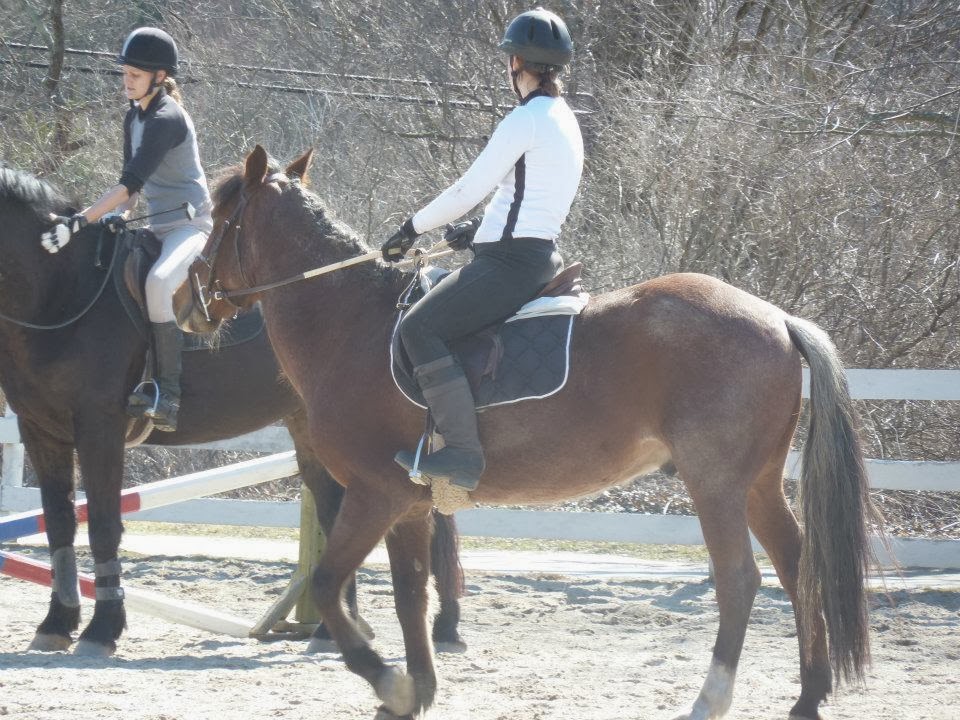
I have no idea what I’m doing in this picture,
but look how awesome those white reins look!

They have lived up to their promise 100%. I’ve schooled in them, showed in them, hacked in them, you name it, and they remain exactly what I hoped for. So if you’ve got small hands and short fingers, or you struggle with the stiffness of typical rubber reins, these are for you.

abscess · product review

Product Review: Davis Soaking Boot

In the bad old days when I was soaking Tristan’s foot every single day, trying desperately to draw out the abscess that we thought was just stubborn and/or trying to keep the abscess holes clean, soaking was a chore. I used the tried-and-true feed pan method. Result: guaranteed spillage, frustration, and possibly tears. (If you want the whole abscess drama in real time, follow the abscess tag and then the surgery tag.)

One day, I found myself at Smartpak to purchase more Betadine and epsom salts, and cleverly placed alongside those vital supplies was a Davis soaking boot. It was $32.95, and as we know that is pretty darn cheap for something connected to horses. So I bought it. And it changed my life.

Chillin’

I’m not trying to be dramatic, but wow. Why did it take me so long? Within two or three sessions, we went from frustration, anger, and lots of cleanup afterwards to uneventful, straightforward soaking. I would put his foot in the boot, pour the epsom salt/hot water/Betadine in, tighten the velcro, toss a flake of hay in front of him, and he would stand stock still for as long as there was hay on the ground. I didn’t even tie him. I often read a book. To this day, that training holds.

Some of the advertising for this boot seems to imply that you could, in theory, fill it and then turn your horse out in it. I believe that to be creativity bordering on bullshit. If you have a boot large enough to hold an appropriate amount of water, it’s too large to stay on your horse. Also, it would get trashed, durable as it is. So don’t do that. If you truly desperately want something to serve as a hoof dressing during turnout, do the old duct tape method and plan on replacing daily. But if you are looking for a way to make your life easier while soaking, buy one of these. It’s a game-changer, and no barn should be without one.

product review · trailering

Product Review: Chain Shank

Product Review: Chain Shank

This goes hand in hand with last week’s ode to the cotton lead rope, but this one is slightly more specialized.

99.5% of the time, I lead Tristan with just the regular cotton lead. He’s well-behaved enough that I’ve been known to just toss the lead rope over my shoulder and let him follow me. In the barn itself, we’re working on a “go home” command that sends him to his stall.

Enter the horse trailer.

Tristan hates horse trailers. With fiery passion. Horse trailers mean not only the stress and discomfort of the ride itself, but also the near-guarantee of hard work at the other end. He’s pissy enough about them that he will stop and stare at parked trailers in the driveway, quivering in horror, hoping against hope that I won’t make him get on.

So, when we haul, we use a chain shank. We have a system: I bring him up to the edge of the ramp or trailer. He is allowed to stand still, and allowed some sidling, but he may not under any circumstances go backwards. When he goes back, it is never just one step: it is a bat out of hell zoom straight back. When that happens, I follow him and shank hard one, two, three times. If he rears (which happens less and less often now but is not unexpected) he gets shanked again and chased back.

When he comes down or stops he looks at me, and he looks at the trailer. He licks and chews. He ducks his head. And then he walks on. It never fails. He just needs to register his complaint, at maximum volume, before he submits.

Hence this chain shank. Tris has no need for a chain shank in his regular life, and I don’t want to complicate things by switching lead ropes every time we go anywhere. So this chain snaps to the end of the regular lead rope, and it snaps off again when we’re done. Instant chain shank lead. In the meantime, it lives in the trailer’s tack trunk. It is an elegant, simple solution to needing a chain shank – but not wanting a whole other lead rope.

product review

Product Review: Cotton Lead Rope

Product Review: Cotton Lead Rope

Yep.

I’m reviewing a lead rope.

But when I said I wanted to write about things that I use every day, and value, and would recommend, I meant it.

This is my favorite lead rope. It is miles and miles away my favorite. It’s just the right length to lead Pony Club style (right hand near the halter, left hand at waist holding the looped end). It is just the right thickness to grip easily without overgripping. It is sturdy as all get out: sometimes the ends fray but I’ve never actually had one of my own unravel or snap.

It’s cotton, so on the off chance a horse takes off with you still holding on, it won’t give you nearly the rope burn that nylon would. (Someday, I will share my rope burn story. It is not for the faint of heart.) Ditto the round shape: those flat lead ropes are a bitch. The bolt snap is quick and easy to use, and the solid brass means it will hold up better. When it’s left out in the rain it just gets heavy, and when it freezes it just gets stiff – and doesn’t break when you bend it to loosen up.

It comes in interesting colors. It goes on sale frequently. It rolls up nicely, so you can keep one in every possible place. (Especially if you’re like me and keep a halter and lead rope in the trunk of your car just in case you see a loose horse by the road. Oh, Vermont.)

Please note that I accept no imitations on this. There are thinner, lighter versions. There are shorter versions. There are bull snap versions. None of those measure up. This is the 9′, 3/4″ thick, bolt snap, heavy duty original.

I could write an ode to the simple cotton lead rope, but I’m not a poet, so I leave you with this simple statement: this lead rope is the absolute best.

grooming · product review

Product Review: Oster Mane and Tail Brush

Product Review: Oster Mane and Tail Brush

The first piece of horse equipment I ever bought for Tristan, almost ten years ago now, was a cheap hair brush at a CVS. I still have it, more out of nostalgia than anything else. It wasn’t a great brush, though, and I basically stopped using it pretty quickly.

Tris has an incredibly thick and long mane and tail. I know people say never to brush them but if I didn’t work on them on a semi-regular basis they would be nothing but dreadlocks. In fact, even with me grooming him every day and checking his mane and tail regularly he had a huge dreadlock in his mane that I had to pick out. Let’s not even talk about his talent for picking up thistles.

To give you a sense of just how thick his tail is.

A smart friend recommended this to me as the best brush she owns. She’s ruthlessly practical and not spendy, so I took her at her word and bought one myself. I. Love. It. It’s tough to pinpoint exactly why, but in all honesty this is the greatest mane and tail brush ever. I am kind of picky about grooming stuff: my stiff brush has to be just the right stiffness, and I have 4 soft brushes of varying softnesses. I have small, stiff hands so they have to be easy to use. This brush? Is perfect.

I actually have a set of the other Oster grooming tools, too, and they live in my show/travel tack trunk in my trailer, but they’re just brushes. This is magic.

Caveat: I never just straight-up brush his mane and tail. Thick as they are, that’s just asking for it. But I always keep a bottle of detangler in my grooming kit, too – more on that in a future product review – and when his mane or tail are getting a bit gnarly I will apply liberally to the area, pick through with my fingers, and then use this comb. I always do it in pieces – for the tail I start at the bottom and work my way up, and for the mane I isolate a few inches at a time. Similarly, after I’ve used conditioner in his mane or tail when bathing I’ll do the same thing. Yes, I pull some hairs out, but his tail after it’s been cleaned and combed through is really wonderful.

In short, this brush is exactly as good as advertised.

product review

Product Review: Sore No More Gelotion

Product Review: Sore No More Gelotion

This is not exactly a ground-breaking review, but I am committed to talking about things that I use regularly and love, and the Sore No More Gelotion is absolutely tops on that list. I keep a bottle in my grooming kit at all times. For that matter, when a bottle starts to run low it comes home with me for personal use – and Tris gets a new full bottle.

If you somehow haven’t heard of this stuff, it’s liniment, meant for easing mild soreness and inflammation. It won’t erase the pain of a broken leg or un-bow a tendon, but wow, will it significantly improve everyday strain and stress from work.

I’ve used many liniments before. For a brief time I boarded at a barn with a wash stall with a communal jug of Absorbine. Tris got a liniment wash after work every day and we both smelled fresh and delightful all the time. I’ve had bottles of other stuff from time to time. This is the one that I keep coming back to.

Why do I prefer it? A couple of major reasons. First, it’s a gel, which I think is crucial for any liniment. Liquid ones are great for adding to buckets for a wash, or maybe for a back, but for legs you are just asking for frustration if you want to apply a liquid. It goes everywhere but where it needs to.

Second, you can apply it under wraps. It won’t burn or blister. I lover being able to really rub it in and then wrap ice over the leg, or a standing wrap.

Third, it smells AMAZING. The first few times I put it on, Tris tried to lick it off. He always sniffs at his legs the whole time I apply it.

Fourth, it’s herbal-based, which is important to me because I have lived in Vermont for many years and am part-hippie at this point. No, seriously, though, when I have the choice I err on the side of herbal stuff, especially when it works so well. I always keep arnica around for myself and I love that it’s the main anti-inflammatory component in this.

Cons? It’s expensive, more so than regular liniments, and it can leave a bit of scurf if you apply a lot of it. Nothing you can’t brush off once it dries, but it’s not 100% clean.

I usually apply generously, by drizzling down and then rubbing it in against the hair so it has contact with the skin, until the whole area is saturated. I find it most useful on legs but I’ve also rubbed it into back and haunches after a hard XC school.

product review

Product Review: White Lightning

Ask two horse people, get three opinions, right? Everyone’s got their favorite stuff for use around the barn. I’m especially picky and I’ll often burn through several possibilities to get just the right thing for my problem. With that in mind, I’m going to do occasional product reviews of things that I’ve used and loved for years. None of these are endorsed unless I mention it up front.

Product Review: White Lightning

I’ve talked a little bit about our recent struggles with white line disease in both of Tristan’s back feet. I’ve been paying too much close attention to his front and it wasn’t until he started chipping excessively in the back that I took a neurotically close look at his hind feet and bam – clear indications of white line problems.

I was first introduced to White Lightning by a barefoot trimmer that I loved, who worked on Tristan for about a year and was a friend of my first trimmer in Vermont. She recommended it for a touch of thrush that he had going on at the time. Since then, I’ve always kept a bottle on hand. I tend to think of it as big guns: it can be a pain to apply and use, but whoo boy does it live up to its labeling.

The gist is that White Lightning is a chemical that reacts with vinegar to produce chlorine dioxide. For small, short applications such as the mild thrush that first led me to the product, you can mix equal parts White Lighning and vinegar in a spray bottle and then thoroughly spray the bottom of the hoof. It needs to be mixed new each time, as the chemical reaction is what counts. You don’t need much at all if you’re using this method – just 2-3 tablespoons of each liquid.

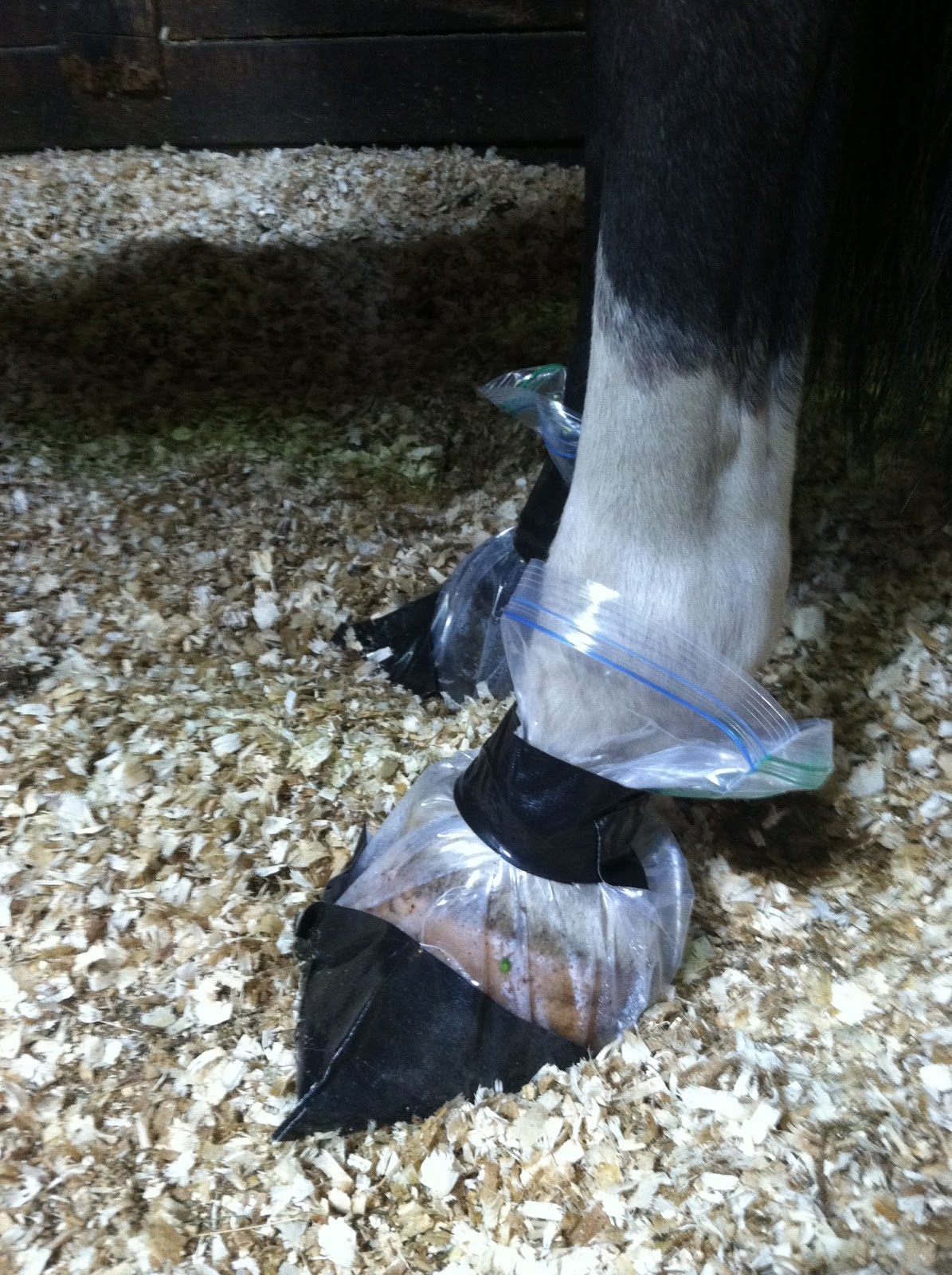
For bigger stuff such as a whole-hoof treatment for persistent thrush or white line disease, you need to get more involved. Clean the whole hoof – even powerwash it if necessary – but the idea is to give the stuff access to all the problem areas. Mix equal parts White Lightning and vinegar, and then the whole hoof needs to be soaked in an airtight bag for 45 minutes. White Lightning recommends 2 oz of the stuff to 2 oz of vinegar, or about enough to get a little ways up above the hoof wall.

It is a pain but thankfully Tris is great about soaking after our abscess extravaganza. Drop a flake of hay, untie him from the crossties, and he. will. not. move. For horses that get more antsy, duct tape is your friend. Cover the bag, and get it nice and tight around their pasterns, too. (For the horse that truly won’t tolerate soaking, this stuff probably won’t work for you, alas.)

It really works. It knocks stuff out cold. For really persistent problems my strategy is to soak at 1 week intervals but I promise you will notice a difference, especially if you keep things at an even keel in the interim – stay on top of picking the feet out, etc.

Caveat: many people find that their horse’s hair can be bleached by the gas that the mixture produces. I’ve never run into this problem but I’m sure it’s possible.