alois podhajsky · movie review

Movie Review: Miracle of the White Stallions

Miracle of the White Stallion (1963)
(available on DVD at Amazon.com)
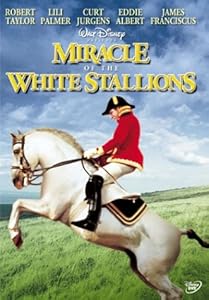
In my world, there are only two perfect horse movies. I’ll talk about the other one soon, but one is Disney’s 1963 movie Miracle of the White Stallions, starring Robert Taylor as Colonel Alois Podhajsky.

Miracle tells the story of a very fraught period in the history of the Spanish Riding School: 1945, when the school was under Nazi reign and in a Vienna that was in constant danger. Podhajsky – arguably the school’s greatest director, and one of the great dressage riders of the 20th century and perhaps of all time – persevered to save not only the school and its stallions, but also the mares and foals from the stud farm in Piber. It’s based on Podhajsky’s memoir My Dancing White Horses, which has been out of print for many, many years and which I would dearly love to read someday.

Make no mistake: this is a movie of its time. There are precisely two mentions of concentration camps; both are fleeting and neither acknowledges the Holocaust. There are Evil Nazis and there are Good Men Who Happen to Be Nazis. There are gosh-darn American GIs, the pacing is not the greatest, and let’s not even talk about the gender politics, though the movie does actually pass the Bechdel Test and arguably Podhajsky’s wife Vedena gets some of the film’s best lines.

Disney pulled out all the stops on this movie. It was filmed on location, using the actual SRS stallions and riders. Alois Podhajsky was Robert Taylor’s stunt double. There are long segments that watch more like one of those old Disney nature documentaries than a feature film – long, sweeping, gorgeous shots of herds of beautiful horses, pleasant historical narration, and minimal plot for chunks.

It seems like someone involved with this movie also realized they were filming history in action: there are extended sequences of training and performance with the SRS stallions and riders, multiple examples of the Airs Above Ground, long, loving, sweeping views of the quadrilles. Transitions are flawless, and the concentration of the stallions is fierce and comes right through the screen. The movie, intended as a commercial success, has become a historic artifact.

I can’t be alone in my childhood obsession with this movie in particular and the Spanish Riding School in general. I rented and watched the VHS more times than could possible be counted, and when I wasn’t watching the movie I was re-reading Marguerite Henry’s White Stallion of Lipizza (which I am delighted to see is back in print, Christmas list ahoy!). As an adult, Podhajsky’s Complete Training of Horse and Rider is my guiding star, one of the few training books that I hold dear to my heart and always find inspiring.

In short: be very aware of this movie’s shortcomings, but don’t tell me about any of them. Absolute perfection.

movie review

Movie Review: International Velvet

International Velvet (1978)
(available on Amazon Instant for $2.99 rental)

This past weekend, I rewatched International Velvet, which is one of my top five favorite horse movies of all time. It’s the sequel to National Velvet. The movie begins with Sarah Brown, the daughter of Velvet’s younger brother Donald, who was orphaned and comes to live with her aunt in England. They turn out to have a love of horses in common, and Sarah trains up the Pie’s last foal to become an eventing superstar, cleverly named Arizona Pie.

This is the kind of movie that does some things really, really right and other things really, really wrong. I rather adore it, for its spirit if nothing else. It captures beautifully the ambition and hard work and joy of horses, and it is a fitting – if sad – sequel to National Velvet in its continuation of Velvet’s story.

The things it gets wrong are the usual small silly things: the Pie has transformed from the book’s piebald gelding, and even from the movie’s chestnut gelding, to a seal bay stallion. He also has to be at least 40, by the universe’s internal chronology, and…yeah, no. Some of the details of horsekeeping are just dumb. The cinematic conceit of making everything faster – stronger – scarier in regard to horses holds true; there’s one extended chase sequence in particular that would be insanely dangerous and probably kill both Sarah and Arizona. (It still works, though; it’s frightening and maddening in equal measure as intended, and the bad guys get a particularly awful comeuppance.)

But oh, the things it gets right. Sarah is a bit of a stereotype, true, but she’s the best kind of horse-crazy. Her relationship with Arizona is a little Black Stallion-y but it still works. The best part about her character is how terrible she is with people. In fact, she’s not really very likeable. “I’m never going to be what people expect me to be,” she confesses to an admiring boy at one point. “Don’t feel badly. There’s nobody else. It’s just me.”

The movie really gets eventing, right deep down, and it doesn’t fall prey to the usual mistakes about the format of the sport that the handful of other movies about eventing do. In particular, the team selection bits are marvelous. There is a bit where the chef d’equipe explains the politics of team selection that is just perfect.

Possibly my very, very favorite thing about it is Velvet, and her adult life. Her relationship with John (Christopher Plummer in all his glory) is note-perfect in its characterization of a happy loving adult relationship. Her sadness and regret at the way her life turned out is poignant and painful. Remember her mother, who was afraid that swimming the Channel was the only big thing that would happen to her? Velvet, despite her protests, turned out much the same. After winning the Grand National, she stopped riding – she says she “lost her nerve” and later in talking about Sarah said, “All I hoped was, she wouldn’t win too early, and afterwards have nowhere to go.”

My second favorite thing? Anthony Hopkins as Captain J.R. Johnson, the British chef d’equipe, who basically steals the entire movie from everyone else. He gets all the best lines and all the best scenes. It might be my favorite role of his. Here are just a very few of his selected quotes:

“Oh. Well. We wouldn’t exactly call that riding, would we? Staying on a horse, perhaps. Where did you learn to ride?…Oh, in the colonies, yes. Well, that explains it. You realize, of course, that they don’t allow cowboys in the Olympics?” 

“No, no, no. Come on! Stop. Start again. This is dressage. It’s meant to be like a ballet, Mr. Clark, not a barn dance, or like a pregnant Tom Mix. Don’t ask me who Tom Mix was. It’s all too long ago, and I can’t remember. Now, once more and not with feeling. Please, spare me that.” 

“Some of you may have come here with the impression that dressage is frightfully boring compared to the greater glories of the cross country event. That’s because you all lack sophistication, amongst other things. 

Now, we come to the cross country event. The cross country event is considered by some, Miss Brown, to be an opportunity to display carefree abandon. This is a mistake for which I would cheerfully re-introduce capital punishment. This is a test of brains. And since horses are only marginally less stupid than some of the people who ride them, an observation which carries with it the experience of a lifetime, I would urge you not to sit on your brains, but to use them.”

“Dressage in pouring rain is like dancing Swan Lake in clogs in a bog. The greater glory of the sport was somewhat obscured from view that day.” 

Final warning: there is a scene on a plane that…well…it’s quite frankly really horrible. If you don’t deal well with animal death, fast forward any of the times they’re on the plane, ok?` I do, every time.

In short: absolutely worth it, both as a horse movie and as an eventing movie. We’ll just pretend the scene on the plane didn’t happen onscreen, and ignore the stupid final resolution of Sarah’s storyline.