dressage

Patience and Deliberate Steps Back

I’ve been thinking a lot about the training pyramid lately. You know, that infamous dressage textbook illustration.
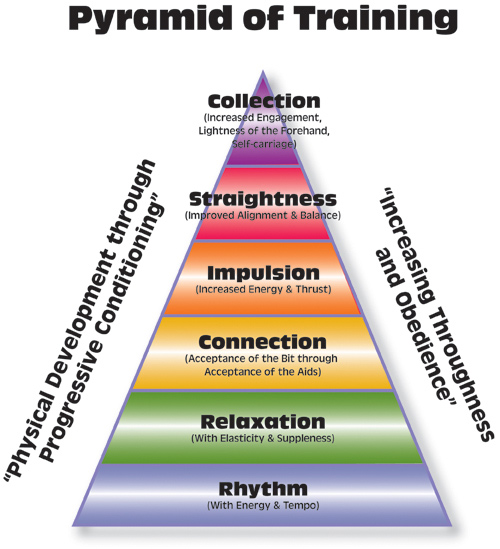
I know we’ve all seen it a million times, but I’m putting it up anyway.
My riding and training has been so hopelessly sporadic this summer. Not everything has been terribly productive, and I haven’t put nearly the miles on that I wanted to. I was busy at work, the house demanded attention, Tristan went through health issues (again, some more, blog post to follow, resolved now), and then we went away on vacation.
A lot of my life is in a tumult right now. I’ve been doing a lot of long, hard, deep thinking, trying to mine my own brain to sort out my reactions to things, the ways in which I can control my own reactions and behaviors, and the decisions that I’m making. My watchword right now is deliberate: I have to be ok with the choices that I make and why. No letting things happen.
On Sunday, I had a ride that worked out beautifully. It was a combination of a lot of things that led to success, but if I had to put my finger on it, the thing that worked out best for me was after walking around the fields to warm up, we trotted around the outdoor dressage ring. Two times, each way, and all I asked for was rhythm and focus from him. No squirreling around, no sucking back, no slamming in and out of the contact, no fights. I simply held the reins in such a way that I could feel the bit, and asked him to trot forward consistently. It was nothing fancy or extensive – it took us maybe 12 minutes.
On lap 3, he started to soften through the corners instead of motorcycling. On lap 4, he started to fill out both reins evenly, and then by the end of the lap, he had stretched into the outside rein and begun to soften. I called it quits. I dropped the reins, patted him, and we moved on to something else – walking the roads for a bit, then up the hills to get some quality muscle work time.
I’ve been reflecting on that ride since, in the same way I am turning everything over endlessly in other parts of my life. I think I’ve finally untangled something in my brain. See, Tristan is a more or less trained horse. Buried inside his brain and in his body are all the tools and memories necessary to put together a very good Training test that on a good day is schooling first. 
But that’s not where or what he is right now. I can’t swing a leg over and expect that horse. And I guess I have been: I’ve been putting him through a cursory warmup and then trying to school shoulder-in, or haunches in or canter transitions. These are all things he has schooled well in the past, and yeah, we’ve been sort of getting to them. Not well – not happily – not cooperatively – but the work has been produced.
Sometimes it’s the right call to muscle through and get to the horse you know is inside. Not right now. Tristan needs to go back to the base of the pyramid, and that needs to be our only focus. Just because he has all the pieces of the pyramid doesn’t mean I can just slap them together and zip up to the top.
So, tonight: rhythm. Short, sweet, 30 minutes focusing on a forward, elastic gait in the walk and trot and maybe in the canter. If we get it, our reward will be a taste of relaxation at the end. Then we repeat. It’s a self-discipline thing. Just because I feel something in him does not mean I have to reach for it and drag it out. Just because I know what a balanced connected trot and canter feel like does not mean we have to get it tonight. Or the next night.
It’s both humbling and frustrating to have to do this again, once more, for the millionth time. Tristan is 21, and he has been under saddle for 11 years now. I have been riding horses for 2/3 of my life. Back to the beginning we go.
dressage · senior horse

Little Snags

Oh, okay, not little snags. I haven’t been riding my horse terribly well lately. He hasn’t been cooperating either, so there’s that.

Right now, here’s one of our problems: cantering improves the trot. But he is not quite strong enough to hold himself well in the canter.

So I am left with, after a 15 minute walk warmup, shoving him through the trot, insisting on forward and through while begging for any semblance of softness. He is stiff and sore in his hind end, I know this; I am attempting to remedy this in other ways. But he is not so stiff and sore that he cannot do the things I am asking of him.

(This, I think, is the endless daily compromise of an older horse. He is sore and he is tired. But the ways to fix that involve more basic dressage. There is a lot of working through to get to the other side. He’s going to come out of his stall stiff no matter what; but he is a horse, and horses live in the moment, and he doesn’t believe me that after warming up his body will feel better, and that the daily work of simple dressage is keeping him healthier and more limber overall.)

Cantering: that helps. A lot. It gets him excited, it breaks up the tension in his back, and it is smoother and easier for him right of the bat.

Best of all is cantering forward on a loose rein, with me out of the saddle.

We cannot do that outside, not yet; though he is way better than he was earlier this summer, when he was bolting hell-bent for leather at the slightest provocation, he is still not what I would call reliable enough for a forward canter in half seat on a long rein. Bolting straight is one thing – bolting sideways is another.

When we are inside, it works, and it helps, but it’s summer in Vermont, and we don’t want to be inside.

So we canter in a more constrained manner, with a firm hand on the reins, and only occasionally do I feel secure enough to stand in my stirrups. Which lessens the effectiveness of a good long canter. Which in turn makes the trot work that much harder.

I tried to get away with just working up through the trot last night, and it was awful. I spent 40 minutes bullying him into softness, which is really not fun.Or good. Eventually he got there, and he got all the praise, and when he gave me a nice soft 20m circle in the trot we called it quits in the upper ring, and I made the mistake of picking at him a bit more in the lower ring.

But afterwards he was nosy and affectionate and sweet, so there’s that, at least.

2016 show season · champlain dressage schooling series · dressage

Longer Show Recap

Can I just say, I envy all of you who can do blow-by-blow accounts of your tests? Like, you remember pieces of them? I dunno. Maybe my head is stuffed too full of everything else, but I can only retain some basic pieces.

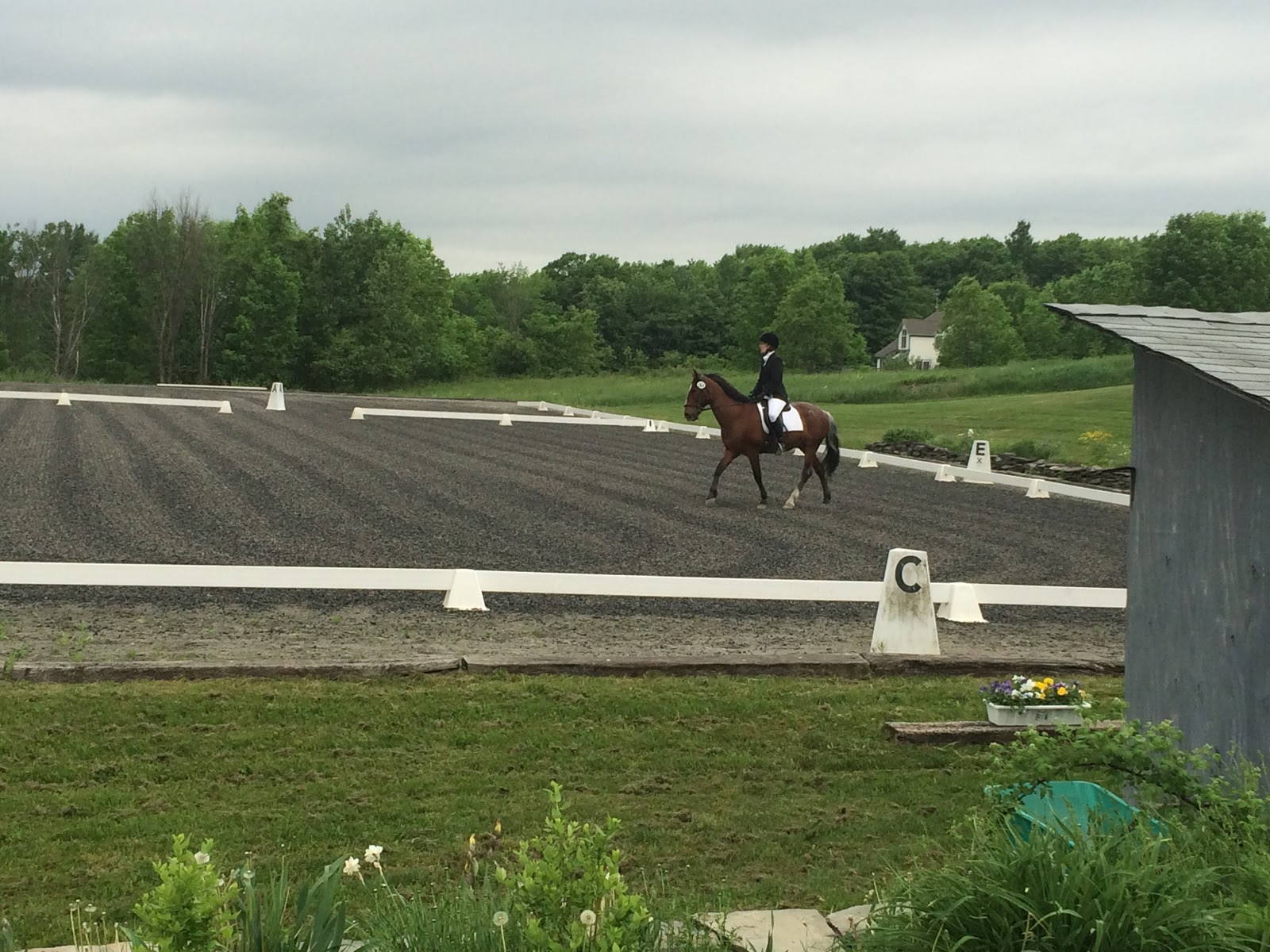
First: holy fuck, the weather was miserable. It wasn’t so much the rain or the wind as it was the rain, and the wind, and the cold, all together, constantly. Watch Emilie’s video to get a sense of the day.

My last prep ride on Friday, after our epic, come-to-Jesus ride on Thursday, was…sluggish. He was tiiiiiiired. We did a thoroughly uninspired run-through of both tests in the dressage ring, in the snaffle, and then he got a long bath. Which he hated, but desperately needed.

Saturday night I didn’t sleep terribly well; I drilled and re-drilled the tests, but they would not stay in my head. Not only that, but I discovered that the long diagonal free walk in Training 1 that I had memorized and schooled was, well, not a long diagonal after all, but a short one. *facepalm*

Sunday morning: bang on schedule for everything, but maybe a smidge short on warmup time. I was in not-fucking-around mode, Which was both good and bad. It meant that I was disciplined and strategic about what I chose to do with him, spotted trouble spots, and tried to work through them. It also meant that I was tense, iron-fisted, and railroaded him through everything.

setting off. nope, didn’t braid. zero regrets.

From a certain point of view, that was the ride he needed. And it worked: we had not a hint of the bolting, bucking, uncooperative little shit that he had been for the previous three weeks. When I told him to jump, he asked how high. He was so docile that halfway through my warmup I went down to the barn and got a whip, and that added in the last bit of sharpness that I needed, but he still remained controllable.

note clenched fists.

But I’m not going to pretend that was a ride that was going to score well in a dressage ring!

I rode Training 2 first, and succumbed at the last second to an offer to have the test read. That was a first for me! I’ve read many tests, seen many read, but have never had one of my own read. It kind of underlined my theme of the weekend: do what you can, and let the rest go.

sit up. SIIIIIT UP.
Anyway, Training 2: I was pleased with the way we rode into corners, the promptness of transitions, and while he was braced AF, we at least had lines of communication. I softened when I felt like I could, which was probably way less often than I actually could have, but having gained the upper hand finally there was no way I was letting it go.
f’rexample
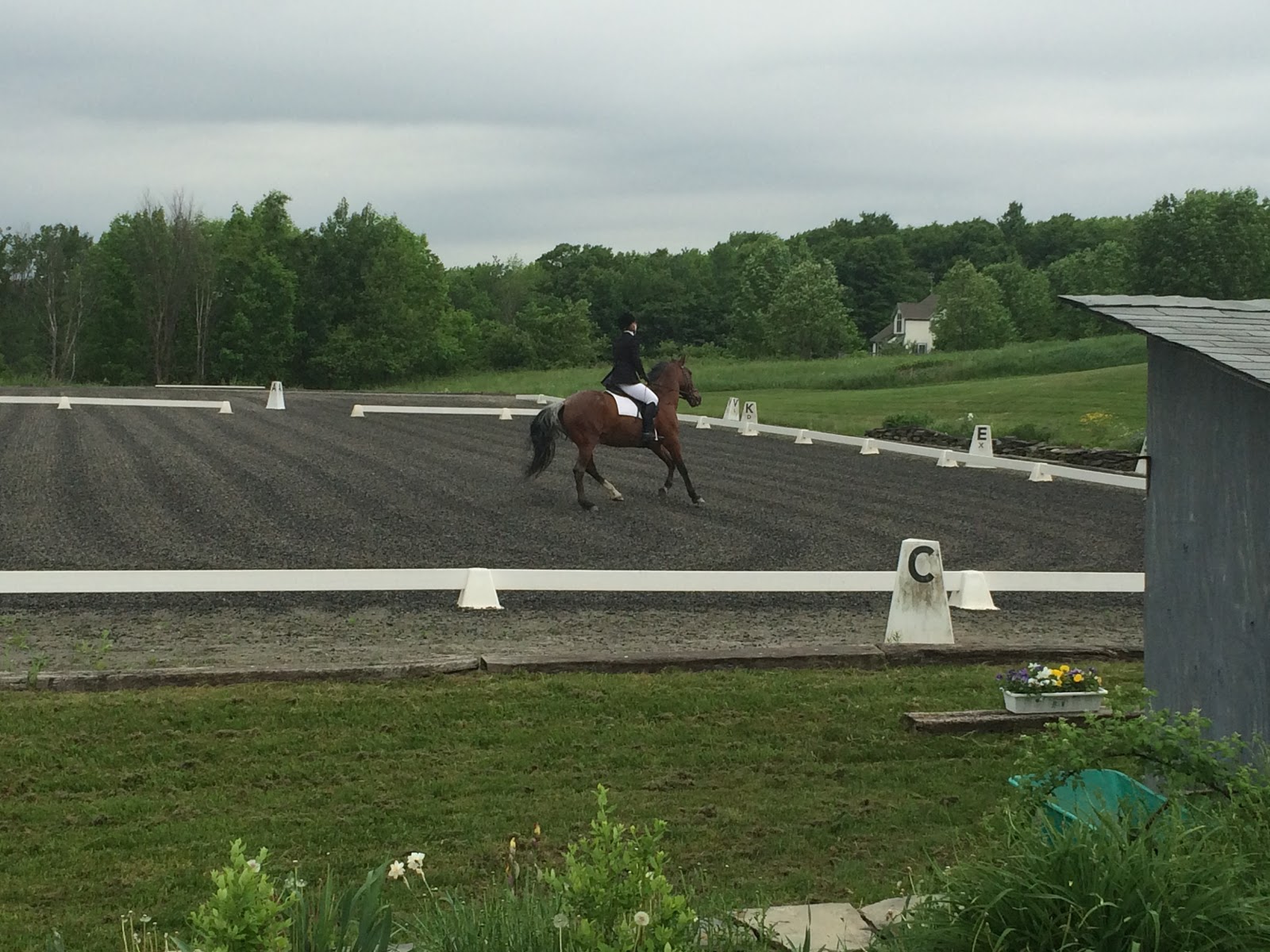
I was less than pleased with the, of all things, the lack of interest in my inside leg, particularly to the left, that meant that we were miiiiiiiiiiiiles away from the fence, particularly on circles and particularly in the canter.
does that circle look like it’s going to end up anywhere NEAR E?
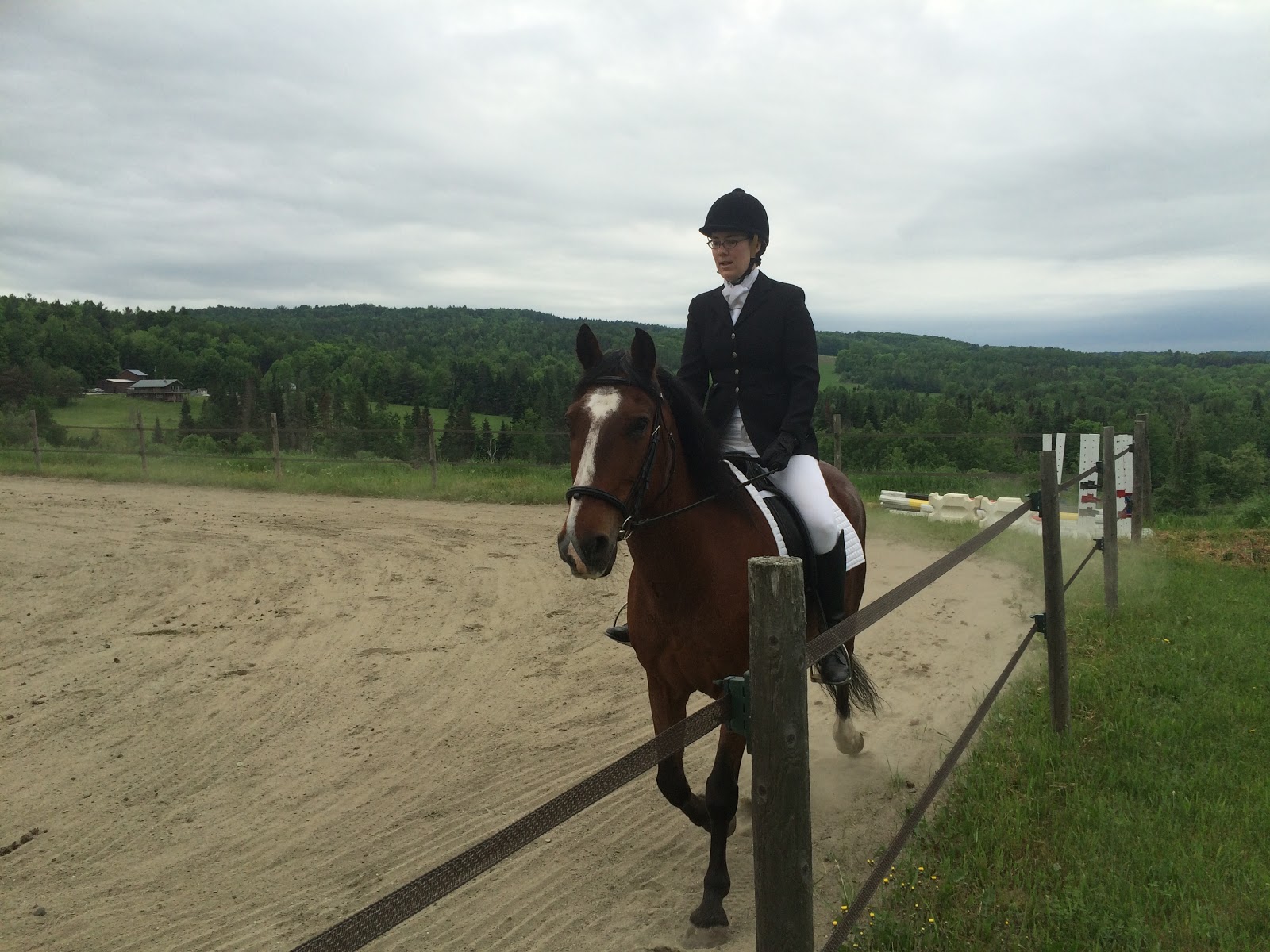
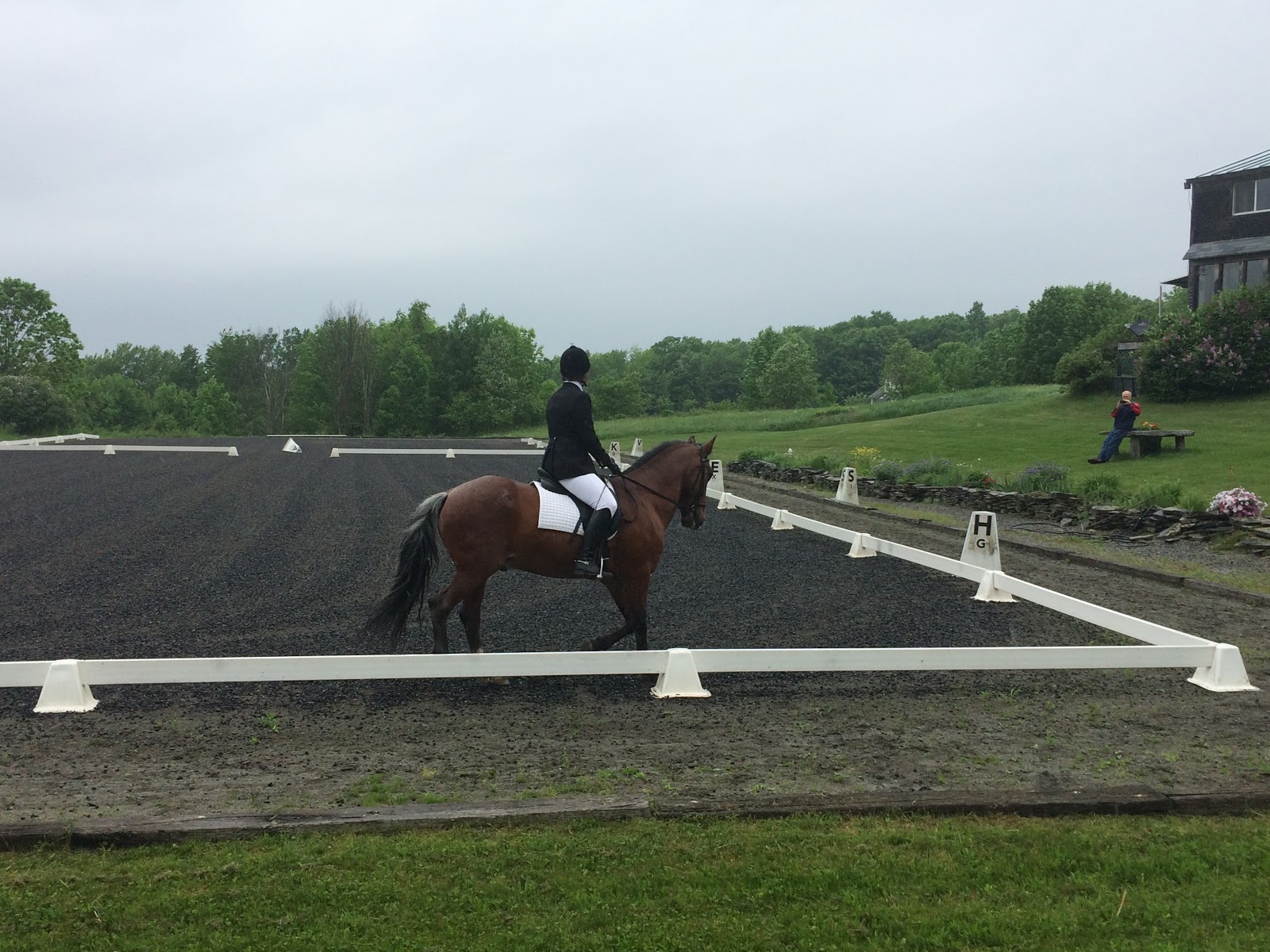
On the other hand: free walk! YEAH! One of my very few claims to fame is that I do a damn good free walk. Just a few seconds after the picture below was taken he stretched out even more. You can get a sense of how windy it was by his mane & tail.

So, Training 2: I felt pretty good about having nailed the thing, if not done it well, and then we hung out by the ring in the rain waiting for Training 1. I felt like Training 1 would be my chance to actually do well.

Mostly I was right in that. I was much more present in the test, having the assurance that he was going to behave. I identified moments to ask for more, and moments to soften. He responded well to both. So while it was a more uneven test than the first one I’d ridden – which had consistency going for it, even if it was consistently tense – I was more pleased with it.

Well, except for a few dumbass moments. First! I kicked over A on my way in. And laughed my ass off down the entire center line. The judge was clearly grinning pretty hard too when I did my salute, and Tristan didn’t care, but man, that was embarrassing.

you can see it on its side in the background here.
Second: I put the right canter circle in the wrong place. It’s in the end of the ring, and I put it in the center. Which is a shame as it was actually turning into a really nice circle when I heard the bell. Damn it. -2.
And THEN when we went to do it again, I was so determined to put him on the rail so he could go deep into the corner so we could get the canter transition on a bend so we could be ready to get a good 20m circle…I put him too close to the rail. And he did a little tap dance and I heard his hoof hit the board and I said “DON’T YOU DARE” right at C, and of course lost all of that prep for the canter. (The judge either didn’t hear me – which I find hard to believe – or took pity on me and did not mark this as an error, but I totally deserved one.)
I was overall happier with this test, with his rideability and my decision-making, though it was still tense.
what do you mean, straight and upright on a canter circle?
In my partial defense, by the time I entered the ring for my second test it was raining so hard I could barely see through my glasses. A few people actually commented on it afterwards.
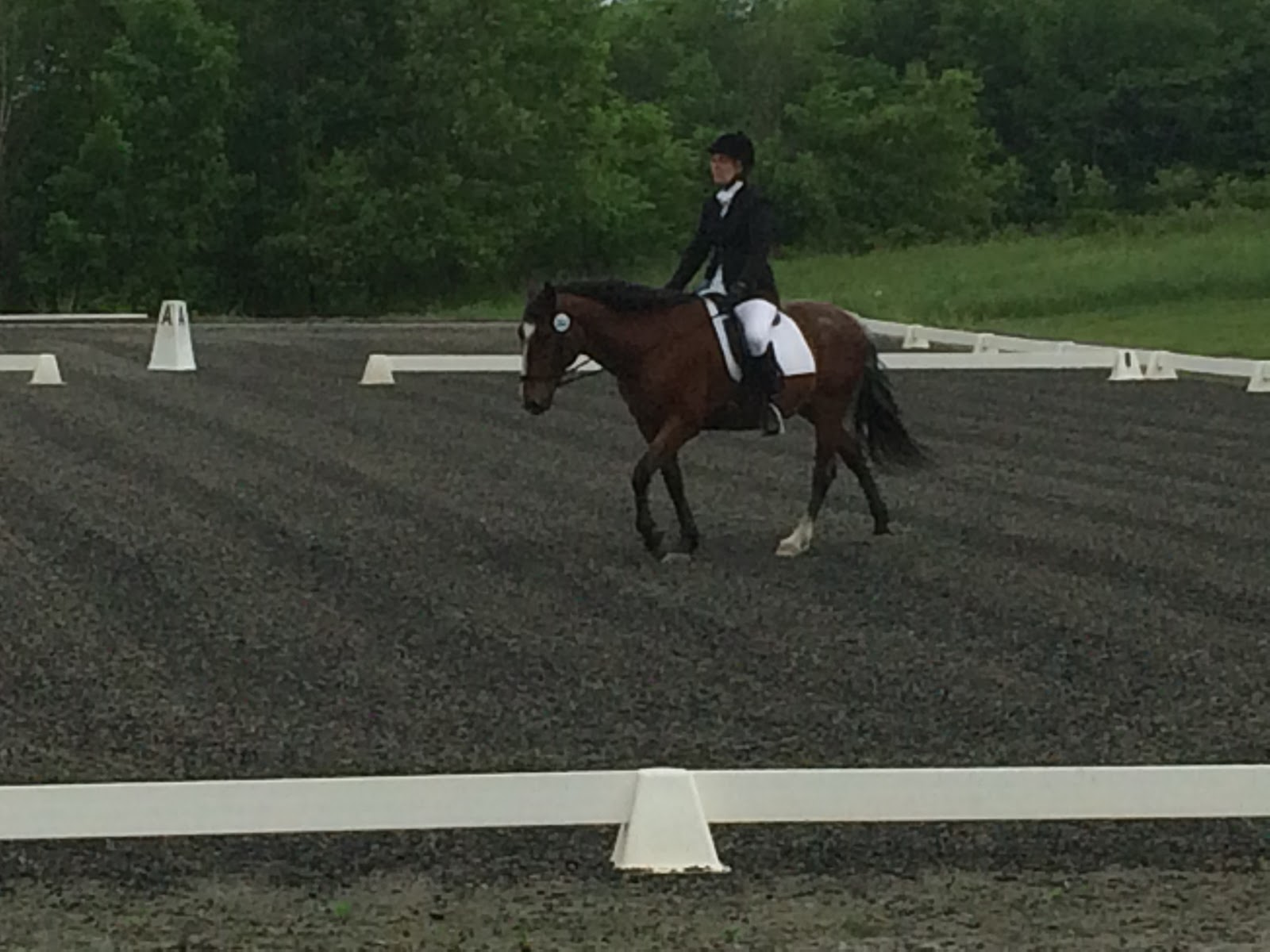
CRUSHED the free walk again!
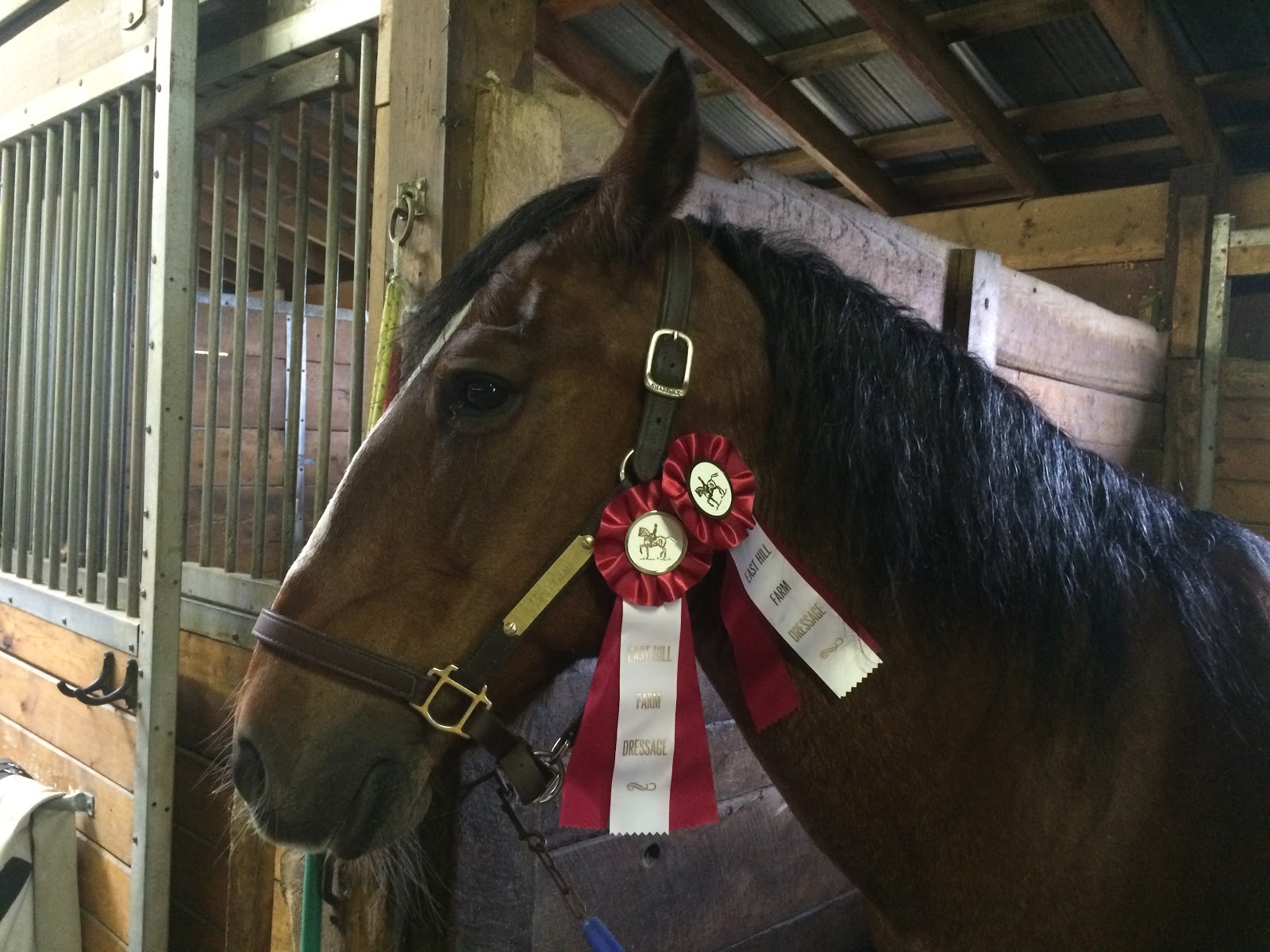
Both tests ended up right around 58%, which is less than ideal, but was good enough for second place in the class, which tells me two things: a) hooray, schooling shows! and b) the judge scored really tough, which I like. Down with the 6’s and 7’s for every movement!
We scored lowest on our canter circles and any moment when we needed to display bend. We pulled in 7’s on both free walks, and the centerlines & halts. Centerline + halt requires little to no actual skill and it’s one of the few things I pride myself on consistently nailing.
my own feelings on appropriate salutes are a matter of public record
I put Tris back in the barn, toweled off my tack pending a cleaning later that day, and praised him to the skies. He really did so well. Far better than I expected. It was not fancy or anything, but for our first time in the ring in 4 years, amid disastrous weather and a less than ideal prep in the last two weeks, plus the totally scrambled state of my brain – I’m pleased.
spent several minutes trying to get him to put his ears forward, no joy
Which is not to say the competitive nature of my brain now wants to SHOW ALL THE SHOWS, NOW. It does. We’ve got probably three more schooling shows lined up for the summer, pending rides, and we can definitely do better.
kinda wish I’d gotten a picture later in the day when all the branches on that tree started swaying

I spent the rest of the day being a general helper around the show grounds. Frankly, I was as miserable, cold, and wet as I’ve ever been at a horse show. The company was exemplary, but wow. At a certain point after about noon most of us hit the wall, reached the other side, and the rain almost didn’t even matter anymore. Wet and cold was a constant state of being.

I helped clean up as much as I could but I admit I bolted as soon as the show was over. I went home, took a loooooooooong hot shower, and sat down on the couch for a cup of hot tea, a few minutes of relaxation…and fell sound asleep for about 2.5 hours. Whoops.

So, that’s the story of the show! Overall good. Plenty of room for improvement.

2016 show season · dressage · fashion · show planning

One step forward, two steps back

First, the good news: show clothes still fit! Including the white breeches!

The coat is just a smidge tight, but not in the “doesn’t fit” way, in the “cut to be restrictive and make you sit up straight” way, and it’s always tended that way.
My stock tie has vanished, but as of late last night I have another one on the way from a friend which is a fun story I will blog about later.
I also located my show helmet, hairnet, show gloves, stock pin without difficulty, remembered that I had actually bought a brand new white show shirt out of some technical wizard fabric like all the kids are wearing these days (my old show shirt was a polyester short sleeved thing that worked for IHSA classes in college but was the actual pits of fashion). I had never worn said shirt but a wearing it in the picture above!
I had also (yay past me!) washed and neatly packed away all my white/show saddle pads. So those are good to go too.
Now the bad news: I tried to start Tristan in his snaffle in the dressage ring last night and it was kind of a disaster. He bolted repeatedly, never relaxed, never softened, would not listen to me and as a result our circles were weird half-square half-oval blobs. In fairness, it was ludicrously windy, so that may have keyed him up, but it was still absolutely awful.
I brought him back down to the indoor and schooled the everloving shit out of him. We ran both tests. We ran every movement in both tests. We ran transitions, We cantered. I put on spurs and a whip and forced him forward into a hand gallop. He was tiiiiiired but finally cooperative at the end.
Then we went up to the outdoor jumping arena, and we repeated that, making sure I had brakes and that he was listening to leg and hand in the walk, trot, and canter. Then we went back up to the dressage ring and trotted and cantered around the outside, politely. He was ever so very tired, but cooperative.
So, today: we’ll see. I’ll start in his snaffle but bring his kimberwicke up. Depending on how the ride goes I’ll decide whether to warm him up in his kimberwicke and switch to the snaffle for the actual rides.
Semi-related gripe: I didn’t read Training 2 through thoroughly enough, what the hell. How many times can you cross the diagonal in one goddamn test?!

2016 show season · dressage · show planning

Baby Steps & Show Prep

First things first: on Tuesday night, I started my ride in the kimberwicke, and let’s just say there was not enough pony kicking in the world. So I hopped off and swapped bridles – I had brought his dressage bridle up – and Tristan was a ROCK STAR.

We ran through Training 1, and my geometry was the absolute suck, but Tristan took a half halt, gave me some bending, and even softened up quite nicely in the canter. It was nowhere near a world-beating ride but there were moments of respectable dressage. Which is really all we’ve ever aspired to.

So, we might actually pull this off!

Things left to do:
– pull out my show clothes you guys I haven’t even unzipped my coat bag since we moved to Vermont and literally the last time I put on my white breeches was July 2012 THIS CAN ONLY END IN TEARS
– give Tristan a bath
– clean tack
– actually read Training 2 and maybe think about memorizing it
– think through some kind of warmup plan? who am I kidding, I’m going to wing this on Sunday morning

Realistically: I have this evening to do one last major ride and pull out my show clothes, and then tomorrow afternoon – maybe? – to do a quick tune-up, give Tristan a bath, and clean tack.

Also last night I pulled out a calendar and counted and for a stretch that started this past Tuesday, this coming Sunday is my only complete day off for 21 days. So of course I’m horse showing, then volunteering afterwards. What is it about horses that encourages so many bad life decisions?

Oh, and it’s going to rain. All day. Yup.

dressage

Progress!

Last night, I got on about 7:30 pm after we returned from the weekend away with my husband’s family.

My goal was solely to confirm that Tristan was going to continue to cooperate in the outdoor ring while wearing his kimberwicke.

Victory!

I got obedient 20m circles each way, and while they weren’t pretty, he at least let me tinker with them a little bit.

Tonight, I’ll start him in his kimberwicke and then swap to the snaffle, and we’ll see if we can’t get an actual schooling ride in. Who knows, I might even do something crazy like try and practice my test. Probably I should memorize the test first. sigh.

yup, that’s the view from the dressage arena

bits · dressage

The new love of my life

As in, I almost certainly love this thing more than my husband right now. (Though probably not more than the dog.)

Tristan has been a challenging ride this spring. Probably not in the grand scheme of things, and not for a rider with actual physical fitness and skills, but he has for me. He’s been throwing bucking fits on simple hill walks. He’s been bolting for home. He’s been jigging constantly and fretting himself into a frenzy.

I pulled out the big guns. This behavior is not new. It simply has not occurred in many, many years – seven or eight, to be precise.

See, when Tristan was first learning about riding in the open, he was equally awful (worse, in some ways). I was not nearly as good a rider but I had a certain stickability. He never dumped me, but it wasn’t a lot of fun either.

Enter our savior.

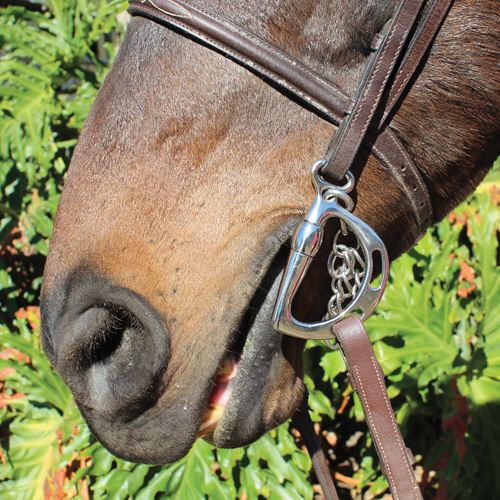
That, ladies and gentlemen, is a mullen-mouth uxeter kimberwicke. 
Mullen mouth = straight across, no joint. Uxeter = the slots on the side of the bit, which allow for two types of leverage, straight or torqued. Kimberwicke = this particular style of bit, which features the separated bit hangers and the curb chain. Kimberwicke bits can also come jointed or without the leverage slots on the side.
Here’s what it looks like by itself.
You can see that the mouthpiece itself also has a low port.
Let me be clear: this is not a subtle bit. This is a bit that says WHOA THE FUCK DOWN RIGHT FUCKING NOW when it is applied firmly. 
It is also, however, a relatively stable bit. Depending on how you adjust the curb chain, it never kicks in. If you attach the reins as I have above, it – and the port on the mouthpiece – only kick in when you really need them to.
Here’s what the lower attachment looks like, putting this bit closer to a pelham in action (not on Tristan, random internet horse):
All of that together means that this is a bit that is relatively inert and stable until it is not. Which means that you can ride in it with quiet, steady hands and have a simple, straightforward go. If you have a horse that likes a mullen mouth bit, you can use it for some dressage work – softening, etc.
Tristan tends to prefer double-jointed bits, so I never had much hope that this would really lead to quality dressage work. What I wanted was to regain some of his respect for me when riding outdoors.
I still remember, with perfect clarity, the first time this bit kicked in. I had taken Tristan out to a field behind an old barn and we were simply walking around a bit. He reared, spun, bucked a few times, and bolted for home. He had done the exact same thing the previous day, and I had not been able to stop him; he jumped two ditches, I lost both stirrups, it sucked an awful lot. (I hadn’t yet learned an effective one rein stop, that’s how inexperienced I was with that sort of thing. I learned later.)
But on that day, three strides into the bolt, I hauled on the reins – not with any sort of tact or subtlety. I just hauled. He stopped cold. Mid-stride. Stock still. He was utterly and completely horrified. He walked politely home, completely mystified as to what had happened to him. It was a truly glorious moment. 
From that day on, he went in his kimberwicke for all outside endeavours, for about two more years. Eventually, it started backing him off too much – he didn’t need it. We moved to a full cheek snaffle for jumping and cross-country, and hacked in his regular loose ring.
When I was casting about for ways to work with Tristan on his new misbehavior, I resisted pulling out the kimberwicke; it felt a little bit like failure, or regression. Eventually, I accepted that feeling and pulled it out.
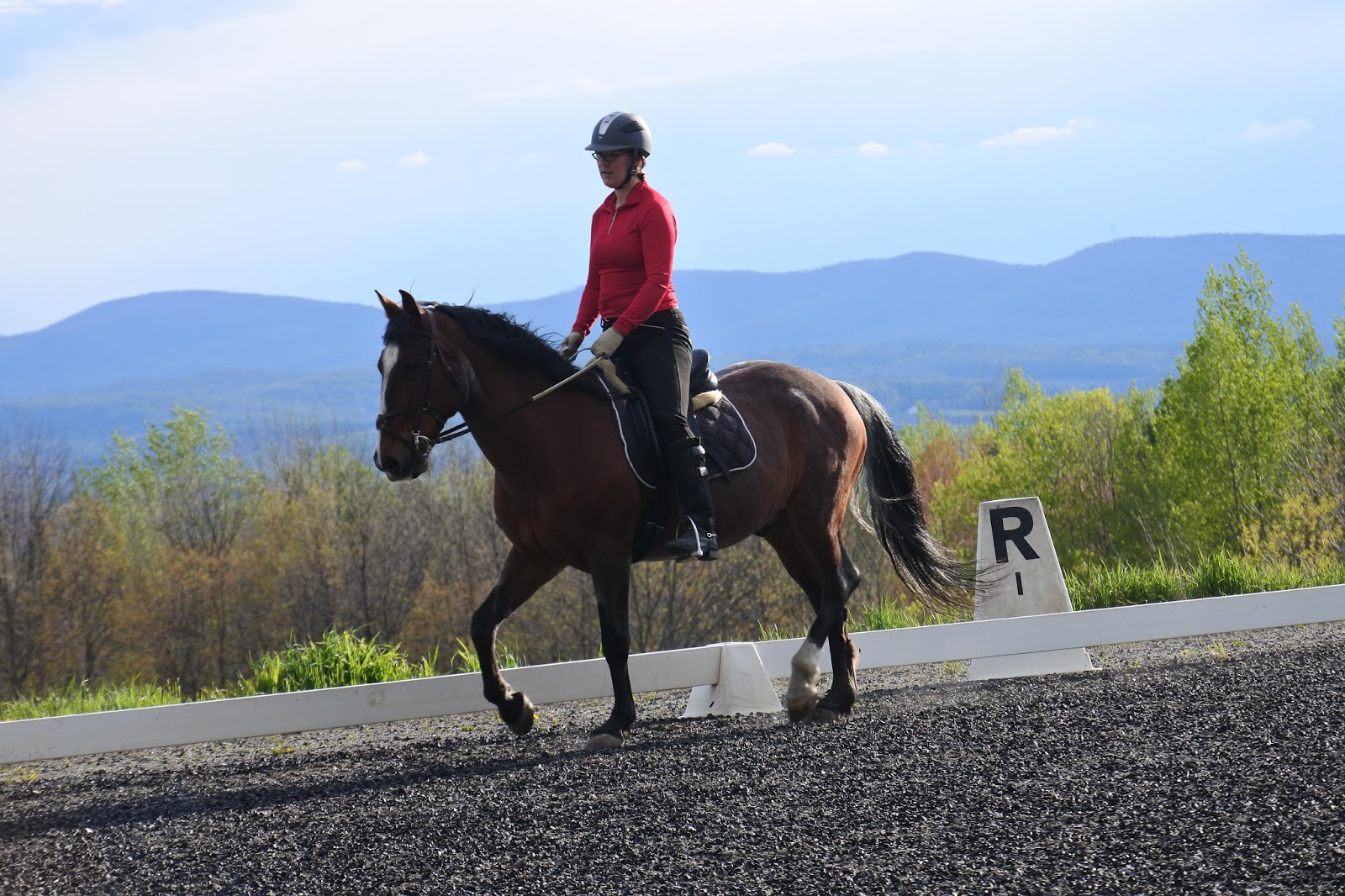
The first day I rode in it was the day of my photo session with Emilie. It was also his first ride in the outdoor dressage arena. He was not thrilled at the walk, and picked up an uneasy trot, and then when we turned to the short stride at the far end, as soon as we passed A, he was OFF.
I simply sat deep, put my hands down firmly, and let him run into the bit himself. I was perfectly quiet and calm. He did not stop mid-stride, but he did immediately drop to a polite walk, tossed his head once or twice, and then licked and chewed.
For the next few minutes, he was a little unhappy, but he was at least polite. I kept steady, quiet hands, asking him simply to trot without flailing. Then I pushed him a little bit, asking him for some actual softening – but not expecting it. And he gave it to me!
Two days ago, we went back up to the outdoor ring, again in the kimberwicke. He never even thought about bolting in the trot. I asked for a canter. He completely exploded – for a stride and a half. Then the same thing happened. Back to a polite walk, a few minutes of disgruntlement, and then we had an actual productive ride, working on geometry and putting together pieces of the test.
At about the 40 minute mark, I asked for a canter to the left, our trickier direction, and he gave me a polite, obedient, and straightforward – if very backed off – 20m circle in the canter. I brought him back to a walk, dropped the reins, and praised him to the skies.
Now, to figure out whether to a) technically bend the rules and ride in the kimberwicke for our schooling show or b) somehow make the transition to the snaffle again and hope that he behaves even in a show atmosphere…
2016 show season · dressage

Training Level Test 1

Whelp, I’ve officially entered Tristan for a schooling dressage show on June 5. I skimmed the tests and picked Training 1 and Training 2 for…no real reason other than they’re sequential. It’s been so long since we’ve attempted a test all the way through that I have no really good sense of what will play to his strengths, and honestly sussing that out is not gonna happen before the entry deadline.

So, I’ve been looking more closely at Training 1.

1. Centerline, halt, turn left. Potential pitfalls: halting square, picking up the trot again without a tantrum, heading straight toward the judge’s box. Beginner Novice B, I MISS YOU AND YOUR BENDING LINE ENTRANCE.
2. Track left, circle in the center. Potential pitfalls: geometry. Bulging right shoulder. Staying in the arena.
3. Transition to canter, turn left. Potential pitfalls: crossing the entrance again; Tristan might see an easy way out. Also, our canter transitions are pretty much mired in suck right now. At least the left transition is as far away from the judge as it gets.
4/5. Canter circle in the center, back to trot. Potential pitfalls: Staying on the circle in the canter, especially left. Geometry. Staying in the ring.
6/7. Free walk across the diagonal. Potential pitfalls: picking the medium walk back up for F. 
8/9. Trot transition, circle right in the center. Potential pitfalls: staying on the circle, a not-ugly transition at A.
10/11/12. Canter transition, circle in the center, trot transition. Potential pitfalls: as mentioned above, our canter transitions are ugh. Geometry always a concern in the canter. Timing the transition back to trot.
13. Centerline, halt, salute. Potential pitfalls: making the turn, keeping the centerline straight, getting the halt square.
The good news: this gives me some marching orders. In particular, those canter transitions. Fix them and we’ll nail down a lot of the other problems – especially the shoulder-flinging.
I’ve been working on the trot-walk-free walk and back again transitions for a little while now. Tris has a great free walk, mostly because he’s so relieved I let him do what he wants. The trick is keeping it marching – we’ve mostly got that, but it will be different in the other ring. I need to be more subtle and tactful about picking the reins back up, too.
In short: while I have no doubt we can get the basic test done, I need to polish some of the pieces. All of them are well within our capabilities. I wish I hadn’t hit a valley right when we need to be ramping up for this test, though.
dressage

Riding Notes: 5 Things

The real takeaway of my last few rides: I really need a lesson to pinpoint what I need to work on next. I’ll have to see how March bills shake out first, though. 😦

Anyway. We’ve had some really good dressage rides the last few days, and I wanted to document a few things that have gone well or that I need to work on. With pictures, because I don’t want to scare you away with a giant wall o’text.

Thing the first: Hips to hands. Always. Everything about our rides goes better when I remember this one. A former trainer used to tell me that I’m really riding and managing the horse in the space between my hips and hands. When I think about that so many other things click into place: my elbows soften, my hands somehow magically come up from my lap, and I start to engage my core. It’s most useful when we are almost, but not quite, at the point of collection; usually those small but crucial pieces are the ones that I’m missing, and putting them in place makes a big difference, and then lets me ride the collection much better.

Thing the second: Tristan has been flinging his shoulders more than usual in warmup. It seems to be a refusal to go into the outside rein. For example: there’s a particular spot in the ring. It’s one of the short sides followed by the corner to go back to the long side. About midway through the short stride, as I’m asking him to come off my inside leg, into the outside rein, to collect more and go into the corner, he flings his shoulders and nearly squashes my leg into the wall. I respond by cringing away from the wall, shifting my weight, and totally disrupting what I’m asking him to do – which, of course, was the point of his shoulder-flinging all along. He gets away scott free from having to do anything in that corner. It’s purely a learned behavior at this point: he doesn’t do it in any other corner, for example! He replicates it in small other ways at other points in the ride (on the open curve of a 20m circle, while getting ready for our first canter, etc.) and I need to better anticipate it, because once he’s got those shoulders moving, they are going, no matter what I can do. Prevention is the name of the game.

Thing the third: I need to add more 20m circles and serpentines back into our repertoire. Those changes of bend are so, so lacking right now. A good thing to remember for walk breaks – stay on the bit, stay collected, but work on changing the bend to increase suppleness.

Thing the fourth: Trot to canter transitions are so so SOOOOO much better when we both stay straight. Like a miracle. You’d think I would remember this from day to day, but if you think that, you have infinitely more faith in my brain than it deserves.

Thing the fifth: We are pretty darn close to ready for a Training level test right now! Not a good one, but all the pieces are there once we warm up and we’re capable of them. Two nights ago I did a lovely free walk long diagonal to medium walk to medium trot at A followed by the first curve of a 20m circle. Everything was on point. Now, can we put those pieces together coherently? Nooooope, not yet. That’s still coming slowly, those transitions between gaits and the quality geometry. But it’s coming, and the gaits themselves are feeling awesome.