
(November 2013)
In the bad old days when I was soaking Tristan’s foot every single day, trying desperately to draw out the abscess that we thought was just stubborn and/or trying to keep the abscess holes clean, soaking was a chore. I used the tried-and-true feed pan method. Result: guaranteed spillage, frustration, and possibly tears. (If you want the whole abscess drama in real time, follow the abscess tag and then the surgery tag.)
One day, I found myself at Smartpak to purchase more Betadine and epsom salts, and cleverly placed alongside those vital supplies was a Davis soaking boot. It was $32.95, and as we know that is pretty darn cheap for something connected to horses. So I bought it. And it changed my life.
 |
| Chillin’ |
I’m not trying to be dramatic, but wow. Why did it take me so long? Within two or three sessions, we went from frustration, anger, and lots of cleanup afterwards to uneventful, straightforward soaking. I would put his foot in the boot, pour the epsom salt/hot water/Betadine in, tighten the velcro, toss a flake of hay in front of him, and he would stand stock still for as long as there was hay on the ground. I didn’t even tie him. I often read a book. To this day, that training holds.
Some of the advertising for this boot seems to imply that you could, in theory, fill it and then turn your horse out in it. I believe that to be creativity bordering on bullshit. If you have a boot large enough to hold an appropriate amount of water, it’s too large to stay on your horse. Also, it would get trashed, durable as it is. So don’t do that. If you truly desperately want something to serve as a hoof dressing during turnout, do the old duct tape method and plan on replacing daily. But if you are looking for a way to make your life easier while soaking, buy one of these. It’s a game-changer, and no barn should be without one.
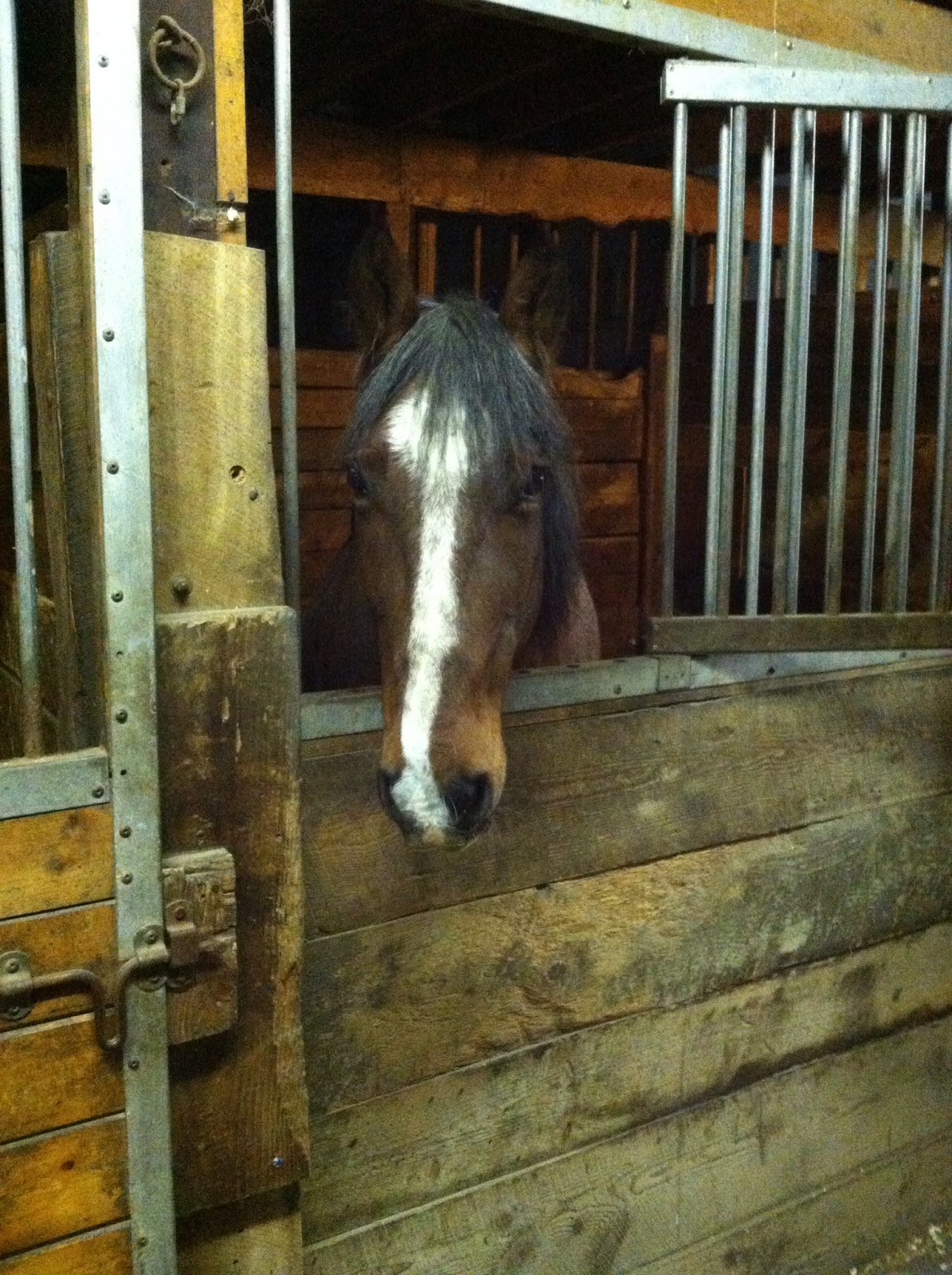
Got back into Vermont late Sunday night, and after a staff meeting first thing, I headed over to the barn to see Tris.
eta: I am an idiot who totally forgot to add in the most fun part of longeing today, which was that after we finished our circles I trotted him over a very small 2′ vertical that was set up from a previous lesson in the ring. As soon as he saw the jump he locked on, went straight for it, and jumped it beautifully. We did twice in each direction, and it was amazing to watch him hunt out the jumps and hold a beautiful canter after them. Tiny baby steps!
I did my master’s thesis on the United States Dragoons, the first regular mounted unit in the United States Army, so you might say I have more than a passing interest in war horses.
This post, from an excellent blog that I follow in my other life called Emerging Civil War, describes a beautiful monument outside the Virginia Historical Society dedicated to the horses of the Civil War. It’s now on my must-see list, up there with the newly unveiled statue of Reckless at the Marine Corps Museum.
Hannah nominated me for the Sunshine Award, and said some very kind things about me, and gave me a list of questions to answer. So here we go!
1. Mares or geldings?
2. English or western? English! Though I have not much to compare it with, as I’ve only ridden in Western saddles a handful of times and only gone faster than a walk once. But when I sit in a Western saddle, I feel trapped in an uncomfortable claustrophobic way. There are some super cool things to do in the Western sports – I want to try my hand at cutting someday – but it’s not where my heart will ever be.
3. Do you prefer younger or older horses? Older. Babies are cute and all but I have fairly limited patience for toddler/adolescent antics, in humans or equines. There’s something special for me about the sweet mellowness of a good older horse.
4. Have you trained a horse from ground zero? Tristan! Every ounce of training he has on him I’ve done myself, right from learning to pick up his feet and being groomed through to cross-country. Now, jury’s out on precisely how successful I’ve been, but he is a nice horse to handle and be around, so I usually count that one in the positive column.
5. Do you prefer groundwork or riding? Do you know, I almost prefer groundwork? Probably because I’m better at it. I’ve started some tough horses on the ground and I still like playing with Tristan and adding pieces of his groundwork to make him a fun horse to handle. But I do so love to ride, so this one is practically a draw for me. (I wouldn’t be happy never riding again, for example.)
6. Do you board your horse or keep him at home? Board, but I’d like to keep him at home someday – probably when he retires.
7. Do you do all natural things or just commercial stuff? Weird dichotomy. I’m from Vermont, right? So when possible I look for solutions that are low-impact in the environmental sense, but I have zero objections to “commercial” stuff if it does the job.
8. All tacked up or bareback? Usually all tacked up, but bareback is appealing in the winter – so much warmer!
9. Equestrian role model? Either Alois Podhajsky or Reiner Klimke.
10. What’s my one, main goal for my equestrian journey? I want Tristan to be happy and healthy. Everything after that is secondary.
Miracle of the White Stallion (1963)
(available on DVD at Amazon.com)
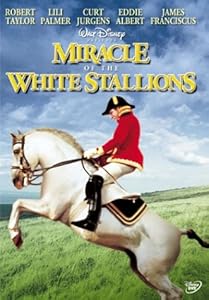
In my world, there are only two perfect horse movies. I’ll talk about the other one soon, but one is Disney’s 1963 movie Miracle of the White Stallions, starring Robert Taylor as Colonel Alois Podhajsky.
Miracle tells the story of a very fraught period in the history of the Spanish Riding School: 1945, when the school was under Nazi reign and in a Vienna that was in constant danger. Podhajsky – arguably the school’s greatest director, and one of the great dressage riders of the 20th century and perhaps of all time – persevered to save not only the school and its stallions, but also the mares and foals from the stud farm in Piber. It’s based on Podhajsky’s memoir My Dancing White Horses, which has been out of print for many, many years and which I would dearly love to read someday.
Make no mistake: this is a movie of its time. There are precisely two mentions of concentration camps; both are fleeting and neither acknowledges the Holocaust. There are Evil Nazis and there are Good Men Who Happen to Be Nazis. There are gosh-darn American GIs, the pacing is not the greatest, and let’s not even talk about the gender politics, though the movie does actually pass the Bechdel Test and arguably Podhajsky’s wife Vedena gets some of the film’s best lines.

Disney pulled out all the stops on this movie. It was filmed on location, using the actual SRS stallions and riders. Alois Podhajsky was Robert Taylor’s stunt double. There are long segments that watch more like one of those old Disney nature documentaries than a feature film – long, sweeping, gorgeous shots of herds of beautiful horses, pleasant historical narration, and minimal plot for chunks.
It seems like someone involved with this movie also realized they were filming history in action: there are extended sequences of training and performance with the SRS stallions and riders, multiple examples of the Airs Above Ground, long, loving, sweeping views of the quadrilles. Transitions are flawless, and the concentration of the stallions is fierce and comes right through the screen. The movie, intended as a commercial success, has become a historic artifact.

I can’t be alone in my childhood obsession with this movie in particular and the Spanish Riding School in general. I rented and watched the VHS more times than could possible be counted, and when I wasn’t watching the movie I was re-reading Marguerite Henry’s White Stallion of Lipizza (which I am delighted to see is back in print, Christmas list ahoy!). As an adult, Podhajsky’s Complete Training of Horse and Rider is my guiding star, one of the few training books that I hold dear to my heart and always find inspiring.
In short: be very aware of this movie’s shortcomings, but don’t tell me about any of them. Absolute perfection.
I can’t remember who first told me about JB Andrew. Probably someone who saw me valiantly trying to teach my little mutt of a mustang to go on the bit and wanted to give me inspiration. But I went home and read all about him, and over the years I followed him from afar. I told people all about him when they seemed surprised that my mustang can be a dressage horse.
 Last week, I did an idle internet search for the first time in a long time and found out that JB Andrews died 18 months ago. I’ll admit it: I broke down and cried at my desk. At work. At lunch, but still. Ack.
He was captured as a weanling out of a herd in Nevada in 1985, and he was started in a prison program in Colorado – “JB” stands for “Jailbird.” His first owner, Ginger Scott, noted that he had some dressage talent and soon a friend of hers named Kelly O’Leary (later Boyd) got the ride.
By 1994, at age 9, he made his debut at Prix St. Georges. He and Kelly trained with Jan Ebeling, and he had matured to an astonishingly large 16.3 hands with size 5 feet. (To give you some context, Tristan is on the high end of average size at 15.1 hands. They are wild animals, who don’t often grow to typical domestic sizes.) He wasn’t rocking the whole world, but he was competitive and successful, and appeared on national leaderboards.

In 1997, he became the first mustang to appear at Dressage at Devon (and for a long time the only, until Padre was entered as an in-hand stallion).
By 1999, at 14 years old, Andy was showing at Intermediaire II and schooling the Grand Prix movements and tests. He would never make his show ring debut at that level, however, due to deteriorating hocks. He was retired to pasture in 2000.
It’s not clear to me what exactly he died of, but an article mentions that a malignant carcinoma was found behind his eye in 2009, so it seems safe to assume that’s what ended his life.
Rest in peace, big beautiful boy. You continue to inspire me and so many others.
JB Andrew at Kelly Boyd’s website
Eurodressage Profile: JB Andrew
JB Andrew: Mustang Magic (book at Amazon.com)
Product Review: Chain Shank

This goes hand in hand with last week’s ode to the cotton lead rope, but this one is slightly more specialized.
99.5% of the time, I lead Tristan with just the regular cotton lead. He’s well-behaved enough that I’ve been known to just toss the lead rope over my shoulder and let him follow me. In the barn itself, we’re working on a “go home” command that sends him to his stall.
Enter the horse trailer.
Tristan hates horse trailers. With fiery passion. Horse trailers mean not only the stress and discomfort of the ride itself, but also the near-guarantee of hard work at the other end. He’s pissy enough about them that he will stop and stare at parked trailers in the driveway, quivering in horror, hoping against hope that I won’t make him get on.
So, when we haul, we use a chain shank. We have a system: I bring him up to the edge of the ramp or trailer. He is allowed to stand still, and allowed some sidling, but he may not under any circumstances go backwards. When he goes back, it is never just one step: it is a bat out of hell zoom straight back. When that happens, I follow him and shank hard one, two, three times. If he rears (which happens less and less often now but is not unexpected) he gets shanked again and chased back.
When he comes down or stops he looks at me, and he looks at the trailer. He licks and chews. He ducks his head. And then he walks on. It never fails. He just needs to register his complaint, at maximum volume, before he submits.
Hence this chain shank. Tris has no need for a chain shank in his regular life, and I don’t want to complicate things by switching lead ropes every time we go anywhere. So this chain snaps to the end of the regular lead rope, and it snaps off again when we’re done. Instant chain shank lead. In the meantime, it lives in the trailer’s tack trunk. It is an elegant, simple solution to needing a chain shank – but not wanting a whole other lead rope.
I’m away this week at a professional conference in lovely Newport, RI. Tristan is being used a handful of times with some advanced students. He’s not really a lesson horse at heart: while he has patience, and is bombproof safe, he doesn’t like the kind of work that regular lessons make him do. He tunes out too easily and gets sour. But a handful of lessons from time to time to keep him in work are just fine.
The barn manager sat on him for the first time last week to get a sense of how to have her students ride him, which was neat to see. He was less than pleased, but she got some nice work out of him.
In the meantime, I’ve scheduled a number of posts about other things for this week, and I’ll be gathering horsey tidbits from Newport to bring back!

 beljoeor.com