vermont · winter

Winter in Vermont

A typical winter day:

8:15 am: Leave for work. Decide on the fly whether to pack riding clothes and drive, or set aside riding clothes and plan on walking home to change, grab a snack, and pick up the car. Check work email on phone, start swearing, decide to walk in case I get stuck at work until very late and there’s no chance of heading to the barn.

8:30 am: Arrive at work. It wasn’t that cold, right? Not too bad! The last 2-3 minutes were not a lot of fun but the end was in sight then, so totally do-able.

9:00 am: Check the weather forecast for the barn. Maybe it will be warmer and less snowy another day this week? Yeah…not so much.

1:00 pm: Start to feel caught up and on top of things, even caught up enough to properly eat lunch and read a non-work book for a little while. Victory!

1:15 pm: Wow, it’s snowing a lot. Like, a lot.

1:45 pm: Ha! It’s almost stopped entirely. Pfffft.

2:15 pm: Re-evaluate goals of making it to the barn, pending resolution of current work crisis.

2:30 pm: Crisis resolves, but it’s snowing again…cars look like they’re moving just fine down State Street, so if they can do it, I can, right?

3:00 pm: Hmmm…snowing harder…

4:00 pm: We’re good! It’s stopped!

4:45 pm: Declare surrender and shut down computer mid-composition of another email, pack up as quickly as possible, walk home in the dark; it’s snowing again.

5:15 pm: Changed, fed, car is dug out of the snow, even feeling motivated and hale and hearty. Text boyfriend dinner options.

5:16 pm: Run back inside one last time to retrieve another pair of gloves/warm hat/snack.

6:00 pm: Arrive at the barn. Realize that wasn’t the safest drive ever and reflect on the way in which you can tell the exact inch where town lines end and state roads crews take over. Oh well, there now.

7:30 pm: Finish ride, sweating underneath layers, frozen at extremities, close up the barn just as the sweat starts to freeze.

7:35 pm: Drive back to barn and triple-check all stall doors, all lights, and front barn door.

8:00 pm: Arrive home, start dinner, change into pajamas and, if really lucky, relax for an hour or so with a cup of tea and a book before bed. If unlucky…open up the computer and back to work!

beginner novice a · beginner novice b · dressage tests

New dressage tests!

The USEA has announced the new 2014 eventing dressage tests!

Here’s Beginner Novice A, and here’s Beginner Novice B.

First, a moment of honesty: these aren’t really all that different from previous tests. There’s only so much you can do with a BN test and still be fair. So we get a 20m circle at the ends, and a 20m circle in the center, both directions, trot and canter, with some free walks/diagonals thrown in for kicks.

Things I like:
– BNA has the circle in front of the judge to the right, which is our best direction.
– BNA has eons of time to prepare for that turn down the center line.
– BNB has a free walk down the long side: all the marching, none of the steering
– BNB has two diagonals at the working trot, which are a really great opportunity to show of a nice forward trot.
– They do read as really different tests, and BNB has just enough extra complexity to make it a nice B option

Things I don’t like:
– BNA is nearly identical to every other circles-in-ends test ever written which means I am going to have trouble finding exactly the right spot for transitions.
– BNA has some fairly quick transitions from canter to working trot to center line which could cause some seriously wonky centerlines and clearly tests should be written so I have all the time in the world to prepare for the things that come up next, right?
– BNB has left lead circles first, sigh, goodbye points.
– BNB actually has a worse transition to the centerline and it puts the free walk at the very end of the test. So you go from working trot to medium walk to free walk to medium walk to working trot all on one half of the arena. That is going to end in tears more than once.
– Neither test has my beloved broken center line. I freaking loved that thing. Way easier than getting a green horse to go straight to C, much softer line all around. *sadface*

lesson notes

Lesson Notes

I do so love a lesson in which my ass is completely and thoroughly kicked, and that’s just what we got yesterday.

I had to do a relative minimum of nagging to get Tristan moving forward, and he reached beautifully for the bit way, way earlier than he usually does. I was already counting the warmup a success, and we hadn’t even gotten into the hard work yet.

First thing we tackled was getting him straighter through his whole body; he has a tendency to want to get a bit overbent in the bridle, and when I straightened that with the outside rein he threw his haunches in. So we worked for a while on really getting him straight and through, which to me felt almost a little bit counterbent. I’ve gotten too used to him overbending.

After that, we played with shoulder-in and leg-yielding to loosen him up. In the shoulder-in we focused on pushing from the hind end and not letting his neck overbend and his shoulder come in too far. In leg-yields it was all about small, quality steps and really maintaining the straightness. Shoulder is supposed to lead a teensy bit but not nearly as much as he was trying for; S. wanted me to allllmost think haunches in during the leg yield. We did both straightforward quarter-line-to-wall ones and then went out from the wall to the quarter line and back.

Finally, we cantered for some time and worked on getting him really forward and attempting some straightness in the canter. He was very tired afterwards, and had sweated quite a bit – all down his neck and chest, and on his face. I spent a fair bit of time rubbing him down with towels and checking on him under his cooler, but he dried off relatively quickly. It was warmer (in the 30s) so hopefully that’s why – I still really don’t want to clip him!

Takeaways:

1) Work on getting him supple behind the saddle and continue that through our rides. If he feels like he’s locking up or lagging behind, throw in some leg-yields to break that up
2) Don’t hang so much on the inside rein in the canter, and work generally on keeping a more stable rein length and hold throughout all gaits and especially through transitions.
3) Pick a spot – or a feel – that’s easily attainable for us now, but still quality work, and back off to that to end each piece of our ride. For us right now that’s a forward, on the bit trot with about a Training-level self-carriage.
4) In the canter, try for counter flexion down the long sides and then back to the correct flexion for the short sides to inject more of a feel for straightness. It’s a LOT of work for the outside aids right now but it will keep adding up.

product review

Product Review: Bit of Britain’s English Stitched Halter

English Leather Triple Stitched Halter

I wouldn’t necessarily classify Tristan as tough on halters, but he has destroyed his fair share – somewhere in the double digits, but not more than 20. (When I write it out like that it looks more dire than it really is…) When he finds a turnout buddy he likes, he is a halter tag champion. He also rolls a lot, and when he rolls he grinds his face into the ground, which tends to weaken buckles and other fittings.
I am fairly fanatic about always having him in – at minimum – a breakaway or leather halter, and strongly dislike rope halters in all situations, so that really leaves a leather halter as my best option. On top of that, he is a tough fit for a halter: he has a whopping big head but an old halter scar on his nose that means if I don’t get just the right fit, the hair on that bump is gone in no time flat; more than 48 hours of rubbing and it’s probably going to open up again.
So for several years, whenever he trashed a halter I would have a cheap breakaway nylon halter in reserve with fleeces and the hunt was on for something else that worked. I found some good one-offs but was never thrilled with the quality, or the fit, or the general handling of them.
Enter this halter. About three years ago, he destroyed a halter just before Hannah and I left for the Area 1 Championships at Fitch’s Corner. I knew I needed a new halter ASAP but didn’t have time for a leisurely tack store visit. I paid a visit to the Bit of Britain truck at Fitch’s (dangerous, seductive place) and came out with this halter, in black. It was a gamble, but when I brought it home and put it on his head it fit perfectly.
And here we are three years later – a record for a halter. It’s faded and beat up, but the only real damage that’s occurred to it is the loss of the extra leather piece from the chin piece – the stub leftover after fitting it to his nose – which doesn’t change the functionality of the halter at all. I’m really, really pleased with it and would recommend it to anyone.
conditioning · massage · topline

Topline Exercises

Every time I handle Tristan – whether it’s just a grooming day, a longeing day, a hack day, or a riding day – I’m doing a series of exercises with him to work on his topline. They’re like strength or core building exercises that isolate the right muscle groups. I’ve been really, really pleased with the immediate visual way I can see his muscles engaging with both of these.

The first is a belly lift.

Placing one knuckled hand – or stiff fingers – on either side of the tail, at the point of the croup, about 1″ to either side of where the tail begins. Draw a straight line down, with moderate to heavy pressure, to just under the point of the buttock, or about halfway down the gaskin. Watch your horse’s withers and back while you’re doing this; every horse will have a slightly different trigger point. As you trace down, his back will lift. When you reach the gaskin, it will be about as high as it can get.

I started doing 5 of these, and now I do 15 every time. I hold the lift in the back for a good solid 2-3 seconds. You can also adjust to focus on one side or the other depending on how your horse is standing, or where he’s turning his head. A head turned to the left will give extra lift to the left side of the withers; the opposite to the right. Ideally, they should be square for most of them but it’s fine to turn their head for some of the exercises if you’re trying to even out an imbalance.

This isn’t just a back exercise, either; though you can’t see it from the back, the back lift is at least partly because this technique causes the horse to tighten his abdominal muscles. It simulates crunches in humans. So it does double-duty, lifting the back and tightening the stomach.

The second exercise is a sternum lift.

Reaching underneath your horse’s chest, find the sternum with your fingers. It’ll be about midway, and when you push up through muscle/fat (and in my case, winter fuzz) you should feel a clear thin line of bone. Using stiff fingers, dig into that bone, perhaps wiggling your fingers a bit, and keep your eye on your horse’s back: it will not rise as obviously as with the belly lift, but it will gradually fill in and have more of a “finished” look than with the first exercise.

I do these for 10 seconds on, 10 seconds off, working up from 3 the first time to 5 now. This one targets different muscles (though there is some overlap) and activates them in a different way. In a way, this one teaches them to hold the lift themselves: watch closely, and you’ll see how long they hold after you remove your hand.

We’ll have to wait for updated topline photos in another few weeks to see if these are helping along with the rest of the work we’re doing, but judging by the evidence of my eyes, and the way the muscles are being used in these exercises, I’m very pleased with them.

meme · winter

Five Things on My Christmas List

Thanks to Cob Jockey for a great idea for a meme!

Some of these things are a bit of a reach, and as such, I haven’t actually put them on my Christmas list. (My parents don’t believe in Christmas lists; they take them as a challenge and a list of things not to buy. My boyfriend’s parents are very good about lists, but because of that I tend to be careful about what I put on there. Ahhhh, relationship Jenga.) But if I could put together my ideal Christmas list? These would all be on it.

1. Sore No More Gelotion

I love this stuff. I will take as much of it as I can get. I enumerated the reasons why it is my favorite in my product review of a few weeks ago.

2. Dublin River Boot

COVET. I love the look of them, I love the idea of them, I want them. I want them with a fierce lust that I usually reserve for new books and heavy duty pick up trucks. (Yes, I’m kind of boring.)

3. Saddle Stand

Believe it or not, I don’t own one. Usually I put my saddle on the side of my truck bed to tack up, but that’s getting kind of old. This would be great to have for tack cleaning, too.

4. SSG 10 Below Winter Gloves

I seriously need to step up my winter glove game. It’s really starting to get cold now, and the fleece gloves I use right now are not cutting it.

5. Smart Shape Base Layer Tights

I feel pretty good about my base layers up top, but right now I just have the winter breeches on bottom – and they are glorious, but I’d like the option of stepping up the ante when I need to.

So, what do you want for Christmas?

accountability · physical fitness (human)

Accountability: Week 1

Each Sunday, I’ll write down what I’ve done for my own and for Tristan’s fitness for the week. My hope is that putting these things out there will hold me accountable to those handful of you who read this blog. In that vein: if you think I could be doing better, or if you see me slacking off from the previous weeks, say something!

Monday
Me: 30 seconds planking, 18 situps, 5 leg lifts R & L
Tristan: 40 minute lesson

Tuesday
Me: 30 seconds planking, 10 leg lifts R&L, walk downtown x2 (40 minutes)
Tristan: Rest

Wednesday
Me: 30 seconds planking, 25 situps, 10 leg lifts R&L, walk downtown (20 minutes)
Tristan: 35 minutes longeing w/ chambon, over cavaletti

Thursday
Me: 30 seconds planking, 10 leg lifts R&L, walk downtown x2 (40 minutes)
Tristan: 45 minute ride

Friday
Me: 30 seconds planking, 10 leg lifts R&L
Tristan: Rest

Saturday
Me: 45 seconds planking, 15 leg lifts R&L, 33 situps
Tristan: Rest

dressage

Transitions

After our lesson last week, I cleaned my dressage saddle. It was a long time coming. I thought briefly about posting a picture of how filthy the water was after I’d rinsed the sponge a few times, but then I tipped over into “too embarrassing.” So you’ll have to take my word for it: blech.

I decided to leave my stirrups off the saddle for my next ride. We started off with some nice marching walk work, forward into the bridle, with bending on the turns to the cavaletti incorporated into each turn around the arena.

Then we moved on to trot, and this is where my plan for the ride started to unravel. My sitting trot is decent – not great – and it wasn’t quite clicking. It wasn’t awful jackhammering, but it was just bouncy enough to make me think that if I was really trying to get him to relax and work through his back, this wasn’t helping. Our two passes over the caveletti definitely confirmed that: on the plus side, I don’t think I’ll need chiro for my back! I probably could have worked through it but by I would’ve done more harm than good.

So I held onto it for long enough to warm up, about 10 minutes in big passes around the ring, and focused instead on transitions. We started with walk-trot and back on a circle, shortening time in each gait and sharpening the transition, and then moved to trot-canter, back and forth. Eventually transitions got sharp enough that I was able to do halt-trot transitions, then walk-canter and back, then a couple of actual honest halt-canter transitions. They weren’t very pretty, but they were prompt and they existed, so victory!

conditioning · longeing · topline

Tristan’s new least favorite torture device

I mentioned once before that I have a new technique for making Tristan work harder. I’m really pleased with the way it turned out, actually: it does exactly what I hoped it would, and it will be a great tool for those winter days where it’s too flipping cold to work for a full hour.

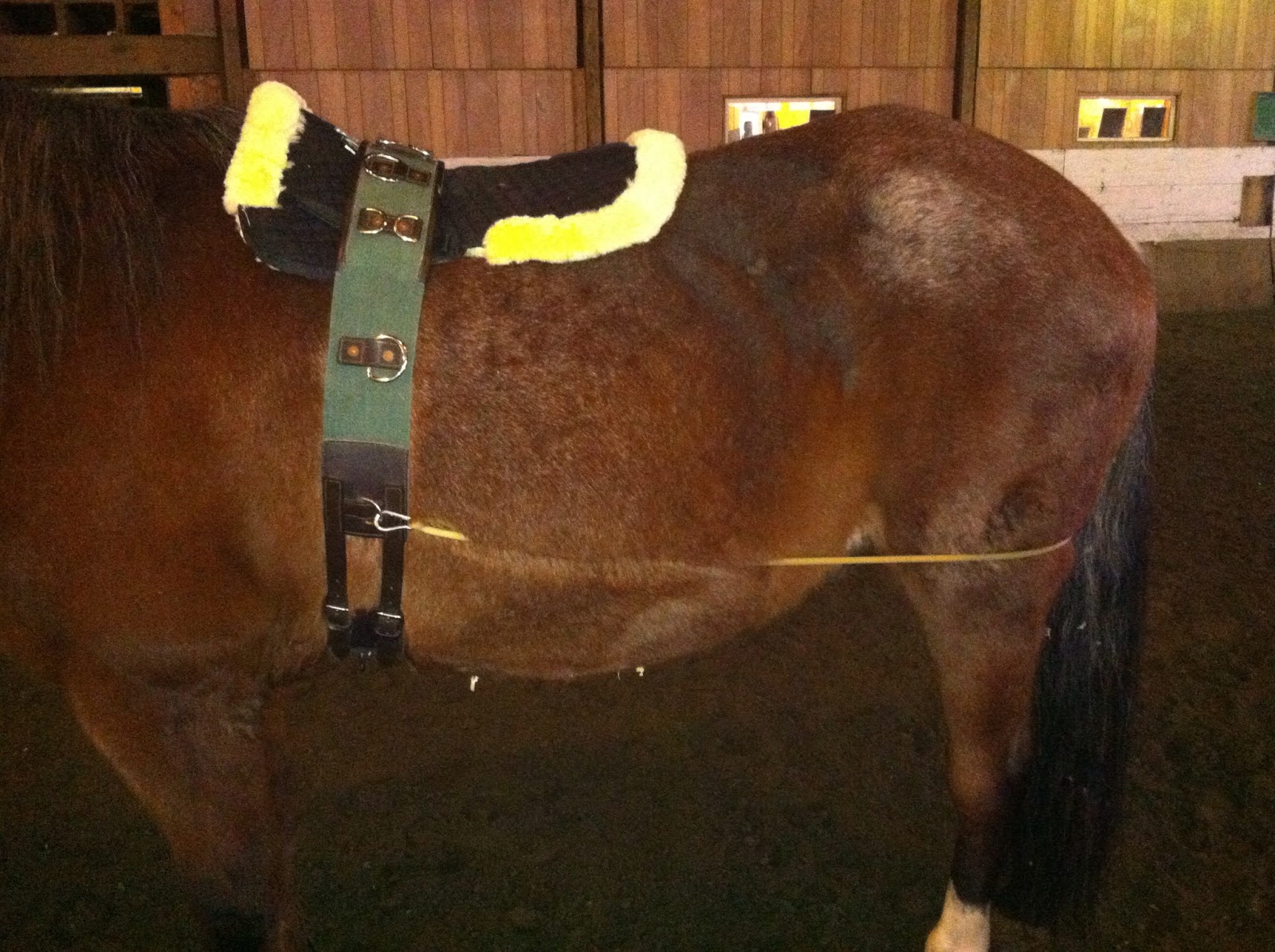
When I was first putting it together, the barn manager walked by and I explained it to her and she exclaimed “It’s like a redneck Pessoa system!” Well, sort of. It has more in common with a TTouch bandage wrap. I like to think it combines the best of both. In essentials: it’s a resistance band that loops around his hind quarters and attaches to a surcingle, making him work twice as hard with every step, strengthening his hind end, stifles, and lower back.

I can’t necessarily take credit for this. I read that someone on the COTH forums had tried it and loved the idea immediately, found it was quick, easy, and inexpensive to put together, and worked exactly as advertised. Ready?

Step 1: Two carabiners, purchased at the hardware store downtown. My hand will show you their approximate size. They’re not large, nor are they mountain-ready, but they did the trick nicely. $1.49 each.
Step 2: 8 feet of surgical tubing, purchased at a local medical supply store. (And if I have a local medical supply store in freaking Vermont, you have one nearby you too.) There were two widths; I went with this one, which is about 1/2″ in diameter. $14.00.
Step 3: Tie the surgical tubing to the end of the carabiner. Get a nice, tight knot. Pull the surgical tubing around the hind end, under the tail, tucked in that groove just above the hocks, and around to the other side. It helps if you have it attached to a surcingle or girth already for this step. I pulled until it was fairly snug, and it took a bit of muscle to pull it back, but it wasn’t so tight that it was hard to pull. More like, I could just feel resistance. I tied it off on a carabiner attached to the other side, and had about 1 foot of tubing left. (So I’d recommend closer to 10 feet for a larger horse; Tris is right on the line between cob and horse sized for many tack fitting things.)
Step 4: Torture your pony. When I longe him in this, he oversteps 2-3X more than he does without it. He also gets tired much faster, so I limit the use of this to 10 minutes, max, and only 5 of that in the trot. 
I am still feeling out when I think it is most useful; I tend to use either this OR the chambon, because I don’t think it’s fair to isolate two muscle groups at once right now. If he were more muscled up, or in better shape, sure, I’d double up. I wouldn’t use either until he’s warmed up, but that’s my own personal neurosis.
I’ve used it both in longeing and under saddle and I almost like it better under saddle, because I can direct that hind end push more effectively. He is a more forward horse on the longe line, and that’s when I tend to use the chambon to help him reach and develop back muscles without interference from the saddle.

Uncategorized

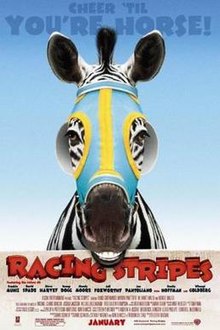
Movie Review: Racing Stripes

Racing Stripes (2005)
(available to rent or buy at Amazon.com)

Whoo boy. I hit play thinking why not? This could be good cheesy fun.

I did not expect the sheer level of crack on display in this movie. I stopped counting or making notes of the ridiculous moments less than halfway through. There are just too many. The real heart of the problem, though, is that the movie can’t agree on its own internal fantasy logic. Is this horse world or people world? Whyfor are the flies comic relief? Do horses behave like horses or like adolescents in horse clothing? So many questions.

If you haven’t heard of this movie, the premise is that a zebra foal falls off the back of a circus truck and is raised on a Kentucky farm adjacent to a racetrack. He grows up thinking he’s a racehorse. The father (Captain Pike from the new Star Trek movies, which was a fun little AU imagining for me) and daughter that raise him used to be in the racing business – he was the Best Trainer Ever – until the mother had an accident on a young horse and was killed. They have angst! But not enough angst to prevent them from doing insanely stupid things like, oh, hitching a zebra to a plow when he’s never been handled…letting the girl ride him to work when he’s never worn a saddle…training him for the Big Race in two weeks using a “gate” made out of two outhouses.

But never mind that. A certain amount of magical realism is inherent in these things. This movie really tries to push it too hard, though. There’s the human world, full of human reasons to win the race, and the horse world, complete with moonlight secret races and bizarro sexual politics and never the twain shall meet. Stripes could care less about his people; his people could care less about Stripes.

Anyway. I have a pretty high tolerance for cracktastic horse movies, and this one left me cold, bored, and disdainful rather than even lightly amused.