lesson notes

Lesson Notes: Sea Changes

So I finally sucked it up and put in a request to ride a school horse in my lessons going forward. I was worried and maybe a bit scared – I haven’t ridden any horse but my own (other than to hack out at the walk!) – in years. Close to three years, I think. I can’t actually remember the last time I did. I can make a decent guess, but that’s it.

That’s not exactly the way to get good as a rider, and certainly even five years ago I got on other horses with regularity, but my role has never been the get-on-and-ride-anything type of rider. I want to do well by the horse I have, and form a partnership with him, and I’m happy with him.

But I digress. I got to the barn and flushed Tris’s foot and rewrapped it; all is proceeding as planned, and he behaved well. Then I checked in with T. and got a little Appaloosa lesson horse named Charlie.

I had a ridiculous amount of fun. There were a few moments when I felt guilty, actually, I was having so much fun. I had…maybe not forgotten, but I had been so out of touch with the idea that a properly trained horse, who has the buttons installed, who has a willingness and a base of athleticism, is magic.

First things first: Charlie, though he looks a bit on the stocky side, is surprisingly narrow to sit on, especially for someone with longer legs. The effect of this was to seriously unbalance my seat for the first 20 minutes or so as I tried to figure out the geometry of it all, which pleased T. to no end as one of my bigger flaws is my tendency to let my leg swing. Tris has such a large barrel that it took up leg even when I didn’t have it right where it needed to be. Take away that barrel and I was floundering.

Then he got on me and worked hard on me for about 10 minutes on a circle and about halfway through it clicked: oh yeah. I can do this after all. And then I was deep in the saddle and keeping my leg on and connecting to the bit through my core. Not all at once, and T. nagged me for another 10 minutes or so when I started slipping, but by the end of the lesson – as he told me afterward – I was snapping back on my own.

I hadn’t ridden a horse on the bit in the canter in years. Which is depressing as hell to admit out loud, but I didn’t even realize it until after I’d gotten Charlie warmed up, and I asked for a canter, and all of a sudden he was soft in the mouth and I could half-halt and hey, there were his hind legs, and I could adjust the canter, and it was awesome. Sigh.

I admit to feeling a bit smug, maybe? I have watched this horse in lessons for years and years, and I had formed the idea that he would feel a lot like Tristan. I couldn’t have been much more wrong. He put up only token resistance to the ideas of bending and going round, and then tried to cross his jaw – which T. said was, for him, a sign of the next level of resistance, but once I learned the feel it was easy enough to wiggle him out of – but when I put leg on properly, he was there, and when I stabilized with the outside rein, he went into it. We were looking and feeling terrific by the end of it, and he looked in the mirrors as good as I’ve ever seen anyone ride him, and I felt awesome and then I realized I was feeling superior to 10 year old lesson kids and adult re-riders so I should get the hell over myself already. But it was still a nice boost in confidence.

abscess · adventures with the vet

And the verdict is…

So!

After extensive physical examination, four or five different views on the rads, jogging up and back, and a consult with the farrier, the verdict from the vet is that my gut was right. Tristan just has a whopping big hole in his foot from the abscess.

It was kind of freaky to see on the rads, honestly. You don’t like to see holes in your horse’s foot. But we were able to clearly see that there was no involvement whatsoever with the joint capsule or the coffin bone, no hint of a keratoma, no pedal osteitis, and the big lump above his coronet band is just a particularly nasty bit of scar tissue that will need to grow down.

The farrier’s opinion is that another 4-6 weeks of growth will make a big difference in his comfort level as the holes will grow down far enough to make the foot much more stable. Probably the holes won’t grow out entirely for another 6 months at least. For the foreseeable future he’ll need to be flushed and wrapped regularly to make sure no new debris gets caught in the tunnels in his foot and re-start the abscess.

Farrier put a shoe but no pad back on so that the foot can continue to flush properly. The vet tranq’d him for the shoeing so he would behave, and he was pretty stoned and pathetic. He got about 2/3 of the way through his soaking before he started to wake up, and since he couldn’t have hay, he was pissed about the soaking. It was an adventure.

I’m glad to know that nothing truly dangerous is going on, though, even if it will be a while before we’re back in action. He’s losing muscling across his back, and it hurts to see. We should be back in serious work just in time to be stuck in the indoor for the winter, too.

abscess

The New Normal

I had a dream last night about galloping my horse, really giving him his head. It was a nice dream.

The farrier took a look at Tristan yesterday and determined two things. First, he has a drainage hole on the bottom of his foot, too, on the toe in line with the other holes. Not a huge surprise and even a bit of a good thing as now there’s a clear entrance and exit for flushing.

Second, he is so sick of being fussed with that he behaved incredibly poorly for the farrier. So poorly that the farrier could not get a shoe on the RF even with help from barn staff. I was not pleased; it’s important to me that my horse behave politely for the professionals in his life. Back to remedial pony school for him.

I got to the barn last night to see that the antibiotics had been delivered, huzzah. We’ve got the routine down, now. Flush with betadine and hot water with syringes with very thin tips, disinfecting the length of the hole. Then soak with his new soaking boot (more on that later) for 30 minutes. Then mix up the antibiotics, pack the hole, cover with gauze, cover with vetwrap, cover with duct tape. The whole process takes about an hour and a half.

The vet’s coming back out soon-ish to check up and to take an x-ray. Tristan is only a tiny bit tender on the foot, which the farrier is convinced is simply some movement of the hoof wall from the sheer size of the hole. If he were more lame, I’d be worried about bigger problems. I’m still concerned enough to want the x-ray, but it should be more of a confirmation than a surprise. Resectioning is still a possibility, but something the farrier is firmly against.

I finally asked about a schedule, and pending the vet visit, it looks like another shoeing cycle will make a big difference in Tristan’s comfort level on the foot. He just needs to grow out more foot to be more stable. So another 4-6 weeks, and maybe we’ll be back on track.

area 1 scholarship committee

Area 1 Scholarship Program

I’m part of the Area 1 Scholarship Committee, which awards four people each year with a small grant to pursue educational opportunities in the sport of eventing. It’s all Hannah‘s fault, really; she emailed me with instructions to talk her out of volunteering to help create the program, and that ended up sucking me in too.

It’s been an amazingly rewarding experience. I was deeply humbled by the applications we received: so many dedicated, brilliant, talented people who shared their lives and their dreams with us. I cried at more than a few.

As Hannah just posted, our first two recipients have written up their experiences [PDF]. We have our two fall applicants picked and confirmed. It’s well and truly off the ground and I couldn’t be prouder. Eventers helping eventers: awesome.

abscess

Never anything halfway…

Apparently the vet said something like “oh, wow” when confronted with Tristan’s foot today.

Sigh.

The infection is pretty bad. He’s off at the trot. The protocol going forward is as follows:

1) Keep soaking, epsom salt + betadine + warm water. There may indeed still be a walled-off abscess above the coronet band that will need to burst.

2) Keep the hoof wrapped at all times. No matter what. Nothing can get in there.

3) Along with that, make sure the hole is thoroughly flushed and cleaned out whenever the wrap is off.

4) The vet is mailing me an antibiotic called metronidazole. This acts specifically on anaerobic bacteria, like he’s got filling his hoof. When it arrives, I need to mix water with the powder and create a paste the consistency of toothpaste, then pack that in the hole(s), then cover with gauze, then wrap with vetrap/elastikon, then duct tape.

5) Probably he will be on stall rest, or at the least very limited turnout. This is not a function of injury per se, rather that I am not confident his foot will stay wrapped if he gets too active in turnout.

I’m trying not to be too worried. We’ll proceed with this protocol, and then check back in with the vet next week. If the infection doesn’t show improvement, we may have to talk about cutting away some of the hoof wall to expose the anaerobic bacteria. If that happens, we’re talking about months of recovery time. 😦

book review

Book Review: The Horse Boy

The Horse Boy: A Father’s Quest to Heal His Son
by Rupert Isaacson

I’ve had this book on the shelf for ages, having been keenly interested in the subject matter. The first barn I ever rode at was also a therapeutic riding center, and I’ve heard about the incredible strides that autistic children are sometimes able to make on horseback.

I gather from the many thousands of reviews on GoodReads that this was a hugely controversial book. I don’t know enough about autism to really analyze the book from that perspective. Was Rowan “healed”? Is it even fair to say that an autistic child can or should be cured? Were the shamanic experiences that Isaacson sought part of Rowan’s incredible gains, or is that simply correlation without cause? Certainly the way Isaacson structures the narrative and tells the story means that he wants us to believe, as he believes, that this journey is what helped his son. I gave my copy of the book to a friend who is currently doing graduate work in special education and has a wealth of experience with severely autistic children; I’ll be interested to hear his opinion if/when he gets around to reading it.

What I can comment on with some knowledge are the horse bits in the book, and they are…not good. Isaacson first discovers that his son, Rowan, responds to horses when Rowan escapes and sprints between the legs of a neighbor’s mare, Betsy. Rowan sprints up to a lot of horses during this book, and Isaacson’s theory is that there is some instinctive communication going on between the autistic boy and the horses. Specifically, he describes the horses’ reactions as submissive. Here’s a typical passage:

And there it was again, the horse’s head going down, the licking and chewing, the voluntary submission. At least Rowan would be safe with the horse. (Chapter 9: Fits and Starts)

Okay: to my knowledge, no equine behavior expert has yet pinned down the licking and chewing reflex specifically to submission. It is displayed in tandem with other submissive behavior, yes. That doesn’t necessarily directly mean anything. I’ve observed it in other distinctly non-submissive situations. My best understanding of it is that it means the horse is thinking about something and processing. I do tend to interpret it as a positive signal when I’m working with a horse on the ground, but the pure submissive/dominant interpretation of horse relationships frustrates me.

Isaacson claims a wealth of equestrian experiences – foxhunting, dude ranching, and he seems to have the basics of dressage down – but he often talks about horses in a way that make him sound like a complete idiot. Case in point:

Even so, when I did have enough money, it was only enough to buy something cheap. The horse had to be athletic enough to hunt and do shows, but at the meager price I could afford the only such horse would be a failed racehorse off the track. And these, as all horse people know, come with one fatal flaw – they are complete lunatics. (Chapter 5: The Adventure Begins)

No they aren’t, jackass.  I’m not even going to bother to deconstruct this one. He’s flat-out wrong, that’s all.

Isaacson displays questionable horsemanship in several other situations – riding Betsy into a “lather” repeatedly by galloping her endlessly just to please his son, for example. He never once, in the entire book, mentions wearing a helmet. For that matter, since his journey with Rowan, he has started a therapeutic riding center for autistic children, and in one photograph that accompanies the book, has three kids piled bareback on a saintly-looking bay gelding that he’s using a dressage whip to…do what, exactly? Encourage into some kind of Spanish walk? The kids aren’t wearing helmets. One of them is wearing Crocs. In short, it’s a photo right out of an illiterate Craigslist ad.

Not all the horse stuff is bad. Some of it is just there, in the background. For every horse person there are at least two opinions on the right way to do something, and there were plenty of things that I didn’t agree with but weren’t disastrous. Overall, it really was a good, thought-provoking and occasionally touching read, and I actually would recommend it – just so long as you turn a blind eye to his horsemanship from time to time.

abscess

Mixed Success

Long trail ride again Thursday night, and then today I took him out and put him back into a bit of work. We spent about 20 minutes at the walk, focusing on getting loose: bending, stretching, stepping up into the bit. All of it with mixed success. He was not thrilled to be on the bit (even a teensy bit) instead of walking the trails on a long rein.

I did two trot sets of 5 minutes each. He didn’t feel great, though he evened out toward the end. I think what I’m feeling is mostly out-of-work stiffness, rather than unevenness. I picked up a canter very briefly, both directions, for just one or two 20m circles. Right felt fine. Left felt AWFUL but stiff and choppy awful, again.  Sadly, he was breathing a teensy bit after the second canter, near the end of the ride, which tells me that I will have some work in building him up again.

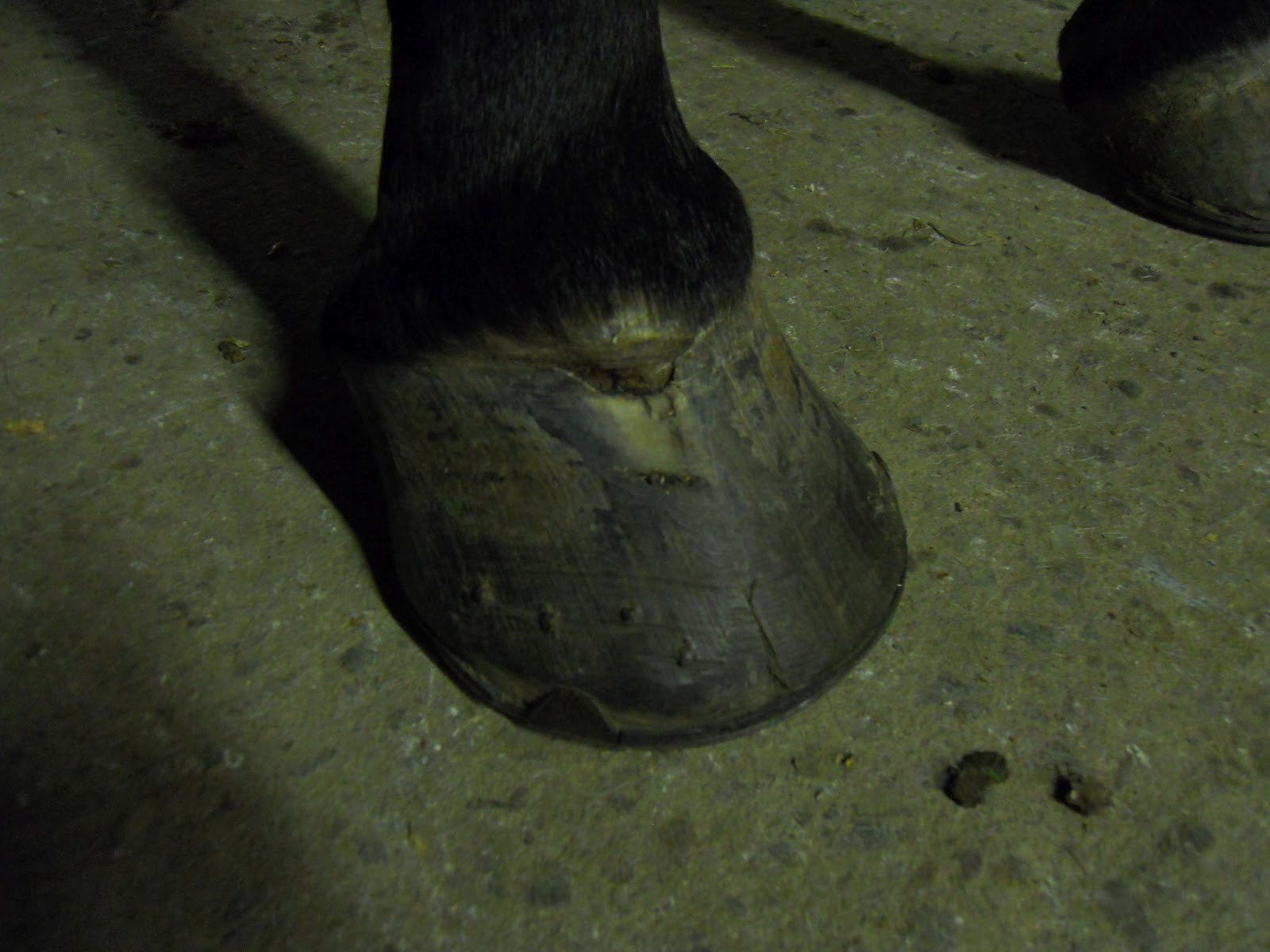
I did finally remember to take some pictures of his post-farrier foot, with a bit carved away to really make sure the abscess drained. I’m still flushing it after every ride to make sure it stays clean. I’ll try to get some better pictures outside next time I go down.

You can see the first abscess hole, and above it the new hoof growing down (thankfully!), then below the second smaller abscess hole.

abscess

Back in the saddle again!

YES. I got down to the barn Tuesday night and put Tristan on the longe line, after a report from the farrier on Monday indicated there was no reason the abscess shouldn’t be on its way out.

Sound at the walk, trot, and canter, both directions, even on the relatively small circle I used!

So I jumped on bareback and we had a 45 minute hack through the woods. He was so happy – charging right ahead, sometimes too fast as he took me onto side trails that hadn’t been cleared in some time. I did a lot of ducking and grabbing mane. Nice, big, swingy walk and happy horse.

After the ride, I flushed out the abscess holes with hot water + betadine. The farrier had dug around a bit in the hoof to make sure it was clean and open, so his hoof looks pretty awful right now. The good news is that the hoof is clearly growing out more or less ok from the coronet band again; there’s definitely a rim of new hoof above the abscess hole. It’ll probably take a few months to clear up completely, but there should be no lingering abnormalities. I wrapped his foot with an Animalintex poultice pad just to be

I’ll do the same again Thursday night, and then Saturday morning I’ll put a saddle back on and start schooling again. He’s been off for about four weeks at this point, so we’ll take it easy with lots of walking and loosening up and a few trot sets.